
Butterflies at Chatfield Farms
By Mary Ann Colley, Vice President of Science and Conservation at Butterfly Pavilion
Spring has arrived and (when it’s not raining) plants and flowers are blooming everywhere in our gardens, parks and open spaces. With this spring bloom marks the opening of Butterflies at Chatfield Farms; our seasonal butterfly house home to hundreds of native Colorado butterflies such as Monarchs, Queens, Painted Ladies, Black Swallowtails, Red Admirals, and Clouded Sulphurs. There more than 50 indigenous plant species in this garden. The rest of the plants (about 20 species) were chosen for the nectar production for butterfly food and are not native species in Colorado. Butterflies at Chatfield Farms is presented through a partnership between Denver Botanic Gardens and Butterfly Pavilion and is now open for its sixth the season!
Butterflies at Chatfield Farms is a great collaboration between two Scientific Cultural Facilities District (SCFD) members. Each year, Butterfly Pavilion constructs a seasonal house at Denver Botanic Garden’s Chatfield Farms, a 700-acre native plant refuge and working farm located along the banks of Deer Creek in southern Jefferson County. While we put up the house, Chatfield Farms creates an immersive experience – planting local and tropical plants, creating a unique and beautiful habitat. Once the plants are settled, we release butterflies into their new home.
This house is in many ways is just like the butterfly house here at Butterfly Pavilion. We are regulated by the United States Department of Agriculture USDA and must ensure that we are meeting all containment guidelines for animal and habitat welfare. What sets Butterflies at Chatfield Farms apart is its intimate and local feel. The house is surrounded by Chatfield Farm’s lush gardens and sits alongside their large lavender garden, where there are 19 varieties and over 2,000 lavender plants.
For a change of pace, travel south and visit Butterflies at Chatfield Farms. It is a truly unique experience where Butterfly Pavilion and Denver Botanic Gardens meet to create a fun and educational experience.
8500 W Deer Creek Canyon Road
Littleton, CO 80128
May 25 – Sept. 2, 2019
9 a.m. – 3 p.m.

Red Admiral on Verbena.

Family admiring a Red Admiral butterfly.

Julia Longwing on grass.

Zebra Longwing on Verbena.

Red Admiral butterfly landing on a guest.

Monarch on Pothos.

Mourning Cloak on Alyssum.
By Mindy Wagner, Interpretation Manager at Butterfly Pavilion
It’s hard to believe that World Oceans Day is almost here! Every June 8th people all over the world, including folks here in “landlocked” Colorado, gather to celebrate our oceans and the wonders of life found within them. Here at Butterfly Pavilion, we celebrate the aquatic diversity of invertebrates throughout the year in our Water’s Edge exhibit, and World Oceans Day is no exception—it is one of our favorite days of the summer!
As a native Coloradan (yes, it’s Coloradan and not Coloradoan), my heart belongs to the mountains. I grew up hiking through muddy trails in the spring and cheering on the Broncos with two blue and orange braided pigtails. I decided early on that I was going to help protect the animals and plants that call our state home. It wasn’t until I started working at Butterfly Pavilion that I grew to appreciate oceans as an immense resource, discovering just how connected to it we are, despite being thousands of miles away and a mile high above sea level.
The beautiful snow that falls in our mountains every year provides epic snowboarding and skiing opportunities, as well as thrilling white water rafting. With the Continental Divide running through our majestic mountains just west of Denver, the water in Colorado’s creeks, streams and rivers will eventually find its way to the Gulf of Mexico and the Gulf of California. Here in Colorado, we have an important responsibility to keep our waterways free of trash and other pollutants to ensure a clean water supply for our oceans. It all starts with us.
Now, I know that helping to protect the water in our oceans seems like a very big and somewhat overwhelming task. However, individual action has a powerful impact. So how can we help?
Use less plastic products. Bring reusable water bottles with you wherever you go and use reusable cloth bags at the grocery store. On top of my grocery list, I always write “GRAB REUSABLE BAGS,” so I don’t forget.
Purchase sustainable seafood. At Butterfly Pavilion, we provide Seafood Watch Guides © to help us all purchase seafood that is caught or farmed in environmentally friendly ways. You can also download the app on your Apple or Android device.
Don’t litter. This is something we’ve all heard since elementary school, but it still rings true to this day. Putting our waste in the proper trash, recycle or compost bin can keep pollution out of our waterways and prevent them from becoming harmful microplastics. Microplastics are small plastic pieces less than five millimeters long, about the size of a sesame seed, which can be harmful to our oceans and the animals that live there (NOAA 2019).
Reduce your carbon footprint – Drive less. Walk, bike, take the bus or light rail and carpool more!
We all want our world, and the amazing opportunities it provides, to be healthy for our children, grandchildren and beyond. I hope you will join Butterfly Pavilion in taking small actions to protect our water here in Colorado, ultimately protecting the health of our oceans. Visit Butterfly Pavilion on World Oceans Day on June 8th to get inspired through live animal feedings in Water’s Edge, sustainable giveaways, art and crafts and more!
An outdoor movie, nature walks, crafts, giveaways and more, in honor of pollinators.
- Outdoor Movie Night will take place outside on the front lawn of the invertebrate zoo in Westminster on June 21.
- Rice’s Honey® is a proud sponsor of the Butterfly Pavilion and its global PACE initiative to increase awareness of the importance of pollinators.
- Butterflies at Chatfield Farms opens tomorrow!
Media note: Photos, video and other editorial material is available by request. Rosie the Tarantula, other invertebrates and scientific experts are available for media appearances and interviews. Contact kstewart@butterflies.org
Westminster, CO – May 24, 2019– Colorado’s Butterfly Pavilion, the world’s only stand-alone Association of Zoos and Aquariums-accredited invertebrate zoo, is rolling out the red carpet to celebrate National Pollinator Week with a FREE outdoor movie night featuring Bee Movie, June 21, 2019, presented by Rice’s Honey. The 2007 Golden Globe-nominated CGI-animated film was created by Jerry Seinfeld, and stars Jerry Seinfeld, Renée Zellweger, Matthew Broderick, John Goodman, Patrick Warburton, and Chris Rock.
National Pollinator Week is a time to celebrate pollinators and spread the word about the critical role they play in our ecosystem, as well as address the urgent issue of declining pollinator populations.
“At the Butterfly Pavilion, we will observe this week in our signature style – by combining science, education and fun for the entire family,” said Butterfly Pavilion President and CEO, Patrick Tennyson. “It is also a perfect time to raise awareness about our PACE program and the crucial research done at Butterfly Pavilion to protect invertebrate pollinators.”
Pollinator Awareness through Conservation and Education (PACE) is Butterfly Pavilion’s global initiative to increase awareness of pollinators and promote habitat and species conservation and restoration. Through a combination of conservation and education programs, PACE works to create a better world for pollinators, making a better world for all of us. https://www.butterflies.local/
“Rice’s Honey® has always been committed to providing natural, delicious, U.S. only raw & unfiltered honey, while also supporting local American beekeepers and promoting the importance of pollinators,” noted Tony Landretti, Chief Executive Officer of Rice’s Honey®. “We believe our continued commitment to Butterfly Pavilion by supporting PACE and other fun, family events like this is an important way to champion pollinators now and for generations to come.”
Before Bee Movie takes center stage, kids and adults of all ages can enjoy a fun evening of arts and crafts, guided nature walks, a ladybug release, special give-a-ways and more. Local food trucks iPIE and Ba-Nom-a-Nom Nice Cream will be on site with food and dessert for purchase. Doors open at 6:00 p.m., and activities begin at 6:30 p.m. Bee Movie begins at sundown. While the outdoor movie night is free, limited space means tickets are required. They are available starting June 1, 2019 at butterflies.local
Butterflies at Chatfield Farms opens Saturday
Memorial Day Weekend is the perfect time to visit the Butterflies at Chatfield Farms, which opens to the public on Saturday. This seasonal habitat at Denver Botanic Gardens Chatfield Farms is home to hundreds of native Colorado butterflies such as swallowtails, monarchs, mourning cloaks and painted ladies. Butterflies at Chatfield is a partnership between Denver Botanic Gardens and Butterfly Pavilion. The habitat is open daily through Labor Day. Learn more at butterflies.local under the “exhibits” tab.
Now Open – Colorado Backyard
Butterfly Pavilion’s newest interactive exhibit connects guests to the rich and diverse life that surrounds us in the Centennial State, with a goal of inspiring greater commitment to conserve our natural treasures in Colorado and beyond. Colorado Backyard features live animals, indoor play structures, an immersive exploration station, a rotating exhibit area and invertebrate photography by talented individuals from the community. The exhibit also hopes to equip visitors to take small, but impactful, actions every day that can ensure these hidden heroes are protected for the future. Colorado Backyard is included in general admission.
Summer Events
Summer at Butterfly Pavilion comes alive with pollinators and pollinator events. This summer’s events include Nature Nerds Family Club workshops (starting June 1), the Zoo Snooze Overnight Adventure (June 28) and much more. Learn more at butterflies.local/Events
Butterfly Pavilion is open 9:00 a.m. to 5:00 p.m. daily at 6252 West 104th Avenue in Westminster. Learn more about Butterfly Pavilion on Facebook or by visiting butterflies.local.
# # #
About Butterfly Pavilion:
Butterfly Pavilion is the world’s only stand-alone, Association of Zoos and Aquariums-accredited invertebrate zoo dedicated to transforming the way people think about the small but mighty animals that are the hidden heroes of the animal kingdom. As the leader in invertebrate knowledge, inspiration and connection, and as a member institution of the Scientific and Cultural Facilities District, Butterfly Pavilion works to foster an appreciation of these critical animals by educating the public about the need to protect and care for threatened habitats globally, while conducting research for solutions in invertebrate conservation. Whether it is providing unique, hands-on learning experiences in our exhibits and educational programs, conducting new research that sets the standard for zoos across the country or building innovative solutions for species and habitat conservation in countries around the world, Butterfly Pavilion is leading the way in ensuring invertebrates are protected for the future. Learn more at butterflies.local.
About Rice’s Honey®:
L.R. Rice founded Rice’s Honey®, headquartered in Greeley, Colorado, in 1924. The company remains committed to its founder’s mission of being the leading producer of high quality, raw & unfiltered honey sourced exclusively from local beekeepers throughout the US. The Rice’s Honey®, brand, Local Hive™, can be found across grocery retailers nationwide, and features 16 varietals of local, American, raw & unfiltered honey that are exclusively sourced in the US. For a full list of products, and locations visit: https://localhivehoney.com/find-a-store
The Rice’s Honey® partnership with PACE, the Butterfly Pavilion’s global initiative to increase awareness of pollinators through public engagement, education and restoration/conservation programs will help inform consumers about the importance of pollination. One of every three bites of food eaten worldwide depends on pollinators. Without them, there would be no fruits, nuts, vegetables, oils or most flowers and they contribute more than $24 billion to the United States economy.
Butterfly Pavilion Media Contacts:
Kristen Petitt Stewart, kstewart@butterflies.org or 970-389-1561
Russ Pecoraro, Vice President of Marketing and Communications, rpecoraro@butterflies.org or 720.375.9984
By Diane Metzger, Brand Manager
Last year on World Oceans Day, Butterfly Pavilion partnered with Whole Foods to provide the community with free canvas bags to encourage the reduction of single use plastic. More than 8 million tons of plastic are dumped into our oceans every year, 50% of which was manufactured for single use.
This waste is catastrophic for ocean animals and habitat, entangling marine life and contributing to the destruction of coral reefs. Here at Butterfly Pavilion, we believe in the power of small actions to make a big impact. By giving out reusable bags we saw an opportunity to educate the community on the ways in which each of us can conserve the ocean every day, even from our land-locked state of Colorado.
But upon delivery to our zoo – we couldn’t believe it – all 700 bags included our name, but it was misspelled.
Not wanting to showcase the mistake, while also not wanting to throw them away, we left the bags to hibernate in a storage closet. A year went by and it seemed as though they would never be put to good use. When planning this year’s World Oceans Day celebration, the question of what do with the bags came up again. After some brainstorming, we realized that all we needed to do was look to our very own message to find the answer. Reduce waste, conserve our world.
Rather than throwing these bags away, we saw an opportunity to tell the story of our mistake and help the community re-imagine the use of items one would usually call “trash.” We’re all human. We’re not perfect. But we do have the power to make choices that are small, but impactful, for our community and the planet. This World Oceans Day, we’ll be handing out those canvas bags – misspelled name and all – to tell the story of how we’re walking-the-talk of conservation. These sustainably-made bags can still serve the purpose for which they were intended, helping us to limit the amount of waste we produce.
In the future, we’ll still giggle about the marketing faux pas, but we’ll feel good knowing that we shared something sturdy, useful and sustainable with our community. Visit us on June 8th from 9 am – 5 pm to grab your very own misspelled Butterfly Pavilion canvas bag and take action to conserve our oceans! Enjoy activities, live animals, special presentations and more, all included with General Admission.
Have questions? Email us at marketing@butterflies.org.
By Alyssa O’Brien, Horticulture Manager at Butterfly Pavilion
Spring is here and with it comes wonderful sunshine and new growth. But is there something sinister to notice as well? Imagine you are out on a walk. Birds are singing. Flowers are blooming. The grass is green. Suddenly your eyes begin to water. What has happened? Has the beautiful scenery moved you to tears? Possibly, but you may be reacting to a substance that is floating through the air: pollen.
While bringing beauty to the landscape, flowers also serve as a tool for plant reproduction. To produce offspring, plants must transfer male genetic material, which is contained within pollen, to the female part of the plant in the stigma. This process is called pollination and, if successful, results in a seed that will contain the genetic material to create a new plant.
In the case of self-pollination, the entire process of pollination only requires one plant. But often, a plant needs to transfer it’s pollen to a different plant for successful pollination to occur, this is called cross-pollination. Since plants can’t move their pollen on their own, they rely on other means, like animals (bees, butterflies), water, and wind to carry their precious genetic material to another plant.

Bee covered in pollen.
To be successful, plants release billions of pollen grains in the hopes that some will land upon the correct plant and pollination will occur. Sometimes this pollen is inhaled by people, which may cause the body to overreact and produce antibodies in an allergic reaction. The symptoms can range from itching nose, eyes, mouth, ears or skin, stuffy or runny nose, rashes, and sore throat. To combat this, people can proactively use allergy medication in advance, take something to manage symptoms when they occur or avoid being exposed to pollen.
Despite the discomfort many feel from allergies, there are many reasons to be thankful for pollen.
- As mentioned previously, pollen is essential to plant reproduction.
- Pollen in the fossil record is used to help scientists determine what plants grew in the past.
- Pollen helps solve crimes. Each plant has its own unique pollen composition and palynologists (pollen and spore scientists), use these “pollen prints” as forensic evidence to find crime scenes and identify evidence. You cannot wash away a pollen print!
- Many animals eat pollen, including humans! There are several Korean dishes like Ganheong and Dasik that are prepared using pine pollen. If you are curious as to what this tastes like, visit pollenranch.com for recipes with pollen.
- Many arthropods eat and rely on pollen as a food source, including Heliconius butterflies (which you can see in the Wings of the Tropics), many bees, mites, beetles, and many others.

Heliconius butterfly eating pollen.
Now that your appreciation for pollen has grown, how can we live in better harmony with it?
- Know that grasses or trees, which rely on wind dispersal, produce large amounts of lightweight pollen. However, feel free to smell as many colorful and fragrant flowers. They rely on insects to spread their pollen and, as a result, produce heavier pollen that is less likely to land on you and blow in the wind.
- Be aware of the times of the year when pollen is more prevalent. Tree pollens are often produced in early spring and grass pollens are usually produced in early summer. Windy or dry days increase the likelihood of pollen being in the air. However, calm or rainy days keep the pollen on the ground and away from you. There are many helpful websites and apps that look at what plant species is producing pollen and what the weather conditions are to provide you with a risk assessment.
- Proactively use allergy medication and take a decongestant. Given that many of us don’t want to limit our exploration of the great outdoors (and here at Butterfly Pavilion, we would strongly advise you to get outside as often as possible!), you can easily prevent and manage symptoms as they occur.
- Enjoy local honey. It’s often said that eating local, raw honey, which contains pollen from the local environment, may reduce allergies. Though this is still being assessed in scientific studies, what we do know is that honey is high in antioxidants, which are great for overall health, and that honey can be very helpful in soothing cough symptoms you may be experiencing during allergy season. Our partner, Rice’s Honey, is a great option here in Colorado!
Want to learn more about our native plants in Colorado and what you can do to conserve them? Visit Butterfly Pavilion today to grow in your appreciation of the great outdoors. Click here to learn about habitat gardening.
By Julie Ann Barowski, Volunteer Program Manager at Butterfly Pavilion
Chances are if you’ve visited Butterfly Pavilion, you’ve engaged with many wonderful volunteers. Whether you’re digging for worms in the Dugout, asking questions about the thousands of butterflies in Wings of the Tropics, or feeling the texture of a horseshoe crab or sea star, your experience was undoubtedly made richer thanks to the knowledge, dedication, and inspiration of our volunteers.
Currently, more than 600 volunteers and interns generously donate their time to Butterfly Pavilion each year.
Each and every volunteer works hard to ensure our exhibits are well kept, our animals receive exceptional care and each guest walking through our doors has a meaningful experience. As our CEO Patrick Tennyson puts it “Over the years I have come to intricately depend on the amazing contribution of our volunteer team. These individuals have shaped the impact and influence of this organization for 24 years now. From our dedicated animal care and floor interpreters to garden and office support to our Board of Directors, they are an amazing attribute and asset to our business operations.”
Outside of exhibits, volunteers also play a crucial role out in the field on Butterfly Pavilion conservation projects, doing everything from restoring open space to collecting essential data on butterflies and dragonflies that inform future conservation decisions. They truly make our critical work in invertebrate research, conservation and education possible.

In celebration of National Volunteer Week on April 7th – 13th, we asked Butterfly Pavilion staff members to tell us what they appreciate most about working with our volunteers. Here are some of the highlights from our diverse departments:
“We wouldn’t bloom without our committed, enthusiastic horticulture volunteers. They put in hundreds of hours a year to plant, weed, water, and trim our conservatory and gardens. Restoration Master Volunteers are the backbone of our habitat restoration projects in the area. Their hard work and expertise make our urban open spaces a true jewel of the community!” – Amy Yarger, Horticulture Director
“Gary Clarke was a very important part of the installation of Colorado Backyard and continues to be a valuable team member for the Exhibits Department. One recent example is the above-and-beyond job of refurbishing the habitat for sunshine the turtle in Wings of the Tropics.”
-Ken Hoke, Exhibits Director
“Georgina did an exceptional job a few weeks ago, stepping up for an ESL class (English as a Second Language) and translating the majority of the class from English to Spanish!”
– Colleen Farrell, Educator
“Our volunteers’ commitment and dedication to Butterfly Pavilion enriches our guests’ experiences and those of our staff, both professionally and personally. We just wouldn’t be able to create so many memorable experiences without them!”
– Mindy Wagner, Interpretation Manager
“Rita is an amazing volunteer! She dedicates hours every week helping Guest Services, Membership, Education and Volunteers by answering phones, making calls to schools, entering membership information and recording volunteer hours. She is an absolute joy to work with and everyone loves her. She has even chosen to become president of the volunteer network that helps support our volunteers. We are so lucky to have Rita helping us out!”
– Julie Webster, Guest Experience Manager
“We are so lucky to have such talented and passionate volunteers helping us tell the Butterfly Pavilion story. In exhibits, at community fairs, in their social circles and more, volunteers educate the community on what we’re doing and why it matters. We also have Social Media Interns, like Breann, who bring outstanding creativity and energy, taking our digital communications to the next level. We couldn’t do it without you all!”
– Diane Metzger, Brand Manager
“I love our volunteers & would not be as successful or as happy without them! They are the reason why Butterfly Pavilion feels like a family. I love seeing our volunteers participating and having a great time in our programs – they are some of my biggest supporters! They really live the mission. Here is a picture of me & Norma in Mexico.”
– Marissa Copan, Community Programs Manager

Here are a few great ways for you and your family to join the National Volunteer Week celebration:
Thank a volunteer in person at Butterfly Pavilion! The simplest acts can often be the most meaningful! You can spot our volunteers throughout the facility wearing green uniforms.
Join the team and volunteer with Butterfly Pavilion. Visit our website to learn more about working alongside other fantastic volunteers as a core exhibit volunteer or by supporting a citizen science project.
Help us spread the word. Do you know a great teen looking for a summer volunteer opportunity or have a friend with a passion for gardening? If so, encourage them to check out the wide variety of opportunities at Butterfly Pavilion.
How Everyday Citizens make large-scale Science Possible
By Sara Stevens, Aquarist at Butterfly Pavilion
Imagine you’re walking down a quiet, sunny trail. A large and expansive pond to your side ripples as a gentle wind stirs the water’s surface. Birds exchange songs in the distance as the sun warms your skin and the sweet scent of grass hits your nose. Suddenly, as if begging for your attention, a dragonfly whirs by. Its bold blue body glints playfully in the light. You continue walking as another dragonfly flits into view, this one a beautiful russet with flecks of orange. It hovers for the briefest of moments before zipping off into the distance, darting with the aerial precision of a fighter pilot. The buzz of activity is staggering and your eyes, so used to looking for the big things in life, begin to seek out these small intriguing animals. Suddenly two grows to four, four to eight, eight to twenty and suddenly you realize- the more you look, the more you see. This once quiet sunny trail is teeming with dragonflies and you are the sole audience for their aerial acrobatics show. You have become an observer, a monitor, and you’ve completed the first step to becoming a citizen scientist.
The Colorado Dragonfly Monitoring Project started in 2018 by Butterfly Pavilion research and conservation coordinator Katrina Loewy, was created to help monitor native and migratory populations of dragonflies found throughout the Colorado Front Range. The project monitors the number of dragonflies found along 0.5 mile stretches of trail, called transects. The same transect must be walked a minimum of six times from May to September to ensure enough data is collected. Now, imagine attempting to record observations in Westminster, in Broomfield, in Boulder, Jefferson County, Adams County, and so many other places, by yourself. Such a large task would be impossible for one person or team, or even one organization, to accomplish alone.
This is why we need you.
Citizen scientists are everyday citizens who help conservation organizations around the world collect vast amounts of data that can be used to help local governments make critical conservation decisions that protect entire ecosystems. A citizen scientist can be anyone, from any walk of life, interested in spending time outdoors and taking an active role in conservation. The only thing you need is a willingness to learn and the dedication to walk your trail. Every year, Butterfly Pavilion trains citizen scientists to monitor Colorado dragonflies they see on a trail of their choice. Those who join will learn how to collect data, how to identify dragonflies, and how that information can help local governments make important conservation decisions.

Why dragonflies?
Dragonflies are great indicators of the health of an ecosystem. Because they spend most of their life cycle in and around water, the presence or absence of dragonflies in an area can indicate the health of the water. Dragonflies are also sensitive to temperature and climate. Observing how their populations fluctuate and move each year can help us measure the impacts of climate change on Colorado ecosystems.
If you love the outdoors, care about the environment, and want to be part of a fun and engaging scientific community, join the Colorado Dragonfly Monitoring Network for the upcoming 2019 season! Our training dates are found HERE on our website. No training is necessary, contact me at sstevens@butterflies.org or call 720.375.9983 for more information and to sign up for a training day!
By Eric Oaks, School Programs Manager
As the School Programs Manager at Butterfly Pavilion, I am often asked: “what do you offer homeschoolers at Butterfly Pavilion?” To that, I reply that we love inviting homeschoolers to our facility for special opportunities to connect with our invertebrates, learn about the importance of conservation and experience hands-on science learning similar to what traditional students access through field trips and onsite classes. Let me show you!
Like the origins of the American education system, which involved small rural family groups gathering in a one-room school house on the open prairie, today’s homeschool groups meet regularly to share experiences and co-teach their own community. Community sites like Butterfly Pavilion provide an important opportunity for these students to learn and grow, complementing their lessons through hands-on experiences that explore science and cultural concepts that can lead to new discovery and areas of inquiry.
Butterfly Pavilion’s exhibits – open 9 am – 5 pm, year-round – are an outstanding educational opportunity for homeschoolers. Through informational signage, touch experiences, and conversations with our talented exhibit educators, young learners uncover new knowledge on invertebrates, conservation, and environmental stewardship, which can extend current homeschool lessons and inspire new ones. Through Butterfly Pavilion membership, you can get unlimited access to exhibits all year long. As an inside tip, visiting exhibits after 1 pm leaves more space to explore, as other school groups are scheduled earlier in the day.
In addition, we have created standalone Homeschool Days throughout the year that offer multiple experiences that are designed around themes that explore habitats and animals from around the world and include special talks from our scientists, multiple classes taught by our educators, and games, activities, and crafts not normally offered during our daily programming. Our next Homeschool Day is planned for May 31st and will be science, technology, education, and math (STEAM) focused, incorporating art and literature into our invertebrate curriculum.
If you can’t make it to the next Homeschool Day, Butterfly Pavilion offers discounts to homeschool groups with ten students or more (a free adult is admitted for every five students) and discounts to homeschool groups with a combined total of at least ten paying individuals. Butterfly Pavilion also offers classes aligned with Next Generation Science Standards that further connect young learners with our exhibits through engaging content and take-home questions.
Visit butterflies.local to buy general admission tickets, register for an upcoming Homeschool Day or reserve a facilitated class!
No matter when your homeschool group gets to Butterfly Pavilion, you will find talented and passionate scientific and environmental educators excited to engage and inspire your young learners. Not only will your students hold a tarantula, experience a butterfly emerge from its chrysalis, or taste test a mealworm. They will experience the world through compound eyes and be inspired by science and a mission to protect and care for threatened habitats in Colorado and around the world.
By Diane Metzger, Brand Manager at Butterfly Pavilion
A visit to Butterfly Pavilion is known to transport guests around the world, offering a stroll through a real rainforest filled with stunning tropical plants and free-flying butterflies, a peek underwater at aquatic animals found in the depths of oceans, a glimpse into the lives of desert-dwelling terrestrial species equipped for the harshest of conditions, and so much more. But one of the amazing things about invertebrates is that you don’t need to look to animals from distant lands to be awestruck by their incredible abilities and essential contributions to ecosystems. In fact, there’s an incredible diversity of invertebrate animals right below your feet and outside your door just waiting to be discovered.
Our newest interactive exhibit – Colorado Backyard – is opening March 23 and will connect guests to the rich and diverse life that surrounds us right here in the Centennial State, with a goal of inspiring greater commitment to conserve our natural treasures in Colorado and beyond. The exhibit will feature live animals, indoor play structures, a virtual reality experience, a rotating exhibit area and invertebrate photography by talented individuals from the community.
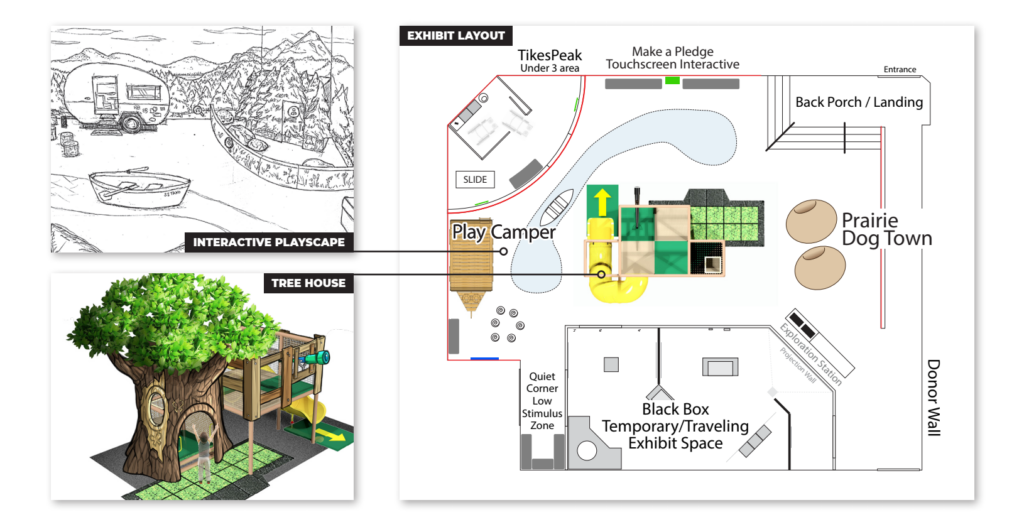
The exhibit was inspired by feedback we received from our members and guests who expressed a deep interest in learning more about the animals and ecosystems right in our backyard. This insight came as no surprise, as us Coloradans – especially those who frequent Butterfly Pavilion – are known for caring deeply about our natural landscapes! We couldn’t be more grateful to be part of this fantastic community.
Our educators and scientists at Butterfly Pavilion were incredibly excited to tap into their expertise and gather the stories of some of the most unique invertebrates that inhabit Colorado, in mountain, wetland, desert, prairie and urban ecosystems. And yes, Colorado has them all! Bumblebees living at over 12,000 feet, beetles that are skilled swimmers, wasps with the ability to paralyze tarantulas, spiders that catch pests behind-the-scenes in our homes – there is so much to discover.
If you’re looking for a sneak peek of the types of stories we’ll uncover, click here for an inside look at the life of our state insect, the Colorado hairstreak butterfly, as told by our Lepidopterist, Kathryn Hokamp.
After experiencing Colorado Backyard, our hope is that when you play in your backyard, trek through the mountains, ski or snowboard through fresh powder, enjoy produce from the farmer’s market, or even do something as seemingly mundane as heading down to your basement to grab an item out of storage, you’ll take a second to think about the little animals that are making a big, and positive, impact on the spaces we need and enjoy daily. We also plan to make sure you’re well-equipped to take small, but impactful, actions every day that can ensure these hidden heroes are protected for the future.
See the full exhibit layout at butterflies.local/exhibit/coloradobackyard. Stay updated on the exhibit construction and all the other exciting happenings going on at Butterfly Pavilion by following us on Facebook and by visiting our website – butterflies.local.
Our countdown begins! We look forward to seeing you on March 23 for the grand opening of Colorado Backyard.
Colorado’s State Insect – The Colorado Hairstreak (Hypaurotis crysalus)
By Kathryn Hokamp, Lepidopterist at Butterfly Pavilion
The story of the Colorado Hairstreak, Colorado’s state insect, began with a Fourth Grade Teacher in Aurora. Melinda Terry led her fourth grade class at Wheeling Elementary to the state legislature and insisted that this beautiful insect become an official symbol of the state. Their efforts spread across fourth grade classes in Colorado, and eventually, this butterfly overcame challenges to the state insect title, including a suggestion that the honeybee would be a better candidate. The Colorado Senate Bill 96-122 was passed and in 1996 and Colorado became the 37th state to officially declare a state insect – Hypauurotis chrysalis, the Colorado Hairstreak.
The Colorado Hairstreak is a montane butterfly, typically found in hills and canyons between 6500 and 9000 feet. They are recognized by their distinctive iridescent purple, blue, and black coloration when their wings are opened and the orange spots on their ventral side when their wings are closed. They have a small tail on their lower wings common to hairstreak, or Theclinae, butterflies and have a wingspan of less than an inch and a half at their largest.
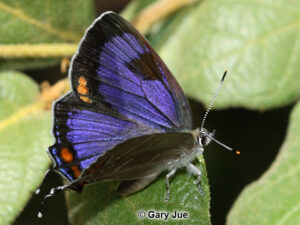
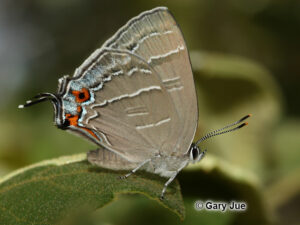
Colorado Hairstreak (Hypaurotis crysalus). Photos by Gary Jue (BAMONA; www.butterfliesandmoths.org)
Male Colorado hairstreaks are very territorial and will defend their oaks from other butterflies of the same species. The adults can be found in the greatest numbers between July and August, and the butterflies only have one generation per year. Unlike the migratory monarchs and painted ladies, Colorado Hairstreaks tend to live within a few yards of their hatching place for their entire lives (Scott 1975). Even when startled, Colorado Hairstreaks tend to fly back into their home oak groves. Males are territorial and will chase each other as they patrol, flying in the canopy of the oaks looking for females. The males locate the females by their distinct purple coloration, though pheromones are also likely important for locating mates (Scott 1974).
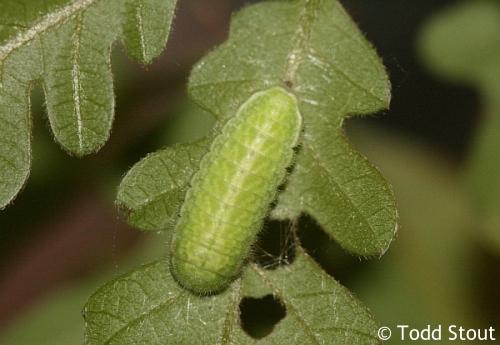
Colorado Hairstreak Caterpillar. Photo by Todd Stout (BAMONA; www.butterfliesandmoths.org)
The Colorado hairstreak is completely dependent on the Gambel Oak (Quercus gambelii) throughout its life. The adults lay their eggs on oak twigs, and the eggs remain there throughout the winter until they hatch in the late spring. The caterpillars will then eat the young leaves of the oak until they pupate (Scott 1994). Once the adult emerges, the butterfly does not consume nectar from flowers but subsists entirely on sap and sugary secretions from oak galls (Wagner and Gagliardi 2015). They also may feed on honeydew, the name for sugary secretions from aphids and other insects. Sap and sugary secretions from insects are not as hydrating or as nutritious as flower nectar, so Colorado Hairstreaks have evolved behaviors to prevent dehydration and depletion of their energy stores (Scott 1994). These include the mostly sedentary lifestyles of the females and the tendency of the species to mate and lay eggs in the late afternoon and evening when summer rains are most likely.
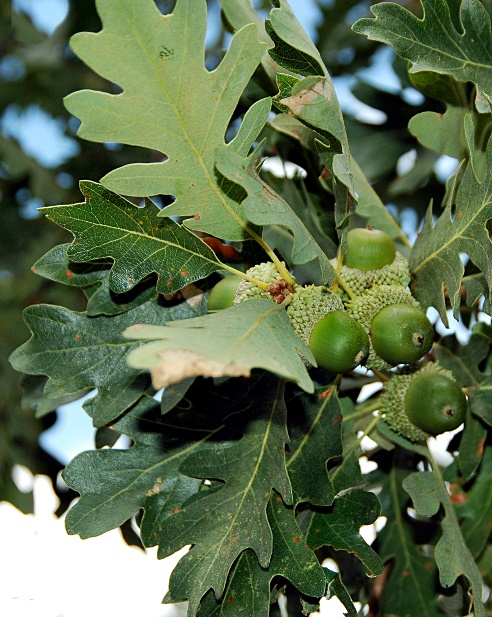
Gambel Oak, Photos by Cory Maylett (Wikimedia Commons)
The Colorado hairstreak is a reclusive butterfly, typically spending its entire life in a single oak grove and never descending to feed on flowers, but they still have captured the imagination of both school children and entomologists with their unique behaviors and gorgeous coloration. Only one generation hatches each year and the adult hairstreaks can be spotted basking and looking for mates on late afternoons in July and August. Any time there is a grove of Gambel Oaks in the foothills of Colorado, a lucky observer can find Colorado Hairstreaks hidden in the branches waiting for the spring.
This is just one of the incredible animals you can discover through Butterfly Pavilion’s newest interactive exhibit—Colorado Backyard—opening March 23! It’s an opportunity to connect to the diverse life that surrounds us and get inspired to conserve all of our natural treasures in Colorado and beyond. Visit butterflies.local/exhibit/coloradbackyard to learn more.
References:
Chu, Janet R. and Stephen R. Jones. Butterflies of the Colorado Front Range: A Photographic Guide to 80 Species. Boulder: Boulder County Nature Association, 2011.
College of Agricultural Sciences. “Colorado Hairstreak (State Insect of Colorado).” In Colorado Insect of Interest series. Colorado State University, https://webdoc.agsci.colostate.edu/bspm/arthropodsofcolorado/Colorado-Hairstreak.pdf.
Scott, James A. “Flight patterns among eleven species of diurnal Lepidoptera.” Ecology 56, no. 6 (1975): 1367-1377.
Scott, James A. “The interaction of behavior, population biology, and environment in Hypaurotis crysalus (Lepidoptera).” American Midland Naturalist (1974): 383-394.
Wagner, David L., and Benedict L. Gagliardi. “Hairstreaks (and Other Insects) Feeding at Galls, Honeydew, Extrafloral Nectaries, Sugar Bait, Cars, and Other Routine Substrates.” American Entomologist 61, no. 3 (2015): 160-167.