
How Everyday Citizens make large-scale Science Possible
By Sara Stevens, Aquarist at Butterfly Pavilion
Imagine you’re walking down a quiet, sunny trail. A large and expansive pond to your side ripples as a gentle wind stirs the water’s surface. Birds exchange songs in the distance as the sun warms your skin and the sweet scent of grass hits your nose. Suddenly, as if begging for your attention, a dragonfly whirs by. Its bold blue body glints playfully in the light. You continue walking as another dragonfly flits into view, this one a beautiful russet with flecks of orange. It hovers for the briefest of moments before zipping off into the distance, darting with the aerial precision of a fighter pilot. The buzz of activity is staggering and your eyes, so used to looking for the big things in life, begin to seek out these small intriguing animals. Suddenly two grows to four, four to eight, eight to twenty and suddenly you realize- the more you look, the more you see. This once quiet sunny trail is teeming with dragonflies and you are the sole audience for their aerial acrobatics show. You have become an observer, a monitor, and you’ve completed the first step to becoming a citizen scientist.
The Colorado Dragonfly Monitoring Project started in 2018 by Butterfly Pavilion research and conservation coordinator Katrina Loewy, was created to help monitor native and migratory populations of dragonflies found throughout the Colorado Front Range. The project monitors the number of dragonflies found along 0.5 mile stretches of trail, called transects. The same transect must be walked a minimum of six times from May to September to ensure enough data is collected. Now, imagine attempting to record observations in Westminster, in Broomfield, in Boulder, Jefferson County, Adams County, and so many other places, by yourself. Such a large task would be impossible for one person or team, or even one organization, to accomplish alone.
This is why we need you.
Citizen scientists are everyday citizens who help conservation organizations around the world collect vast amounts of data that can be used to help local governments make critical conservation decisions that protect entire ecosystems. A citizen scientist can be anyone, from any walk of life, interested in spending time outdoors and taking an active role in conservation. The only thing you need is a willingness to learn and the dedication to walk your trail. Every year, Butterfly Pavilion trains citizen scientists to monitor Colorado dragonflies they see on a trail of their choice. Those who join will learn how to collect data, how to identify dragonflies, and how that information can help local governments make important conservation decisions.

Why dragonflies?
Dragonflies are great indicators of the health of an ecosystem. Because they spend most of their life cycle in and around water, the presence or absence of dragonflies in an area can indicate the health of the water. Dragonflies are also sensitive to temperature and climate. Observing how their populations fluctuate and move each year can help us measure the impacts of climate change on Colorado ecosystems.
If you love the outdoors, care about the environment, and want to be part of a fun and engaging scientific community, join the Colorado Dragonfly Monitoring Network for the upcoming 2019 season! Our training dates are found HERE on our website. No training is necessary, contact me at sstevens@butterflies.org or call 720.375.9983 for more information and to sign up for a training day!
By Eric Oaks, School Programs Manager
As the School Programs Manager at Butterfly Pavilion, I am often asked: “what do you offer homeschoolers at Butterfly Pavilion?” To that, I reply that we love inviting homeschoolers to our facility for special opportunities to connect with our invertebrates, learn about the importance of conservation and experience hands-on science learning similar to what traditional students access through field trips and onsite classes. Let me show you!
Like the origins of the American education system, which involved small rural family groups gathering in a one-room school house on the open prairie, today’s homeschool groups meet regularly to share experiences and co-teach their own community. Community sites like Butterfly Pavilion provide an important opportunity for these students to learn and grow, complementing their lessons through hands-on experiences that explore science and cultural concepts that can lead to new discovery and areas of inquiry.
Butterfly Pavilion’s exhibits – open 9 am – 5 pm, year-round – are an outstanding educational opportunity for homeschoolers. Through informational signage, touch experiences, and conversations with our talented exhibit educators, young learners uncover new knowledge on invertebrates, conservation, and environmental stewardship, which can extend current homeschool lessons and inspire new ones. Through Butterfly Pavilion membership, you can get unlimited access to exhibits all year long. As an inside tip, visiting exhibits after 1 pm leaves more space to explore, as other school groups are scheduled earlier in the day.
In addition, we have created standalone Homeschool Days throughout the year that offer multiple experiences that are designed around themes that explore habitats and animals from around the world and include special talks from our scientists, multiple classes taught by our educators, and games, activities, and crafts not normally offered during our daily programming. Our next Homeschool Day is planned for May 31st and will be science, technology, education, and math (STEAM) focused, incorporating art and literature into our invertebrate curriculum.
If you can’t make it to the next Homeschool Day, Butterfly Pavilion offers discounts to homeschool groups with ten students or more (a free adult is admitted for every five students) and discounts to homeschool groups with a combined total of at least ten paying individuals. Butterfly Pavilion also offers classes aligned with Next Generation Science Standards that further connect young learners with our exhibits through engaging content and take-home questions.
Visit butterflies.local to buy general admission tickets, register for an upcoming Homeschool Day or reserve a facilitated class!
No matter when your homeschool group gets to Butterfly Pavilion, you will find talented and passionate scientific and environmental educators excited to engage and inspire your young learners. Not only will your students hold a tarantula, experience a butterfly emerge from its chrysalis, or taste test a mealworm. They will experience the world through compound eyes and be inspired by science and a mission to protect and care for threatened habitats in Colorado and around the world.
By Diane Metzger, Brand Manager at Butterfly Pavilion
A visit to Butterfly Pavilion is known to transport guests around the world, offering a stroll through a real rainforest filled with stunning tropical plants and free-flying butterflies, a peek underwater at aquatic animals found in the depths of oceans, a glimpse into the lives of desert-dwelling terrestrial species equipped for the harshest of conditions, and so much more. But one of the amazing things about invertebrates is that you don’t need to look to animals from distant lands to be awestruck by their incredible abilities and essential contributions to ecosystems. In fact, there’s an incredible diversity of invertebrate animals right below your feet and outside your door just waiting to be discovered.
Our newest interactive exhibit – Colorado Backyard – is opening March 23 and will connect guests to the rich and diverse life that surrounds us right here in the Centennial State, with a goal of inspiring greater commitment to conserve our natural treasures in Colorado and beyond. The exhibit will feature live animals, indoor play structures, a virtual reality experience, a rotating exhibit area and invertebrate photography by talented individuals from the community.
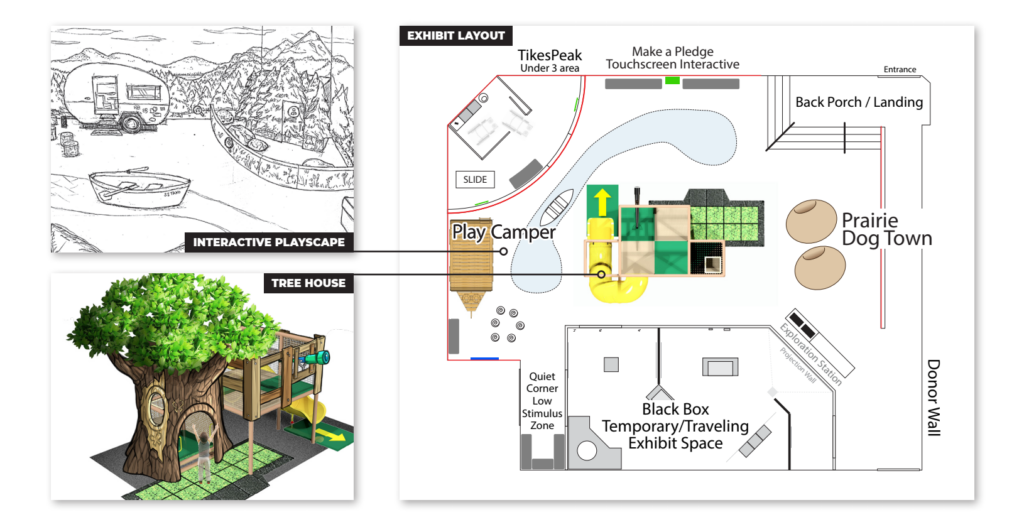
The exhibit was inspired by feedback we received from our members and guests who expressed a deep interest in learning more about the animals and ecosystems right in our backyard. This insight came as no surprise, as us Coloradans – especially those who frequent Butterfly Pavilion – are known for caring deeply about our natural landscapes! We couldn’t be more grateful to be part of this fantastic community.
Our educators and scientists at Butterfly Pavilion were incredibly excited to tap into their expertise and gather the stories of some of the most unique invertebrates that inhabit Colorado, in mountain, wetland, desert, prairie and urban ecosystems. And yes, Colorado has them all! Bumblebees living at over 12,000 feet, beetles that are skilled swimmers, wasps with the ability to paralyze tarantulas, spiders that catch pests behind-the-scenes in our homes – there is so much to discover.
If you’re looking for a sneak peek of the types of stories we’ll uncover, click here for an inside look at the life of our state insect, the Colorado hairstreak butterfly, as told by our Lepidopterist, Kathryn Hokamp.
After experiencing Colorado Backyard, our hope is that when you play in your backyard, trek through the mountains, ski or snowboard through fresh powder, enjoy produce from the farmer’s market, or even do something as seemingly mundane as heading down to your basement to grab an item out of storage, you’ll take a second to think about the little animals that are making a big, and positive, impact on the spaces we need and enjoy daily. We also plan to make sure you’re well-equipped to take small, but impactful, actions every day that can ensure these hidden heroes are protected for the future.
See the full exhibit layout at butterflies.local/exhibit/coloradobackyard. Stay updated on the exhibit construction and all the other exciting happenings going on at Butterfly Pavilion by following us on Facebook and by visiting our website – butterflies.local.
Our countdown begins! We look forward to seeing you on March 23 for the grand opening of Colorado Backyard.
Colorado’s State Insect – The Colorado Hairstreak (Hypaurotis crysalus)
By Kathryn Hokamp, Lepidopterist at Butterfly Pavilion
The story of the Colorado Hairstreak, Colorado’s state insect, began with a Fourth Grade Teacher in Aurora. Melinda Terry led her fourth grade class at Wheeling Elementary to the state legislature and insisted that this beautiful insect become an official symbol of the state. Their efforts spread across fourth grade classes in Colorado, and eventually, this butterfly overcame challenges to the state insect title, including a suggestion that the honeybee would be a better candidate. The Colorado Senate Bill 96-122 was passed and in 1996 and Colorado became the 37th state to officially declare a state insect – Hypauurotis chrysalis, the Colorado Hairstreak.
The Colorado Hairstreak is a montane butterfly, typically found in hills and canyons between 6500 and 9000 feet. They are recognized by their distinctive iridescent purple, blue, and black coloration when their wings are opened and the orange spots on their ventral side when their wings are closed. They have a small tail on their lower wings common to hairstreak, or Theclinae, butterflies and have a wingspan of less than an inch and a half at their largest.
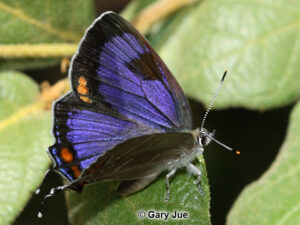
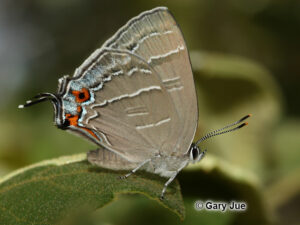
Colorado Hairstreak (Hypaurotis crysalus). Photos by Gary Jue (BAMONA; www.butterfliesandmoths.org)
Male Colorado hairstreaks are very territorial and will defend their oaks from other butterflies of the same species. The adults can be found in the greatest numbers between July and August, and the butterflies only have one generation per year. Unlike the migratory monarchs and painted ladies, Colorado Hairstreaks tend to live within a few yards of their hatching place for their entire lives (Scott 1975). Even when startled, Colorado Hairstreaks tend to fly back into their home oak groves. Males are territorial and will chase each other as they patrol, flying in the canopy of the oaks looking for females. The males locate the females by their distinct purple coloration, though pheromones are also likely important for locating mates (Scott 1974).
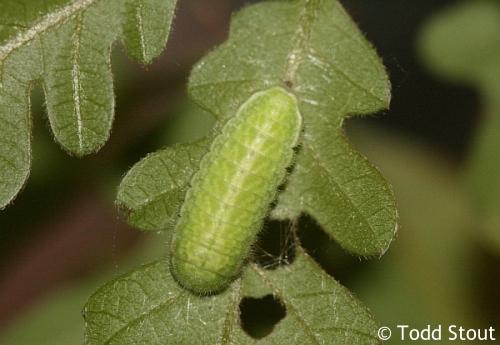
Colorado Hairstreak Caterpillar. Photo by Todd Stout (BAMONA; www.butterfliesandmoths.org)
The Colorado hairstreak is completely dependent on the Gambel Oak (Quercus gambelii) throughout its life. The adults lay their eggs on oak twigs, and the eggs remain there throughout the winter until they hatch in the late spring. The caterpillars will then eat the young leaves of the oak until they pupate (Scott 1994). Once the adult emerges, the butterfly does not consume nectar from flowers but subsists entirely on sap and sugary secretions from oak galls (Wagner and Gagliardi 2015). They also may feed on honeydew, the name for sugary secretions from aphids and other insects. Sap and sugary secretions from insects are not as hydrating or as nutritious as flower nectar, so Colorado Hairstreaks have evolved behaviors to prevent dehydration and depletion of their energy stores (Scott 1994). These include the mostly sedentary lifestyles of the females and the tendency of the species to mate and lay eggs in the late afternoon and evening when summer rains are most likely.

Gambel Oak, Photos by Cory Maylett (Wikimedia Commons)
The Colorado hairstreak is a reclusive butterfly, typically spending its entire life in a single oak grove and never descending to feed on flowers, but they still have captured the imagination of both school children and entomologists with their unique behaviors and gorgeous coloration. Only one generation hatches each year and the adult hairstreaks can be spotted basking and looking for mates on late afternoons in July and August. Any time there is a grove of Gambel Oaks in the foothills of Colorado, a lucky observer can find Colorado Hairstreaks hidden in the branches waiting for the spring.
This is just one of the incredible animals you can discover through Butterfly Pavilion’s newest interactive exhibit—Colorado Backyard—opening March 23! It’s an opportunity to connect to the diverse life that surrounds us and get inspired to conserve all of our natural treasures in Colorado and beyond. Visit butterflies.local/exhibit/coloradbackyard to learn more.
References:
Chu, Janet R. and Stephen R. Jones. Butterflies of the Colorado Front Range: A Photographic Guide to 80 Species. Boulder: Boulder County Nature Association, 2011.
College of Agricultural Sciences. “Colorado Hairstreak (State Insect of Colorado).” In Colorado Insect of Interest series. Colorado State University, https://webdoc.agsci.colostate.edu/bspm/arthropodsofcolorado/Colorado-Hairstreak.pdf.
Scott, James A. “Flight patterns among eleven species of diurnal Lepidoptera.” Ecology 56, no. 6 (1975): 1367-1377.
Scott, James A. “The interaction of behavior, population biology, and environment in Hypaurotis crysalus (Lepidoptera).” American Midland Naturalist (1974): 383-394.
Wagner, David L., and Benedict L. Gagliardi. “Hairstreaks (and Other Insects) Feeding at Galls, Honeydew, Extrafloral Nectaries, Sugar Bait, Cars, and Other Routine Substrates.” American Entomologist 61, no. 3 (2015): 160-167.
By Kathryn Hokamp, Lepidopterist at Butterfly Pavilion
Click here to help protect pollinators
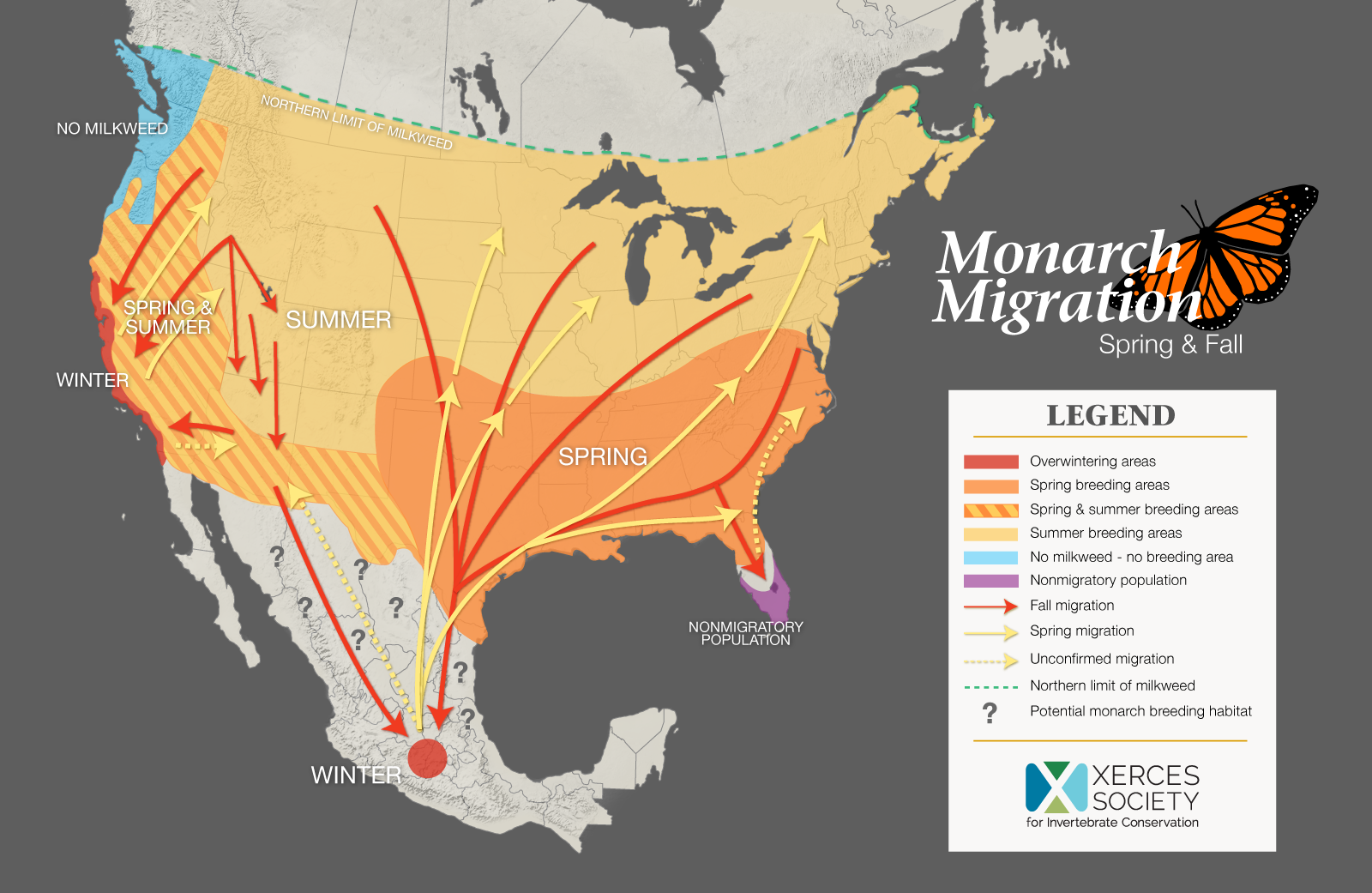
Monarch Butterflies (Danaus plexippus) have been in the news frequently in the past several months, and the information can be confusing and seem conflicting at times. There are reports of record low numbers of overwintering monarchs in California alongside apparent record high numbers of butterflies migrating through the Midwest. This can seem paradoxical, but it is important to remember that the monarch migration in the United States is split. Some Monarchs overwinter in California, some overwinter in Michoacán, Mexico, and some are part of non-migratory or semi-non-migratory populations in Florida and the Gulf States. As a rule, butterflies that migrate east of the Rocky Mountains overwinter in Michoacán, and butterflies west of the Rockies overwinter on the coast of California. See the map below from the Xerces Society for details, and note the mixing of populations as well as the uncertainty on the map (indicated with question marks and dashed lines). We know more about D. plexippus than we do about many butterflies, but our knowledge is far from complete.
What is happening in California?
The Xerces Society has been conducting a Thanksgiving count of overwintering monarchs in the state since 1997 with the help of citizen scientists. The count is conducted every year at various monarch overwintering sites in the weeks around the Thanksgiving holiday. This year’s count was extremely low with only 28,429 monarchs counted compared to 192,668 butterflies counted at the same sites in the previous year. This drop-off is even more concerning when compared to the estimated 4.5 million monarchs overwintering in California in the 1980s, showing a 99.4% decrease. A paper by Schultz et al. published in 2017 suggested that 30,000 butterflies is the probable threshold for the collapse of the western population of monarch butterflies, which means the population can likely still be saved, but it is important for conservation plans to go into effect immediately.
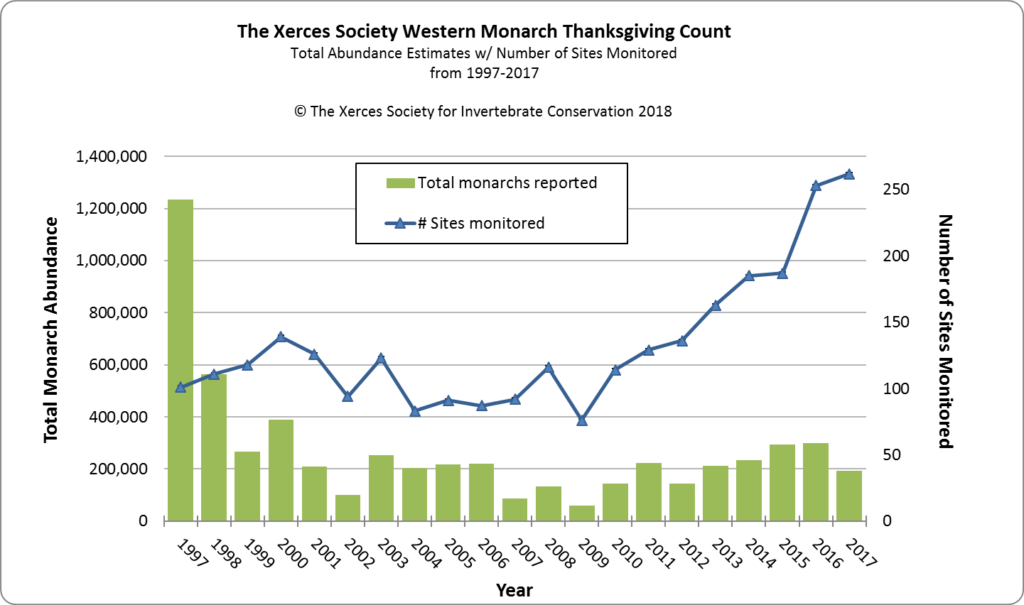
The Xerces Society has published an action plan to save the western monarch population which includes the following action items:
- Protect and manage California overwintering sites.
- Restore breeding and migratory habitat in California.
- Protect monarchs and their habitat from pesticides
- Protect, manage, and restore summer breeding and fall migration monarch habitat outside of California.
- Answer key research questions about how to best aid western monarch recovery.
With this plan, the Xerces Society hopes to conserve the western monarch population and to restore monarchs to previous numbers in the west.
Are the eastern migratory monarchs still imperiled? Preliminary data suggests that the eastern migratory population is having a good year while the western migratory monarchs are having a catastrophically bad year, but both populations of monarchs are still under threat from human activity. The monarch population in Mexico declined 84% between 1996 and 2015, and a good year is not necessarily indicative of an upward trend in the population and may fall into normal fluctuation within the greater downward trend. Nonetheless, the apparent high numbers, while preliminary, are a good sign for the population and we need to continue to foster the growth of the migratory monarch population.
Why are the monarch overwintering numbers high in Michoacán and low in California? There are many possible factors contributing to the low numbers of western D. plexippus versus the apparent high numbers of eastern D. plexippus, but it is safe to suggest that the difference in success is related, at least in part, to the weather patterns in the United States during 2018. The fall saw record highs in amount of precipitation in much of the eastern United States, while the west saw widespread drought (see map below from NOAA). Drought affects monarchs in many ways including decreases in the number of flowering plants that meet adult nutritional needs, decreases in milkweed and milkweed reproduction (Asclepias sp. are the larval foodplant for D. plexippus), and increases in the number and size of forest fires creating hostile air conditions and decreasing viable habitat for the butterflies.

On the other hand, weather conditions in most of the east were very good for the monarchs in 2018. The conditions were good for supporting the growth of milkweed in the spring while D. plexippus was breeding, and the conditions remained good throughout 2018. We are likely to see more monarchs overwintering in Michoacán than have been seen in many years, but it is important to remember that we do not have definitive numbers from overwintering sites in Michoacán yet, and we are unlikely to have conclusive numbers before March, so the monarchs in Mexico may have lower or higher numbers than predicted. There are many factors beyond climate that will affect the size of the monarch population including, but not limited to:
- Pesticide Use
- Disease (most notably Ophryocystis elektroscirrha or OE)
- Habitat destruction
- Poor management of overwintering sites
What is the impact of Colorado? Colorado is in an excellent position to foster the survival of both the Eastern and Western Monarch populations for various reasons.
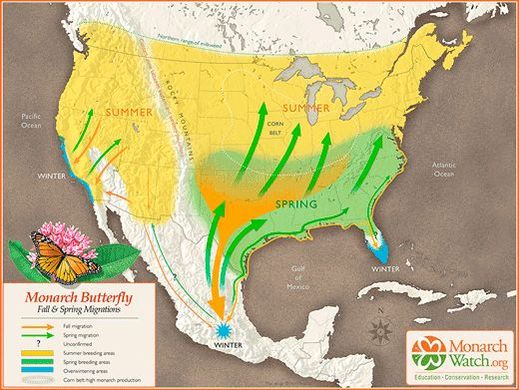
- The eastern and western monarch populations mix along the Rocky Mountains, so Colorado is home to both populations (see below map from Monarch Watch)
- While most monarchs migrating through the front range are likely heading to Mexico, we are very near the mixing point and are well positioned to support both the eastern and western populations
- While Colorado does not see the large numbers of monarchs that migrate through other states to the east and the west, unusual weather patterns may push monarchs into the area, and we can help conservation efforts by providing butterfly habitats and recording monarchs seen in the area for Monarch Watch or Journey North
Questions to Consider:
- Is it possible that there are monarch overwintering sites on the Pacific Coast that we do not know about? It is only 43 years ago that the scientific community in the United States and Canada even learned the location of the Monarch overwintering sites in Michoacán, and there is much we still do not know about the monarch migration.
- Is it possible the overwintering sites are moving? We know climate change is affecting the distribution of the Asclecpias sp. needed for monarch breeding, and we know monarchs shift their overwintering sites, particularly in California, but the concern for western monarchs began with the low numbers observed breeding, so shifting in overwintering sites could not account for the extremely low numbers counted in California.
- Could the western migratory monarchs be migrating to Mexico? Some monarchs migrate to Mexico from west of the Rocky Mountains, but it is not a large scale migration. We will know more about the numbers migrating to Mexico from the western United States once more tagged monarchs are recovered this winter, but it is unlikely to be a huge number.
- How much do we know about the monarch migration? We know more about plexippus than we do about many butterflies, but much of the mechanics of the monarch migration is still a mystery. There are unconfirmed migration routes and unverified overwintering sites. There is much more to learn about Monarch Butterflies.
What you can do to help the monarchs
- Make your garden a butterfly habitat! Plant native milkweed and nectar plants in your garden, and don’t treat your garden or lawn with pesticides. If the monarchs and other butterflies have good garden habitats for feeding and reproduction, they will have higher chances of survival.
- Join Monarch Watch at Butterfly Pavilion and help us to tag monarchs in the fall! We need accurate data on monarch movement, and there is not a large amount of data coming from Colorado. We can help by tagging monarchs in our area that will hopefully be recovered later in the season.
- Become a citizen scientist! We rely on data and observations from people around the country to understand monarchs and the things affecting their survival. This list includes many opportunities to get involved with monarch conservation as a citizen scientist, and Butterfly Pavilion can help as well! You can become a volunteer for the Colorado Butterfly Monitoring Network or contact us for more opportunities!
- Read information from trusted sources when learning about monarchs and other invertebrates. Monarch butterflies are very popular animals, and some of the information generated about them is not based on good science. Monarch Watch and Monarch Joint Venture are good resources for any monarch questions.
Photo credit – 2018 precipitation departures from average. Areas in the purple shadings picked up at least 12 inches more than average in 2018. (NOAA/NWS) via weather.com
Julie Ann Barowski, Volunteer Manager at Butterfly Pavilion
One of the greatest aspects of Butterfly Pavilion is our people. Everyone from staff to volunteers brings their passion to the organization every day, making it possible for us to achieve big impacts in invertebrate and habitat conservation. Lorraine Martinez and Greg Gonzalez are no exception. They are current participants in the Senior Community Service Employment Program (SCSEP), an innovative program through which seniors provide hands-on service to our organization, updating and learning new skills, in order to better prepare for reentering the workplace. SCSEP is funded by the U.S. Department of Labor and administered by Service, Employment, and Redevelopment (SER) National and Colorado is one of just 6 states that currently participate.
Before retirement, Lorraine Martinez worked for several departments of the State of Colorado and had a background in computers and administration. She decided to go back to work and discovered SCSEP through a friend. Through the program, Lorraine has trained at an art thrift store and with a student mentor program. At Butterfly Pavilion Lorraine wanted to focus on her computer skills and so her talents were put to use helping our Education team with data management, research, and other special projects.

Lorraine says in addition to feeling like she’s getting a full refresher course in computers, she’s excited to learn more about our animals and the work Butterfly Pavilion does behind the scenes. Lorraine says, “It’s amazing to see all the research and learn how important it is. It opens up a whole new world.” Lorraine says a really fun bonus of her work is sharing her new knowledge with her 5 grandkids. She takes home new facts to teach them and they get into conversations about insects.
Greg Gonzalez had a career as a lawyer before working in several managerial positions at mental health organizations. When his grant-funded position ended, Greg was on his way to enroll in an Excel class when he saw a sign for SCSEP. Greg is now exploring a variety of roles at Butterfly Pavilion using his vast skill set. He started as an exhibit interpreter, helping our guests learn more about and interact with animals. He also helps with school group logistics and is currently working on Spanish translations for exhibit signage in preparation for Butterfly Pavilion’s new facility in Broomfield opening in 2022.

Greg says that through this experience, he’s rediscovered his passion for learning. He especially enjoys teaching guests about animals here, with Rosie the Tarantula, horseshoe crabs, and the atlas moth being among his favorites. Greg enjoys connecting with our guests about how we share the planet with these amazing creatures. His passion is obvious, and he says, “I get excited every time I do exhibit interpretation because the kids get so excited, especially about Rosie. It’s fun. It’s contagious!”
Along with great experiences for Greg and Lorraine, their presence has had a fantastic impact on Butterfly Pavilion. “My interactions and witnessing the connections of others with our SCSEP trainees is one of the highlights of my day, every day. From checking in with Lorraine about how her family is doing to seeing Greg’s excitement when a school bus arrives, the actions of our SCESP participants are making a real tangible, positive difference in the culture of Butterfly Pavilion,” says Eric Oaks, Butterfly Pavilion School Programs Manager.
We are so thankful to have Greg and Lorraine as a part of our team, and we look forward to engaging other SCSEP participants in the future. If you or a senior you know is interested in learning more about SCSEP, you can visit www.seniorserviceamerica.org.
Distance Learning: It’s for Everyone, Near & Far
By Erin Dreps, School Programs Manager at Butterfly Pavilion
Field trips are no doubt a magical experience during which even the shortest bus ride feels like a stardust-powered transport to another world. While delivering lots of fun, they can also inspire excitement about learning and provide real-world insights into classroom topics. The win-win nature of this arrangement for students and teachers reinforces the magical quality of field trips.
We see this happening every day at Butterfly Pavilion: over 30,000 students pass through our doors on field trips every year. But increasingly, the wizardry required to pull off a field trip is getting more complex as teachers face ever greater obstacles when transporting students off site. The rising cost of buses district transportation, “blackout” dates, needing longer travel times in the thickening gridlock – these are just some of the barriers cited by teachers we work with who want to take their students on a field trip.
While Butterfly Pavilion has always offered outreach programs, in which an educator travels to a school or community site to meet folks where they are, this can still pose logistical challenges for schools and it does not avoid the travel costs altogether. Even with scholarships offered to qualifying groups, the costs and challenges taken together have some teachers looking for alternatives. Then, of course, there are the students who simply live too far from Butterfly Pavilion to enjoy a field trip or an outreach.
Enter distance learning. Distance learning (DL), sometimes called “virtual field trips,” offers classrooms the opportunity to connect with Butterfly Pavilion educators via interactive videoconferencing. This avoids travel costs and hassles of all kinds while still enabling students to connect with experts and welcome a virtual “visitor” to their classroom.

Butterfly Pavilion has been in the DL game since 2016, offering both “point-to-point” programs (connecting with one classroom at a time) and webinar-style programs (connecting with lots of classrooms and homeschoolers all over the world simultaneously). Despite initial trepidation about the types of interactions we could facilitate as a face on the screen, we’ve learned a lot quickly:
First, because the instructor is not physically in the same room as the students and because it’s not very practical to share props or materials with the students, each program builds in some sort of hands-on activity with a low materials requirement – printouts and basic classroom supplies that teachers can easily provide. These printouts can be a bigger-than-life size diagram of a tarantula whose anatomy students label during the program, an aerial view of Butterfly Pavilion with bee sightings map which students inventory as a simulation of citizen science data collection, or a map of North American on which students trace the monarch butterflies’ migration as they imagine themselves journeying alongside these impressive insects. Including a hands-on element for the students to interact with helps to offset the fact that facilitating actual physical movement via videoconference is not necessarily feasible. Next, while the instructor, with the in-classroom teacher’s help, is able to call on and hear from some students in point-to-point programs (and students or their teachers can participate via chat boxes in the webinars), this process is not as efficient as it is in person. So, instead, we build in turn-and-talk moments so that students still get to share their ideas, even if not with the entire group.
While there may not be a magic school bus moment in a virtual field trip, DL still supports student learning and engagement and supplements the regular classroom curriculum while introducing a bit of novelty (once, getting ready to sign off, a student ran up to the camera and asked, “Are you on TV??”). The care we’ve put into ensuring these programs are interactive and meaningful has been reflected in the awards bestowed upon them by the Colorado Distance Learning Association (2016), the Colorado Alliance for Environmental Education (2017), and the Center for Interactive Learning and Collaboration (2018).
Want to bring DL into your classroom or homeschool? It’s easy.
- Join our free Wild Wetlands live stream event on January 31.
- Book one of our point-to-point programs any time.
Email us at education@butterflies.org with any questions!
By Amy Yarger, Horticulture Director at Butterfly Pavilion
Have you ever been inside a snow globe? One of the perks of visiting Butterfly Pavilion in the winter is enjoying an “inside-out” snow globe experience. Outside it may be cold and snowy, but inside, there is warmth and color and the dancing of butterflies. It’s one of my favorite experiences, and it wouldn’t be the same without the colors, textures and fragrances of the exotic plants found in Wings of the Tropics.

One of the favorite winter bloomers among the Butterfly Pavilion team is Dombeya wallichii or dombeya tree. D. wallichii (pictured above), a native of East Africa and Madagascar, is a broad-leaved tree which may reach a height of 30 feet in the wild. Every December and January, dangling clusters of pink flowers appear from the branches. Its claim to fame, however, is the fragrance: Butterfly Pavilion staff and volunteers have taken to calling it the “caramel corn tree”. The fragrant flowers produce prodigious nectar, so be on the lookout for greater egg flies and paper kite butterflies visiting the flowers.

Another winter-blooming plant found in Wings of the Tropics is the red powderpuff, or Calliandra haematocephala (pictured above). This is one of three Calliandra species we grow in Wings of the Tropics. The big brushy red flowers, present from December through March, are especially attractive to our larger butterflies, such as swallowtails and birdwings. I like to call it the “Elmo Tree,” because the after a day or two, the flowers look rather Muppet-like.

For sheer number of winter flowers, it is hard to beat Clerodendrum splendens (pictured above) in the winter. This fast-growing West African vine clambers over many parts of the exhibit, and most of the year, visitors only see it as yet another green climber in the tropical landscape. From about Thanksgiving on, however, the green is replaced by clusters of scarlet flowers. On sunny days, clusters of butterflies drink nectar from the blossoms. When the blossoms fall, the sepals remain purplish-pink, adding still more color.
Other flowering plants in Wings of the Tropics bloom throughout the year; this is important, because most of our butterflies rely on flower nectar for their food. We enjoy the flowers for their beauty, the butterflies enjoy them for their breakfasts. Daily programs such as our “Rainforest Tour” or even our monthly Tripod Photography sessions will allow you to get a closer view of these and other plants. Or, if you simply find yourself experiencing botanical withdrawal, come pay us a visit. It’s like a tropical vacation without the long airport lines!
About Butterfly Pavilion:
Here at Butterfly Pavilion, we transform the way people think about invertebrates. These small but mighty animals that surround us are so much more than people think. They are everywhere, because everything depends on them. They are the hidden heroes of the animal kingdom. As the world’s only stand-alone invertebrate zoo accredited by the Association of Zoos and Aquariums, Butterfly Pavilion works to foster an appreciation of these critical animals by educating the public about the need to protect and care for threatened habitats globally, while conducting research for solutions in invertebrate conservation. Whether it is providing unique, hands-on learning experiences in our exhibits and educational programs, conducting new research that sets the standard for zoos across the country or building innovative solutions for species and habitat conservation in countries around the world, Butterfly Pavilion is leading the way in ensuring invertebrates are protected for the future. Learn more at butterflies.local.
# # #
Butterfly Pavilion Media Contact(s):
Kristen Petitt Stewart, kstewart@butterflies.org or 970-389-1561
Russ Pecoraro, Vice President of Marketing and Communications, rpecoraro@butterflies.org or 720.375.9984
Discover spineless wonders this holiday season.
Dec. 1-31, 2018, enjoy special animal showcase and wear your favorite holiday sweater to get $2 off admission. December is the perfect time to enjoy a trip to the Tropics!
Media note: Photos, video and other editorial material is available by request. Rosie the Tarantula, other invertebrates and scientific experts are available for media appearances and interviews. Contact kstewart@butterflies.org
Westminster, Colo. – November 27, 2018 – “♫On the first day of invertebrates at the BP, I held Rosie.♫” Wait, an invertebrate for the holidays? That’s exactly what guests will find during the 12 Days of Invertebrates showcase at Colorado’s Butterfly Pavilion, Dec. 1-31, 2018. The holiday-themed exhibit also includes 12 butterflies flitting, 11 bees buzzing, 10 stick insects hiding, 9 sun beetles pooping, and the list goes on in the spirit of the classic holiday song. In all, 12 spineless wonders will be highlighted during the month of December.
In addition to seeing the 12 different animals highlighted in this exhibit, the public can hear the entire list in a special 12 Invertebrates of Christmas song, premiering Saturday, Dec. 1 on butterflies.local and Butterfly Pavilion’s social channels. The original song created just for Butterfly Pavilion, has been penned and performed by Boulder’s own Jeff & Page, the musical duo who bring science and nature to life through kid-delighting music and stories.
Visit butterflies.local to learn more about the 12 Days of Invertebrates, hear the song (starting Dec. 1) and learn more about ongoing exhibits and other programs. The 12 Days of Invertebrates showcase is included in general admission and is $8/children (2-12), $12/adults (Westminster residents $10), $10/seniors and children under 2 are free. During December, wear a holiday sweater and get $2 off admission!
December is the perfect time to enjoy a trip to the Tropics
With an arctic blast heading toward Colorado this weekend, it’s easy to stay warm in the Wings of the Tropics exhibit! The 7,200 square-foot, indoor tropical rainforest averages a balmy 70 degrees during the winter and features stunning tropical plants in bloom and free-flying butterflies from around the world! The indoor zoo and play area provide the perfect opportunity for the whole family to get their winter wiggles out while engaging with science, incredible live animals, and learning focused on habitat and species conservation. Visit Butterfly Pavilion from 9 a.m. – 5 p.m. daily, 6252 West 104th Ave., Westminster, CO 80020. Last entry is at 4:15 p.m.
Give the gift of over 5,000 invertebrates this Holiday
A Butterfly Pavilion Membership makes the perfect gift for families, friends or anyone with a young (or young at heart) science or animal enthusiast on their hands. It comes with hours of entertainment and education, as well as the knowledge that membership helps support the conservation and research work Butterfly Pavilion is doing all around the globe. A Butterfly Pavilion zoo membership opens the door to science learning, invertebrate exploration and year-round entertainment that will engage and inspire.
Butterfly Pavilion membership includes: unlimited admission all year, guest passes and discounted guest admission rates, VIP access to events and special sneak peeks, 10% discount on all camps and programs for kids and adults, 10% discount on birthday parties and private event rentals and much more. Memberships (and renewals) are now on sale at butterflies.local.
About Butterfly Pavilion:
Here at Butterfly Pavilion, we transform the way people think about invertebrates. These small but mighty animals that surround us are so much more than people think. They are everywhere, because everything depends on them. They are the hidden heroes of the animal kingdom. As the world’s only stand-alone invertebrate zoo accredited by the Association of Zoos and Aquariums, Butterfly Pavilion works to foster an appreciation of these critical animals by educating the public about the need to protect and care for threatened habitats globally, while conducting research for solutions in invertebrate conservation. Whether it is providing unique, hands-on learning experiences in our exhibits and educational programs, conducting new research that sets the standard for zoos across the country or building innovative solutions for species and habitat conservation in countries around the world, Butterfly Pavilion is leading the way in ensuring invertebrates are protected for the future. Learn more at butterflies.local.
# # #
Butterfly Pavilion Media Contact(s):
Kristen Petitt Stewart, kstewart@butterflies.org or 970-389-1561
Russ Pecoraro, Vice President of Marketing and Communications, rpecoraro@butterflies.org or 720.375.9984
Colorado State University and Butterfly Pavilion Formalize Partnership
By Dr. Rich Reading, Director of Conservation at Butterfly Pavilion, and Mary Ann Colley, VP of Science and Conservation at Butterfly Pavilion.
What kinds of habitats do tarantulas prefer? How do we best stimulate our octopuses with enrichment? These are just a couple of the fascinating questions that students from Colorado State University (CSU) have researched in the strong and growing partnership between our two world-class organizations.
With dozens of students from CSU coming to work as paid and unpaid interns for Butterfly Pavilion over the years, our organizations have been working together for decades, but only recently has that partnership been formalized in a signed Memorandum of Understanding (MOU). More specifically, BP signed the MOU with CSU’s College of Agricultural Sciences and we are working to develop a second MOU with the College of Natural Sciences.
In addition to ensuring meaningful experiences for CSU interns, the MOU will allow for scientists from both CSU and Butterfly Pavilion to take either Research Associate or Affiliate Faculty positions at each other’s institutions, expanding the impact of both organizations. Dr. Ruth Hufbauer of CSU’s Department of Bioagricultural Sciences and Pest Management (BSPM; where most of CSU’s entomologists and the Gillette Museum of Arthropod Diversity reside) within the College of Ag and Dr. Jennie Willis of CSU’s Department of Biology within the College of Natural Sciences have both become Research Associates at Butterfly Pavilion. On the Butterfly Pavilion side, Dr. Rich Reading, Director of Conservation, has become an Affiliate Faculty member with the College of Ag and Mary Ann Colley, Vice President of Science and Conservation, has become an Affiliate Faculty member within the Department of Biology. Along with these positions, these folks will act as the main liaisons between the two organizations as we implement the cooperative agreements.
As outlined in our agreement, there are three primary objectives of this partnership:
- Improve the quantity and quality of conservation, management and research projects conducted by both partners.
- Increase the educational opportunities for students at CSU through internships; jointly conducted research and conservation projects; and conservation education opportunities.
- Increase the visibility of the work conducted by BP and CSU among the general public, but especially BP visitors.
In addition, the cooperative agreement outlines the obligations of each party and better describes how we will work together. For example, we will use the C. P. Gillette Museum as a repository for insects we collect during our field research projects, solving the problem of where we can store these animals while adding to the growth of the museum’s collection. Most of our collaboration, however, revolves around joint research projects and providing for opportunities for CSU students. In this win-win, we get high quality interns and the students get access to our collection and real world experiences with meaningful work.
As we continue to build the Center for Invertebrate Research and Conservation (CIRC), partnering with CSU will become even more important and these cooperative agreements will help guide our relationship with a great university.
About Butterfly Pavilion:
Butterfly Pavilion is the world’s only stand-alone, Association of Zoos and Aquariums-accredited invertebrate zoo dedicated to transforming the way people think about the small but mighty animals that are the hidden heroes of the animal kingdom. As the leader in invertebrate knowledge, inspiration and connection, and as a member institution of the Scientific and Cultural Facilities District, Butterfly Pavilion works to foster an appreciation of these critical animals by educating the public about the need to protect and care for threatened habitats globally, while conducting research for solutions in invertebrate conservation. Whether it is providing unique, hands-on learning experiences in our exhibits and educational programs, conducting new research that sets the standard for zoos across the country or building innovative solutions for species and habitat conservation in countries around the world, Butterfly Pavilion is leading the way in ensuring invertebrates are protected for the future. Learn more at butterflies.local.
Butterfly Pavilion Media Contact(s):
Kristen Petitt Stewart, kstewart@butterflies.org or 970-389-1561
Russ Pecoraro, Vice President of Marketing and Communications, rpecoraro@butterflies.org or 720.375.9984