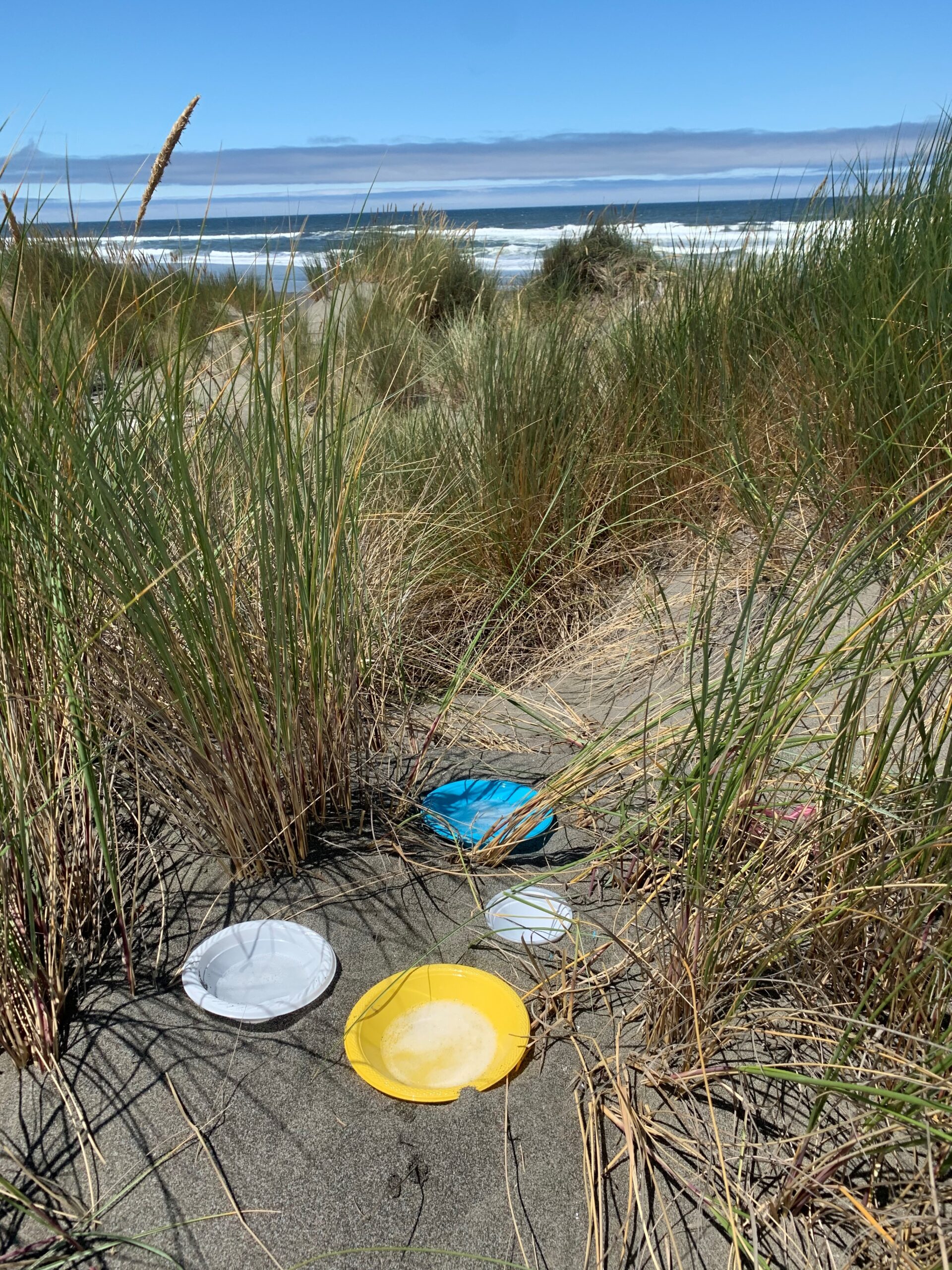
By Mindy Wagner, Interpretation Manager at Butterfly Pavilion
A few months ago when I was walking through Lair o’ the Bear Park with my bonus kids, we noticed a honey bee drinking from the river. The bee looked tiny compared to the surrounding rocks, sticks and our dog, Pepper. But despite all this, we were all captivated by this bee. We got down on our bellies (at a safe distance) and watched this bee for what seemed like minutes (anyone with small kiddos can understand how impressive that is). Ever since this moment, the kids have looked differently at bees. Instead of “Ahh a bee!” I hear “Look at that cute bee!” Instead of squashing the bee they are simply watching the bee in an aerial dance on its search for food. Every day at Butterfly Pavilion we strive to make similar meaningful connections that inspire guests of all ages and provide real attainable actions everyone can take to protect animals and the environment – to become environmental stewards.
I do often worry that “environmental stewardship” feels like an unattainable goal to many people. Our lives are busy and costs are always a consideration, but much like our small but mighty animals, small but mighty conscious decisions to take action do make a difference and can lead to more long-term environmental stewardship around us. But what inspires people to take these actions, especially with animals like spiders and beetles? Butterfly Pavilion believes creating meaningful interactions with these animals is crucial to inspiring guests. This happens through touch experiences in our exhibits, live animal shows, outreach programs and on-site classes. We encourage a fearful child to hold a tarantula for the first time and watch them light up with curiosity and amazement. We engage students to ask questions after watching a mantis shrimp obliterate its dinner. These programs and more at Butterfly Pavilion and zoos around the United States successfully influence attitudes about conservation and stewardship (Yerke and Burns, 1991 and Davison et al., 1993.)
Zoos and aquariums have come a long way from our controversial past. We no longer seek to simply entertain but are instead a hub for environmental research, conservation and education programs. Visits to zoos, like Butterfly Pavilion, prompt individuals to reconsider their role in environmental problems and conservation action, while helping them to see themselves as part of the solution (Faulk et al., 2007.) It is our responsibility as a zoo to provide our guests with knowledge and opportunities that actively promote conservation action. Below is a list of the many small and large opportunities Butterfly Pavilion provide to support our guests on their environmental stewardship journey.
- Ocean Conservation – Do you love seafood? Visit the Water’s Edge exhibit at Butterfly Pavilion to learn about choosing sustainable seafood and many other conservation actions you can take to protect the health of our oceans, even from Colorado!
- Recycling and Compost – Which bin does that trash go in? We offer guests opportunities to learn about recycling and composting both at Butterfly Pavilion and at home.
- Plastic Bag Pledge Days – Can you ditch the plastic bag? Join Butterfly Pavilion on November 17th from 10-3 for your opportunity to pledge to use only reusable bags and receive a free cloth bag for your next grocery store trip.
- Colorado Backyard – Our new exhibit opening at Butterfly Pavilion in March of 2019 will provide even more ideas and opportunities for conservation actions right here in Colorado.
- Citizen Science, Habitat Clean Up, and Habitat Restoration – Programs including the Colorado Butterfly Monitoring Network and the Urban Prairies Project allow committed individuals to get their hands dirty and help the plants and animals around Butterfly Pavilion and throughout Colorado. We also offer many one day habitat restoration projects, senior habitat gardening, and river clean up opportunities throughout the year. Keep checking butterflies.local for more information.
- Science Classes and Talks – Beekeeping Bootcamp, Nature Journaling, Scout Days, Camps and the Nature Nerds Family Club are just a few of the many classes that provide individuals and families opportunities for exploration and investigation into our natural world and how to care for it. Check out our upcoming children and family programs and our adult programs.
- On-site Programming – All programs at Butterfly Pavilion offer conservation messaging and actions. Learn about ways to protect the rainforests and coral reefs and why that is so crucial to our survival as humans at our daily programs and World Conservation Days throughout the year.
While zoos and aquariums have achieved great success in conservation and environmental stewardship, there is still work to do (Marino et al. 2010.) If we want to continue to build and foster environmental stewardship in younger generations, zoos must provide on-site science career education and training (Gang, J.) This is an important goal for Butterfly Pavilion as we transition to the Center for Invertebrate Research and Conservation (CIRC), the new state-of-the-art facility we’ll be opening in Broomfield in 2022. Butterfly Pavilion at CIRC will be across the street from a STEM school with whom we will partner to offer hands-on active classrooms, not only teaching, but demonstrating and actively involving school aged children in conservation actions.
I’m so happy that my bonus children, and thousands of other individuals every year, have the opportunity to participate in the many programs that organizations like Butterfly Pavilion provide, which inspire taking a more active role in ensuring the natural world is protected for the future.
I want to hear what you think! Does Butterfly Pavilion inspire and support you and your family in taking steps towards environmental stewardship? Take the survey here!
Learning More
For information about participating in any of our education programs, please contact the Department of Education at 720-974-1861 or registrar@butterflies.org .
For information about volunteering with education or interpretation programs, please contact the Department of Education at 720-974-1861 or registrar@butterflies.org .
Contributions to all areas of Education in any amount are welcome and provide important, direct support to the costs of annual programming. For information about supporting Butterfly Pavilion’s educational programs, please contact 720.974.1863 or pmcmullenbushman@butterflies.org .
Sources
Falk, J.H.; Reinhard, E.M.; Vernon, C.L.; Bronnenkant, K.; Deans, N.L.; Heimlich, J.E., (2007). Why Zoos & Aquariums Matter: Assessing the Impact of a Visit. Association of Zoos & Aquariums. Silver Spring, MD.
Marino, L.; Lilienfeld, S.O.; Malamud, R.; Nobis, N.; Brogliod, R., (2010). Do Zoos and Aquariums Promote Attitude Change in Visitors? A Critical Evaluation of the American Zoo and Aquarium Study. Society and Animals 18: 126-138.
Gang, J. From Exhibit to Classroom: Transitioning Zoos and Aquariums for the Twenty-First Century. Center for Humans and Nature. Available at https://www.humansandnature.org/from-exhibit-to-classroom-transitioning-zoos-and-aquariums-for-the-twenty-first-century
Davison, V.M.; McMahon, L.; Skinner, T.L.; Horton, C.M.; Parks, B.J., (1993). Animals as actors: take 2. Annual Proceedings of the American Association of Zoological Parks and Aquariums, 150-155.
Yerke, R.; Burns, A., (1991). Measuring the impact of animal shows on visitor attitudes. Annual Proceedings of the American Association of Zoological Parks and Aquariums, 532-534.
Povey, K.; Winsten, K., (2015) CEC Ambassador Animal Position Statement. Association of Zoos and Aquariums. Available at https://www.aza.org/cec-ambassador-animal-position-statement
Invertebrates are in trouble.
Latest National Academy of Sciences report shows startling loss of insect abundance.
At Butterfly Pavilion, we’ve closely monitored the dramatic declines in invertebrate populations for several years. The latest study published in the National Academy of Sciences showing the startling loss of insect abundance in Puerto Rico over the last 35 years is further proof that invertebrates, the unsung heroes of our world, are in peril and fuels Butterfly Pavilion’s mission to create a global hub for invertebrate science, conservation and education where we will continue to contribute additional research and monitoring; engage in meaningful invertebrate conservation; and summarize and communicate all of this work to the public.
About Butterfly Pavilion:
Butterfly Pavilion is the world’s only stand-alone, Association of Zoos and Aquariums-accredited invertebrate zoo dedicated to transforming the way people think about the small but mighty animals that are the hidden heroes of the animal kingdom. As the leader in invertebrate knowledge, inspiration and connection, and as a member institution of the Scientific and Cultural Facilities District, Butterfly Pavilion works to foster an appreciation of these critical animals by educating the public about the need to protect and care for threatened habitats globally, while conducting research for solutions in invertebrate conservation. Whether it is providing unique, hands-on learning experiences in our exhibits and educational programs, conducting new research that sets the standard for zoos across the country or building innovative solutions for species and habitat conservation in countries around the world, Butterfly Pavilion is leading the way in ensuring invertebrates are protected for the future. Learn more at butterflies.local.
Butterfly Pavilion Media Contact(s):
Kristen Petitt Stewart, kstewart@butterflies.org or 970-389-1561
Russ Pecoraro, Vice President of Marketing and Communications, rpecoraro@butterflies.org or 720.375.9984
Bugtober: Toxic Terrors at Butterfly Pavilion
By Parker McMullen Bushman, VP of Programs, Interpretation and Education at Butterfly Pavilion
On a mild spring morning, a group of second-graders shuffle into the one of the two onsite classrooms at Butterfly Pavilion. They’ve just gotten off of a school bus and aren’t sure what to expect from their visit. After a short lesson student scientists are set free to observe live animals, study models and specimens and use a simple dichotomous key to identify common arthropod characteristics and practice classifying insects, spiders and other spineless creatures. The students break their silence and erupt with excitement. “Whoa!” they say, elbowing each other. “Look at that bug!” “What is it doing?” “Are those the babies?” The magic is brewing and learning has begun.
This is a normal day of classes at Butterfly Pavilion. Each year Butterfly Pavilion serves thousands of students through field trips, facilitated classes and outreach programs. These environmental education (EE) experiences in elementary and middle school provide students with opportunities to generate an appreciation of the natural world during the earliest stages of knowledge development (Sobel, 2004). Butterfly Pavilion’s mission is to foster an appreciation of invertebrates by educating the public about the need to protect and care for threatened habitats globally, while conducting research for solutions in invertebrate conservation.
Invertebrates are an extremely effective and relatable method for teaching students about the environment. A 2018 study found that lessons that used insects had a significant impact on student interest in environmental and entomological topics. In addition students found lessons that included insects to be more interesting, valuable and important over the course of the year (Weeks, 2018). This isn’t surprising, insects are very relatable animals and can be found in every home and backyard. Invertebrates are the most successful and prolific animals on the planet. They have adapted to occupy practically every ecological niche. This makes for easily accessed and super relevant teaching materials.
As our global population continues to grow and put pressure on the world’s natural resources, it becomes increasingly important for people to understand the impact of their choices on the environment. EE classes like the ones offered at Butterfly Pavilion give students knowledge of the natural and man-made world and the interactions between the two. EE develops the necessary skills needed to address the challenges that arise from those interactions and instills the motivation to take responsible action at all levels toward a solution. In addition to increasing student knowledge of their impact on natural resources, research has shown enormous learning benefits from EE. When integrated into school science curriculum, EE noticeably increases student achievement in science, math and social studies (NEETF, 2000).
At Butterfly Pavilion it is important to us to make sure that all students have access to EE experiences. In 2017 Butterfly Pavilion served 57,571 students through EE programming. In order to make these programs more accessible, Butterfly Pavilion awarded $43,906 in scholarships to 12,105 underserved students and campers. Butterfly Pavilion also provides qualifying Title I schools subsidized comprehensive programming as well. For 15 years Butterfly Pavilion has worked with low-income children and their families through our Growing Scientists: Sparking STEM in Early Learners Program. Each year this free, inter-disciplinary and experiential science project for grades K to 2 provides approximately 4,000 children, their families and approximately 70 teachers in seven Title I schools in Denver Public Schools and Adams 12 Five Star District an opportunity to engage in real world learning experiences and a powerful science environment. Students benefit from engaging and effective educational programming via the three participating scientific and cultural institutions – Butterfly Pavilion, Children’s Museum of Denver at Marsico Campus and Denver Botanic Gardens. Teachers benefit from professional development and educational materials that complement the classroom curriculum and encourage their leadership within their schools and communities.
Environmental education programming such as Growing Scientists are especially important when community resources and school district budgets are limited. These opportunities connect classroom concepts to the real world, create memories and provide a more holistic learning experience. The children and families served through Growing Scientists may not have these experiences without the support of the program and its partners. Funding helps subsidize student, teacher and family programs and transportation fees so that all Growing Scientist students have free access to these enriching and often career-shaping experiences.
Former US Department of Education Secretary Arne Duncan stated at the 2010 Sustainability Education Summit, “Right now, in the second decade of the 21st century, preparing our students to be good environmental citizens is some of the most important work any of us can do. It is for our children, and our children’s children, and generations yet to come.” Whether we bring nature into the classroom, take students into the outdoors to learn or find impromptu teachable moments with guest in our exhibits, at Butterfly Pavilion we are connecting learners of all ages to the world around us. We are preparing the leaders and stewards of tomorrow and we take this call to action very seriously, but also joyfully. Because it is hard not to smile when a 2nd grader, holding Rosie the tarantula, squeals in delight and wonder.
Learning More
For information about participating in any of our education programs, please contact the Department of Education at 720-974-1861 or registrar@butterflies.org .
For information about volunteering with education or interpretation programs, please contact the Department of Education at 720-974-1861 or registrar@butterflies.org.
Contributions to all areas of Education in any amount are welcome and provide important, direct support to the costs of annual programming. For information about supporting Butterfly Pavilion’s educational programs, please contact 720.974.1863 or pmcmullenbushman@butterflies.org .
Citations
NEETF. (2000). Environment-based Education: Creating high performance schools and students. (A report available at www.neetf.org). Washington, D.C.: The National Environmental Education & Training Foundation (NEETF).
Sobel, David (2004) Place-Based Education, Connecting Classrooms & Communities, Great Barrington, MA: The Orion Society.
Weeks, F.J., & Oseto, C.Y. (2018). Interest in Insects: The Role of Entomology in Environmental Education. Insects.
We Are Butterfly Pavilion
At Butterfly Pavilion, we are committed to changing the way people thing about invertebrates. The truth is, we are inextricably linked with these tiny giants.
Our Vision:
Butterfly Pavilion is the premier invertebrate research, conservation and education institution in the world.
Our Mission:
To foster an appreciation of invertebrates by educating the public about the need to protect and care for threatened habitats globally, while conducting research for solutions in invertebrate conservation.
At Butterfly Pavilion, we believe in conserving, protecting and educating the public about invertebrates from habitats around the globe. The reason we do this is because many of these animals are often forgotten.
They tend to be small, hide in dark places and may trigger a fear in many people. The truth is invertebrates make up 97% of the animal life on earth, with 1.2 million described species. Invertebrates are the foundation of countless food chains, control pests, pollinate our food, have vast research implications and are eaten by humans around the world.
In order to protect these important animals, Butterfly Pavilion participates in the Safety Web for Arthropod Reproduction and Management (SWARM). This program focuses on keeping vulnerable arthropods (invertebrates like insects, spiders and crustaceans) in zoo collections by breeding and refraining from wild collection. SWARM is a program sanctioned by the Association of Zoos and Aquariums (AZA) Terrestrial Invertebrate Taxon Advisory Group (TITAG). If you have ever been to Butterfly Pavilion, you have probably had an up close experience with one of our most important ambassador animals: Rosie the tarantula and she is the focus of the SWARM that Butterfly Pavilion holds. Our large collection of Rosie tarantulas (also called the Chilean Rose Hair, Grammostola rosea) allows us to communicate with other zoos about breeding, husbandry, welfare and conservation of this important species.
Chilean Rose Hair tarantulas are native to the edges of the Atacama Desert in Chile, which is the driest desert on earth. In their natural habitat, female Rosie tarantulas stay in their burrows and wait for an unsuspecting insect to walk by. These tarantulas may make their own burrow, or take a premade or naturally occurring space as their home. Males are much more active than females, as they wander around to find suitable mating partners. Once mated, a female tarantula produces a large egg sac made of silk which can hold hundreds of young. Males can live 5-10 years and female can live 20-25 years! It is because of this lifespan, that we can use tarantulas as an indicator species; they are sensitive to potentially massive changes in their environment and may not live to sexual maturity based on these changes.
Butterfly Pavilion believes that an up close interaction with animals such as Rosie can provide an invaluable experience to all of our guests, which helps them understand more about the importance of invertebrates to humans and the world at large. This is why we continue to work on keeping these magnificent animals in zoos and protect their habitats around the world.
If you like the work we are doing, please consider making a donation by clicking right here.
Nature Play and Family Adventure are more important than ever
Even here in Colorado, children (and adults) are spending more time indoors and on screens than ever before.
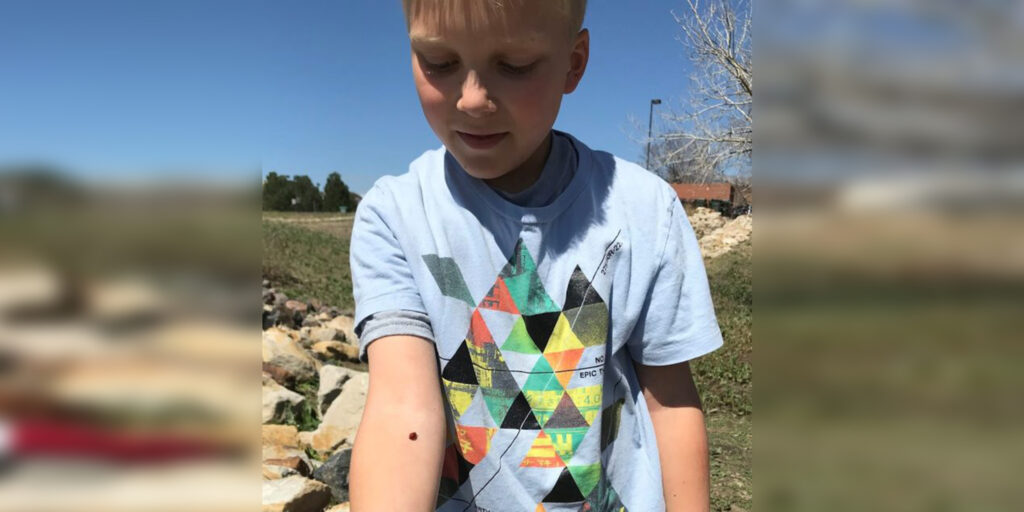
Look under that rock! It’s an earthworm! I wonder how they squirm like that… I wonder if I could wiggle like that! Let’s see how far we can wiggle like worms across the lawn!
Here at Butterfly Pavilion, we know that engaging children and families in outdoor nature play is vital to creating passion and inspiring nature conservation.
Over the past decade, focused research around nature play and time spent in nature has dramatically increased. We know that even here in Colorado, children (and adults) are spending more time indoors and on screens than ever before.
Did you know that on average, young children can identify over 1000 corporate logos but less than 25 plant species? (Armitage, 2007). How many do you know? Take the quiz from Next Nature at the bottom of this article to see how many you can get!
Collectively, scientific research shows that social, psychological, academic and physical health is positively impacted when they have daily contact with nature.
Just some of the many positive benefits of nature play include:
- Supports intellectual, emotional, social, and physical development
- Supports creativity and problem solving
- Improves academic performance
- Improves nutrition and physical health
- Reduces stress & symptoms of Attention Deficit Disorder
- Improves self-discipline
- Improves social relations
Children & Nature Network: CLICK HERE FOR THE FULL LIST
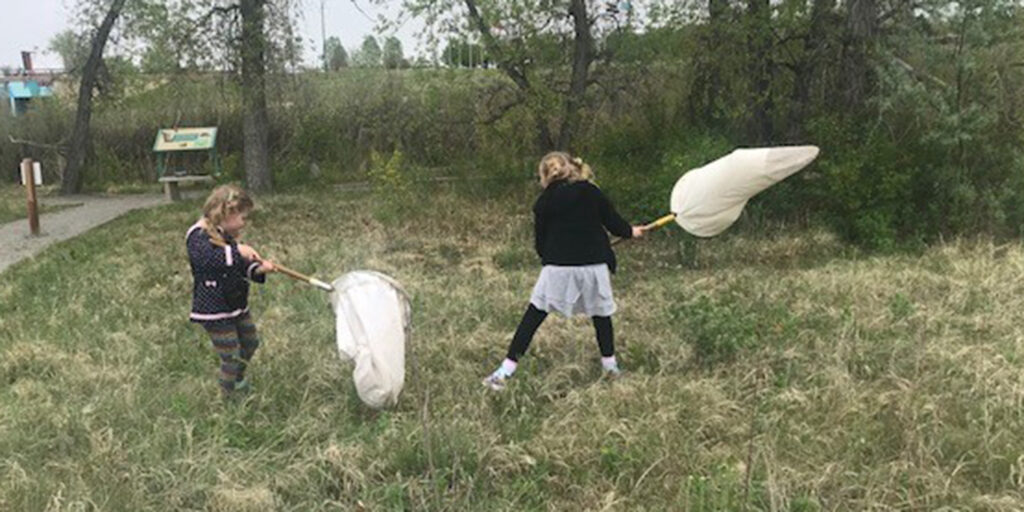
Additionally, research on intergenerational programming has found that the elderly, young adults and children surveyed in several programs reported increased feelings of well-being and life-satisfaction as a result of their involvement.
Since families are our key audience here at Butterfly Pavilion, we want to provide fun opportunities that meet YOUR needs! Plus – we’ve figured out the formula for the best family program. Want to know what it is?
Expert environmental educators + Amazing animals + Fantastic gardens and trails + Passionate participants = The Best Family Nature Experience Ever!
On Sunday, April 22 we held our first ever Party for the Planet Earth Day Family Cleanup! Participants ages 6 months through 75 years old came together to clean up litter in Big Dry Creek after a really windy week, and weed out Curly Dock from our open space. We replaced the weeds with native milkweed and ended with snacks, fun games and seed paper gifts made by Butterfly Pavilion volunteers! Thanks to Amy Yarger, Horticulture Director, for leading such an awesome family event.
In May, our Butterfly Pavilion Nature Nerds Family Club had a Bird and Bug Hike led by Zac Smith (Interpretation Lead) and Joe Barry (Horticulture) where we hiked to find the birds and bugs in our backyards and made solitary bee homes and backyard birdfeeders. In June we explored aquatic invertebrates in Big Dry Creek with Alex Gray! What a blast!
This summer, we have held Zoo Snooze overnight adventures for families, and held our first grandparent and grandkid intergenerational campthis summer!
Moral of our story? Get outside and mess around! Get dirty, get curious, and don’t be afraid to play (I’m looking at you, “adults”). Nature play is good for people of all ages and Butterfly Pavilion wants to help your family make their experience as fun, beneficial and connected as possible.
“My son LOVED his Zookeeper camp – especially having his own hissing cockroach to take care of for the week! He hasn’t stopped talking about it! So thanks to everyone there for running such an engaging program – the counselors were great!”
Sources Cited and Recommended Books/Articles to Check out!
Leafs and Logos Quiz: Take this quiz from Next Nature – how many can you get?
Armitage, K. C. (2007). “The Child Is Born a Naturalist”: Nature Study, Woodcraft Indians, and the Theory of Recapitulation. The Journal of the Gilded Age and Progressive Era, 6(1), 43-70.
Children and Nature Network (www. childrenandnature.org/research/), Annotated Bibliographies of Research and Studies, Volumes 1 and 2 (2007).
Recommended Reading: Richard Louv, Last Child in the Woods
Invertebrates do more than just survive, they thrive almost anywhere we think of life existing; outnumbering and outweighing us. Because of their massive presence throughout the world, invertebrate animals play a vital role in maintaining ecosystems and the overall health of our planet.

Considered to be the father of modern naturalist movement, E.O. Wilson is famously quoted that, “If all mankind were to disappear, the world would regenerate back to the rich state of equilibrium that existed ten thousand years ago. If insects were to vanish, the environment would collapse into chaos.”
While, not all invertebrates are insects, this beautifully stated observation showcases their importance. Spiders are estimated to consume 400–800 million tons of prey annually and have been found to be major factors in the creation and maintenance of a healthy agricultural system, keeping pests down and affectively preventing monumental crop loss. Many invertebrates act as cornerstone species, creating the environment necessary for certain ecosystems to exist. Sea stars are partly responsible for keeping ecosystems like kelp forests—which provide a large portion of the Earth’s oxygen—alive and act as home to many recognizable animals like sea otters, seals and sea lions, orcas, as well as countless fish. Numerous medications and medical technologies have been developed thanks to invertebrate animals. Horseshoe crab blood is utilized to check the purity and sterilization of medical instruments and treatments, and the venoms—considered by some to be a reason to fear invertebrate animals—from creatures such as the cone snail have given rise to non-opioid pain medications and heart drugs.
Despite these incredible facets of invertebrate life on Earth, most of these animals go underappreciated, at best; or even reviled and feared, at worst. Rarely do we explore the beautiful countryside of Colorado with intent to observe the smaller creatures that may buzz by us. Our pleasant summer evenings are seen as ruined by the presence of animals such as mosquitos or the sound of a cicada’s mating call. Studies have shown that people look at any animal considered a “bug” as creepy and disgusting; including insects, spiders, millipedes, centipedes, slugs, snails, pill bugs, and even worms. How many times have you heard tales about daddy long legs having supposedly dangerous, tiny fangs? How many of you have heard to protect your ears from an earwig? Who’s been told that tarantula over there could kill you? These are the kinds of stories that are told. However, here at Butterfly Pavilion we aim to tell the true, amazing stories of our world’s invertebrate animals. We believe in the messages these “bugs” can deliver.
To do this, our amazing team of volunteers and staff works tirelessly to bring you face to face with some of the most incredible creatures alive. Every day at Butterfly Pavilion we offer a wide range of programs that you are able to take part in. These range from live animal encounters, like our Butterfly Encounter, to learning about humans eating bugs through our Bug Bites program. During the coming spring and summer seasons we will be offering even more special programming that will take you, as our guests, outside to be right there with the invertebrate animals with which we share our backyards. You can have the opportunity to be a citizen scientist and help us conduct the Monarch Watch, a nationwide survey of Monarch Butterflies that is done every year to help monitor their numbers. You will be able to help us locate where on our grounds we are seeing these animals and learn how to find them in your own community.

To help emphasize the benefits of not using chemicals in our gardens we will be offering opportunities for you all to release live Ladybugs into our gardens. These voracious creatures are fantastic controllers of aphids, and feast happily on those little pests keeping a garden healthy without using chemicals that would harm other animals too. We will continue to showcase the incredible hunting techniques of various invertebrates with live feeding demonstrations of our Peacock mantis shrimp on Mondays and Thursdays and our Salmon pink tarantula on Tuesdays and Saturdays.
A large body of recent studies has shown how people—especially children—are spending less and less time outside. Since being in an outdoor environment can actually help increase a person’s skills in cooperation, independence, and risk taking, playing outside has been found to reduce symptoms of mental illness, mitigate most ADHD symptoms, and boost human immune systems. We are working hard to offer these benefits to all of you with what we do here at Butterfly Pavilion. Starting in June we will be offering special nature play activities and games outside in our gardens that will bring you out onto the grounds around the building to explore this lovely habitat.
Every day we hear our guests say things like “That’s amazing! I had no idea octopus were so smart!” and “I’m so glad I finally held the tarantula!” Come visit us at Butterfly Pavilion to experience a new story with our amazing animals.
Butterfly Pavilion, Pollinator Awareness through Conservation and Education, and Rice’s Honey
Butterfly Pavilion loves pollinators, and you should too!
Pollinators are animals that help feed the world. From the smallest fly to a large, lumbering bumble bee, pollinators are vital for food production and healthy and diverse ecosystems. By transferring pollen from flower to flower, pollinators initiate the reproductive process in plants, in agriculture and in the wild. This process gives us fruits, nuts, chocolate, coffee and even tequila! Almost one out of every three bites of food we eat is because of a pollinator. This vast importance led Butterfly Pavilion to create the Pollinator Awareness through Conservation and Education (PACE) Initiative.
The scary thing is, pollinators are in decline. From 2016-2017, beekeepers in the US have lost 33% of their colonies and native bees have not fared much better. One recent study analyzed the status of over 1,000 native bee species and found that over 50% were in decline and 25% are at risk of extinction. The cause for declines of both managed and native bee species can be summed up with the 4 Ps: parasites, pathogens, pesticides and poor nutrition. Butterfly Pavilion is aiming to curb these losses by taking a holistic approach to pollinator protection.
From local programs to work on a global scale, our work is focused around the study and monitoring of pollinators, pollinator habitat restoration, collaborative partnerships, sustainable business ventures via capacity building, and education. It is our duty to protect this vital group of animals now so they can continue to support successful ecosystems in the future.
Some local projects include: the Urban Prairies Project, which aims to restore our prairies to their original beauty to support native pollinators, Colorado Butterfly Monitoring Network, which trains citizen scientists around Colorado to identify native butterfly species to impact conservation decisions, and Beekeeping Bootcamp, which trains backyard beekeepers about the wonder of honey bees and how to keep them in a sustainable, environmentally friendly way. Global projects include work in Nepal with Honey Bee Fences, which provide a sustainable income via honey to farmers while keeping elephants out of their valuable crops. Elephants hate bees (who knew?)!
One innovative way Butterfly Pavilion is making all of this work happen is through a brand new partnership with Rice’s Honey. Rice’s Honey is a leading producer of high quality, U.S. only raw and unfiltered honey headquartered in Greeley Colorado, and has a mission to promote pollinators and sustainable bee farms across the country. To fulfill that mission, Rice’s Honey donates a portion of proceeds from every bottle of its Local Hive ™ honey sold to Butterfly Pavilion’s PACE initiative, which aims to promote and protect the prosperity of pollinators worldwide.
This partnership enables Butterfly Pavilion scientists and educators to have a local, regional, and global impact on pollinator declines. This work cannot be done alone, so it is vital to partner with like-minded organizations to protect these imperiled animals.
To purchase Local Hive by Rice’s Honey, please visit www.localhivehoney.com. To learn more about PACE, please visit www.pace4pollinators.org.

Helping save a beach one insect at a time
Butterfly Pavilion studies how the restoration of California’s coastal dunes could help conserve populations of invertebrates .
In the early 1900’s developers used a grass called European beach grass to help stabilize the ever-shifting sand dunes so they could build closer to the ocean. At the time, it seemed like a great idea. But soon the beach grass grew out of control and took over, blanketing the coast in a sea of invasive plants! It changed more than the landscape; it also impacted the animals that called these dunes home.
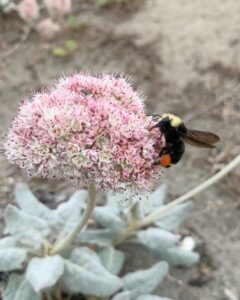
Over the years the Bureau of Land Management (BLM) made a decision to restore the dunes around Eureka, California. This required hundreds of volunteers removing millions of plants year after year in order to successfully return the dunes back to their naturally-diverse state. As the native plants have returned, so have the animals, including threatened and endangered species! As with many conservation projects, some members of the community have raised concerns about the impact of removing the grasses. Why would you get rid of the lush grass and replace it with scrubby native plants? The main answer: diversity! In order to make sure this restoration is truly having a positive impact on the environment, the BLM agreed to bring in a team of experts from Butterfly Pavilion to decide which was better: restored or unrestored dunes. The Butterfly Pavilion research team has made many trips to these dunes to collect and identify the number and diversity of invertebrates (like beetles, bees, spiders, and butterflies) living on the restored dunes. It is important to protect the diversity of invertebrates on the dunes so that many different species can perform their diverse roles, such as pollination and decomposition, which keep the ecosystem healthy. By comparing the populations of invertebrates between the restored and unrestored sites, we can inform BLM about the vegetation and management practices that will promote healthy invertebrate life on the dunes!