
Gardens on Spring Creek Butterfly House
Step into a vibrant world of color and beauty at the Gardens on Spring Creek Butterfly House, an enchanting extension of Butterfly Pavilion! Here, you will encounter a stunning array of native North American butterflies, including iconic monarchs, striking tiger swallowtails, delicate painted ladies, zebra longwings, bold red admirals, and more! Since its grand opening in November 2019, this 1,700-square-foot sanctuary has been a collaborative gem, created by Butterfly Pavilion, the Gardens on Spring Creek, and the City of Fort Collins. Open year-round, the butterfly house invites you to immerse yourself in a breathtaking experience where you can observe and identify butterflies and moths that flutter in your own backyard. Come explore and be inspired by the wonders of nature!
At the Gardens on Spring Creek Butterfly House, you can explore:
- 400–600 free-flying butterflies and moths, including monarchs, longwings, swallowtails, and more.
- A chrysalis window where you can watch butterflies emerge from their chrysalises.
- Adult moth displays with separate enclosures for males and females due to their high egg-laying capacity.
- Caterpillar displays that highlight the complete life cycle of these fascinating creatures.
- A 220-square-foot living wall, featuring 2,200 annuals, ferns, and foliage plants that provide roosting space for butterflies and moths.
- More than 100 varieties of tropical plants, specifically curated to support pollinators.
- Hanging sponge balls and cups soaked in sugar water, as well as decaying fruit, to provide extra nutrition for butterflies.
- Interpretation and education programs led by knowledgeable staff and volunteers.
The Gardens on Spring Creek Butterfly House staff also actively participate in community science initiatives like the Colorado Butterfly Monitoring Network, Monarch Watch, and the Monarch Larva Monitoring Project. The data collected through these programs helps scientists better understand the health of local ecosystems by tracking butterfly populations and activity.
Founded in 2004, the Gardens on Spring Creek has become a beloved destination for school groups, retirement communities, families, and students in the Fort Collins area. The Butterfly House fosters a deeper appreciation for invertebrates and the habitats they depend on, offering guests an up-close experience with native butterflies and moths. Unlike Butterfly Pavilion, which features tropical species of butterflies, the Gardens focus on North American natives, providing a burst of summer during Colorado’s winter months. In the summer of 2024, the staff successfully hand-reared three species of silk moth caterpillars (Polyphemus, Promethea, and Luna) to engage and educate visitors about the wonders of moths. Visit the Gardens on Spring Creek Butterfly House at 2145 Centre Avenue, Fort Collins, Colorado, or learn more at www.fcgov.com/gardens.
Butterfly Pavilion to reopen June 12 to members and June 13 to the general public. New experience features timed, small group tours that provide exclusive access to experts and animals, while meeting health and safety protocols set by the State of Colorado and Jefferson County Public Health. Timed entry tickets for members and guests are available online only at butterflies.local.
Media Note: Photos, video and other editorial material is available by request. Rosie the Tarantula, additional animals and scientific experts are available for media appearances and interviews by contacting rpecoraro@butterflies.org.
Westminster, Colo – June, 9, 2020 – Butterfly Pavilion is set to reopen its exhibits to current members on Friday, June 12, and the general public on Saturday, June 13, with a brand new experience using timed, small group tours that maintains social distance and sanitation, while offering exclusive access to live animals, invertebrate experts and the inspiration that comes from exploring the diversity of the invertebrate world.
Operating hours will be from 9 am to 5:30 pm. Members and guests are required to reserve tickets online at butterflies.local prior to arrival and get in line in front of the building at their scheduled entry time. Time slots will be released online on a bi-weekly basis to ensure flexibility should state and municipal health and safety regulations change. Following check-in, guests will be led on an exhibit tour by trained Butterfly Pavilion staff.
General admission will be $13 for adults, $11 for seniors (65+), $9 for children (ages 2 – 12) and free for children under age 2. Members will continue to receive free admission.
Explorer Pass holders will continue to receive $2 admission per person for up to 10 people. Guests may also continue to use free passes for general admission. In either of these two circumstances, call 303-469-9201 to reserve tickets.
In addition to timed entry, Butterfly Pavilion is taking measures to ensure guest and staff safety that meet requirements set by the State of Colorado and Jefferson County Public Health. All guests and staff will be required to wear a mask covering the mouth and nose in the facility. Masks will also be available for purchase for $5 each at the front desk. Staff will conduct frequent hand washing, use alcohol-based sanitizer and wear gloves when necessary. All facility areas will be sanitized hourly throughout the day.
Guests will not be able to hold Rosie the tarantula, but she will be on exhibit for viewing, and the Colorado Backyard indoor play area will be closed until further notice. However, guests will have the opportunity to explore Crawl-A-See-Em presents Survival, Water’s Edge, the Wings of the Tropics butterfly house, the gift shop and the outdoor gardens and nature trails.
“We can’t thank the community enough for their outpouring of support during the time of closure. We’re incredibly excited to reopen our doors and reconnect our guests with the invertebrate discovery and educational engagement that they’ve been missing,” said Patrick Tennyson, President and CEO at Butterfly Pavilion.
Visit butterflies.local and follow Butterfly Pavilion on Facebook and Instagram for the most up to date information on operations and upcoming events and programs.
Virtual Learning Opportunities
For guests who are not quite ready to visit Butterfly Pavilion in person, the organization will continue to offer virtual education programs that may be enjoyed from the comfort of home for only $3 per computer connection. Information on upcoming programs is available at butterflies.local/virtuallearning.
Emergency Fund for Animal Care and Employee Assistance
For those who are able and would like to support Butterfly Pavilion during this difficult time, consider donating to the organization’s emergency fund supporting the thousands of animals that call Butterfly Pavilion home, as well as the staff that cares for them, at butterflies.local/emergencyfund.
About Butterfly Pavilion:
Butterfly Pavilion is the world’s only stand-alone, Association of Zoos and Aquariums-accredited invertebrate zoo dedicated to transforming the way people think about the small but mighty animals that are the hidden heroes of the animal kingdom. As the leader in invertebrate knowledge, inspiration and connection, and as a member institution of the Scientific and Cultural Facilities District, Butterfly Pavilion works to foster an appreciation of these critical animals by educating the public about the need to protect and care for threatened habitats globally, while conducting research for solutions in invertebrate conservation. Whether it is providing unique, hands-on learning experiences in our exhibits and educational programs, conducting new research that sets the standard for zoos across the country or building innovative solutions for species and habitat conservation in countries around the world, Butterfly Pavilion is leading the way in ensuring invertebrates are protected for the future. Learn more at butterflies.local.
Butterfly Pavilion Media Contact:
Russ Pecoraro, Vice President of Marketing and Communications, rpecoraro@butterflies.org or 720-375-9984.
Every spring, people along the Front Range start seeing small gray and brown moths just about everywhere. These little moths have a knack for getting into houses and buildings and can be seen in massive numbers on the roads, under overpasses, and in pretty much any yard or neighborhood from Pueblo to Fort Collins (and beyond!). We call these abundant insects miller moths, but they are also known as Euxoa auxiliaris or the army cutworm in their larval phase. These moths migrate yearly and almost always leave us with many questions, especially when they are swarming around lights and TVs inside our homes. Why are there so many? Why do they appear so suddenly? And most importantly, why are they so good at getting into our houses?
For some people, the miller moths are annual unwelcome guests, but these moths are essential for our native ecosystems. This abundance of moths is a yearly feast for our local birds and reptiles, providing a much-needed meal at the time it is most needed – spring nesting time. Like many other annual invertebrate guests, miller moths are an incredibly important and reliable food source for adult and baby birds, and the large number of moths we will be seeing through June and July is ensuring that the local swallows and many other insectivorous birds are getting the nutrients they and their newborn offspring need!
2020 is already seeing an influx of miller moths, far more than have been seen in the last four years, according to CSU Entomologists Whitney Cranshaw and Frank Peair. The reason for this is the relatively dry winter and early spring conditions. Miller moths are migratory – the moths we are seeing now were born in the fields of eastern Colorado and even further east into Kansas and Nebraska. While we face the yearly influx of moths, the farmers to our east expect a yearly influx of army cutworms that can decimate crops, eating a huge variety of herbivorous plants as caterpillars. Once the caterpillars pupate and the moths emerge, the moths follow the nectar sources east, pollinating flowers all along their route. They will spend the summer feeding in the mountains before returning to the plains in the fall to lay the next generation of eggs.
Miller moths are also observed clustering in an around buildings in certain years. The low amount of rainfall over the winter paired with a late freeze resulted in fewer wild flowers, encouraging moths to seek food around homes and gardens where the nectar resources are more abundant. If there are moths in your house, that means the flowers around you are getting pollinated and your local birds are feasting, so say hello to our summertime guests (and perhaps enjoy the extra enrichment your cats and dogs get by chasing them)!
We’re proud to announce that last week, Mongolian President Khaltmaagiin Battulga issued a decree awarding Butterfly Pavilion’s own Richard P. Reading, Ph.D., the high state decoration of Mongolia, the Order of the Polar Star, in recognition of his significant contributions to wildlife conservation, leadership, strengthening bilateral cooperation, and building the capacity of the next generation of Mongolian conservationists over the last 26 years.
 The Order of the Polar Star is the highest honor Mongolia can bestow upon a foreign citizen. Past recipients have included former U.S. President Barack Obama and the former U.S. Ambassador to Mongolia, Alphonso La Port.
Dr. Reading began working in 1994 as a consultant for the United Nations and has worked throughout the country on a wide range of species, from butterflies to wild Bactrian camels. Much of Rich’s work from 2000 to 2017 focused on conservation of Ikh Nart Nature Reserve Sitting on the northern edge of the Gobi Desert in Mongolia, Ikh Nart Nature Reserve was established to protect a fascinating area of rocky outcrops and a globally important population of argali sheep. Yet, the 160,000 acres of Ikh Nart protects much more. Because the reserve lies within the transition between steppe and desert habitats, it contains a relatively high diversity of plants and animals, including one of the last great temperate grassland systems in the world.
 The preservation of grasslands is essential for many reasons, including:
-
They provide an important ecosystem service as a carbon sink, taking carbon out of the air and storing it below the ground.
-
They are a genetic repository for many of the crops we depend on for food, such as wheat. When our crops suffer from diseases, scientists can go back to the source (grasslands) for answers on how to battle them.
-
Understanding how grasslands work is key to the management of ranches in the U.S., which helps ensure a reliable source of meat production.
Despite its importance, Ikh Nart remained no more than a “paper park” (one that existed only on paper, without any management) following its creation in 1996 due to resource constraints and lack of capacity. In 2000, Dr. Reading and a team of conservationists began work to transform Ikh Nart into a well-managed protected area that could serve as a model for other nature reserves and parks in Mongolia and elsewhere.

The team’s efforts resulted in several successes, including a significant decrease in threats such as poaching, illegal mining and over-grazing; effectively doubling the size of the protected area; establishing a zone that eliminated most livestock grazing; increased wildlife populations and expansion in their ranges; developed a steady stream of well-trained professionals, including rangers, park managers, researchers, and students to manage the park; and created strong support for the local economy, including the creation of women’s cooperatives and tourism to enhance livelihoods.
Currently, Dr. Reading and Butterfly Pavilion focus on conducting research on the ecology and population dynamics of several threatened species of native Mongolian Parnassius butterflies as a basis for developing a conservation program for these species working in close cooperation with Mongolian colleagues and graduate students from the Mongolian Academy of Sciences and Mongolia National University. He also led the effort to conduct a two-year assessment of invertebrate biodiversity in the Ikh Nart Nature Reserve, providing a sample of the collection to the reserve for their use and house the rest of the collection with the Mongolian Academy of Sciences. He is now working to write a guidebook for the most common invertebrate species of the reserve.


Congratulations, Dr. Reading, for this amazing recognition of your important, world-changing work!
If you would like to make a tax-deductible gift to support Dr. Reading and Butterfly Pavilion’s research and conservation efforts around the world, click here.
Programs you would help support include Dr. Richard Reading’s work toward the conservation of the Parnassius butterfly in Mongolia, especially population monitoring, habitat assessment and host plant identification, as well as the development of a butterfly farm in Sumatra, Indonesia, Butterfly Pavilion’s work on the Florida Reef Tract Rescue Project, and multiple breeding and monitoring programs.
About Butterfly Pavilion:
Butterfly Pavilion is the world’s only stand-alone, Association of Zoos and Aquariums-accredited invertebrate zoo dedicated to transforming the way people think about the small but mighty animals that are the hidden heroes of the animal kingdom. As the leader in invertebrate knowledge, inspiration and connection, and as a member institution of the Scientific and Cultural Facilities District, Butterfly Pavilion works to foster an appreciation of these critical animals by educating the public about the need to protect and care for threatened habitats globally, while conducting research for solutions in invertebrate conservation. Whether it is providing unique, hands-on learning experiences in our exhibits and educational programs, conducting new research that sets the standard for zoos across the country or building innovative solutions for species and habitat conservation in countries around the world, Butterfly Pavilion is leading the way in ensuring invertebrates are protected for the future. Learn more at butterflies.local.
PLEASE NOTE: World Spider Day on March 14, 2020 has been cancelled due the facility’s temporary closure. Read more >>
By Leanne Deschenes, Registration and Communication Coordinator
What is your favorite day of the year? Mine is March 14th. Falling about a week before the spring equinox, it marks a time when the days get longer and the ice in Big Dry Creek behind Butterfly Pavilion starts to melt. There are signs of spring and remnants of winter, two very special seasons here in Colorado. The reason I am most excited for this day, however, is because it is World Spider Day! This year, Butterfly Pavilion is going all-out to celebrate.
Spiders are extraordinary creatures that help humans tremendously, making it no surprise to arachnid-enthusiasts that they’ve earned their own holiday. Some spiders prey on insects that are considered pests and are used by farmers in place of pesticides. Spiders are also excellent bio-indicators, meaning that fluctuations in their populations can tell us about the health of the environments they inhabit. Some species’ venom is used to make medicine for heart disease, muscular dystrophy and chronic pain, and their silk is being studied for use in medical sutures. Spiders are as diverse as they are helpful, with over 40,000 different species in the world!
To get ready for World Spider Day, and to learn more about what makes them unique, I decided to observe some of Butterfly Pavilion’s resident arachnids in the Colorado Backyard exhibit. Here’s what I discovered:
Colorado tarantula
The brown-and-tan Colorado tarantula found in Colorado Backyard is a calm, patient critter. Its habitat provides lots of burrows for hiding, but today the tarantula was in clear view. It remained still as children watched from the viewing dome, casting shadows over the animal’s photoreceptors. If only I could stay as still while sitting at my desk!
Cellar Spider
The Cellar spider looks remarkably different from the Colorado tarantula. given its smooth, spindly legs and translucent, tan body. It is no wonder that these long-legged arachnids can be mistaken for harvestmen, or daddy long-legs, which look similar, but are in a different order, than spiders. As I observed the animal in its dimly lit habitat, I could understand why the Cellar spider is named for its fondness of small, dark corners. If I see one in my basement I’ll leave it be, and thank it for eating those pesky fruit flies!
Jumping Spider
The jumping spiders featured in Colorado Backyard are my favorite. With big, round photoreceptors that resemble googly-eyes and a tiny, fuzzy body, the jumping spider looks like a miniature version of your favorite childhood stuffed animal. Although this cutie was stationary while I observed it, I knew that it could dash away with its hyper-fast hop if it wanted to. If I’m lucky enough to find one in my home, I’ll bring this outdoor-loving arachnid into my garden.
While these are just a few of the spiders found at Butterfly Pavilion, they are also many more that share our great state of Colorado with us. This close proximity means they’re also the spiders easiest for me to conserve! If you encounter a local spider, I encourage you to react with fascination rather than fright (even if it feels a little scary). World Spider Day at Butterfly Pavilion is a great opportunity to get started!
Whether you’re a lifelong spider-saver or new to saying “no” to squishing specimens, there are plenty of opportunities to learn more about arachnids at Butterfly Pavilion. According to Brittany Oram, Camp Lead and Exhibit Interpreter, “World Spider Day at Butterfly Pavilion is a chance for guests of all ages to learn about our eight-legged friends. Through animal encounters, zookeeper talks, scavenger hunts and games, guests will come to appreciate the many things all arachnids do in their daily lives.” Brittany and the Butterfly Pavilion team invite you in on Saturday, March 14 to join the fun. You might even end up with a new favorite holiday!
For more information on World Spider Day at Butterfly Pavilion, click here to learn more! This experience is included with General Admission and free for current Butterfly Pavilion members.
-
Pollinator District is a first-of-its-kind initiative, linking natural resources, city and county government agencies, real estate development and non-profit conservation organizations
-
Baseline, a new community in Broomfield, Colo., will be the world’s first Pollinator District
Westminster, Colo. – June 20, 2019 – Pollinators such as honey bees, native bees and butterflies are vital to the human production of food and the reproduction of native plants. Over the past few decades habitat destruction, chemical pollution, parasites and pathogens have significantly decreased their numbers. In response to these challenges, Colorado’s Butterfly Pavilion announced today that it is creating Pollinator Districts, communities designed to conserve and improve habitat for pollinators in all aspects of development and operation. Pollinator Districts engage all the people that live, work and play in these spaces, encouraging them to experience nature and build a greater appreciation for these critical species and their habitats.
“Protecting pollinators helps achieve multiple conservation goals: encouraging the protection of public green spaces, highlighting urban and rural interdependence, promoting the use of native plants in residential landscaping, and advancing environmental education at schools, communities and with the general public,” said Patrick Tennyson, president and CEO of Butterfly Pavilion. “Butterfly Pavilion is uniquely positioned to leverage our expertise on pollinators to change the way people think about our communities and how we can protect these incredibly important creatures!”
The first community set to become a Pollinator District is Baseline, a new mixed-use community at the junction of I-25, 470 and Baseline Road in Broomfield, Colo. McWHINNEY, a Colorado-based development and investment firm is designing Baseline to also include a dining district, a center for businesses, a science campus, and a new standard for residential living.
“We see the Pollinator District creating a healthy, vibrant community where residents want to spend their free time, are deeply invested and therefore more willing to contribute to it,” said Kyle Harris, general manager of the Baseline development for McWHINNEY. “This is a completely new approach to real estate development in Colorado.”
In the Pollinator District, enhancements are integrated into engineered green spaces such as rain gardens, bio-swales, green roofs, public common areas and residential development. Elements of Pollinator District include:
- Research – Establishing a baseline of pollinator diversity and understanding challenges in the area of interest.
- Habitat restoration – Restoring open spaces with native shrubs and wildflowers to provide nutrition for pollinators.
- Habitat gardening – Building gardens that more closely resemble natural habitat, including a variety of native flowering plants and shrubs, open ground and a passive water source.
- Beekeeping – Providing aspiring beekeepers in the community with training on how to keep bees through sustainable techniques.
- Public education and engagement – Educating diverse audiences on pollinator conservation topics through volunteer opportunities, workshops, classes, public events and more.
- Sustainability – Prioritizing sustainable design, construction and maintenance practices that conserve water and soil and preserve native plant communities whenever possible.
Flower-rich pollinator landscapes support greater biodiversity, supporting not only pollinators, but other beneficial insects, birds and small mammals. “After development we’ll actually see more biodiversity,” Tennyson said. “It usually doesn’t work that way!”
Establishing the Pollinator District is a key step on Butterfly Pavilion’s journey to creating the Center for Invertebrate Research and Conservation (CIRC). In 2017, Butterfly Pavilion announced its plans for a new $45 million state-of-the-art facility located in Broomfield, Colorado for this new research center. CIRC will be an 81,000-square-foot, world-class research lab with an accredited zoological facility to serve as the preeminent local, national and global hub for invertebrate knowledge, conservation, inspiration and connection.
Pollinator Districts are part of Butterfly Pavilion’s PACE initiative, a global effort to increase awareness of pollinators and promote habitat and species conservation and restoration. PACE is made possible through a partnership with Local Hive by Rice’s Honey, a leading producer of high quality, U.S. only raw and unfiltered honey, headquartered in Greeley, Colorado. A portion of proceeds from every bottle of Local Hive by Rice’s Honey sold is donated to PACE to protect pollinators worldwide.
Learn more about Butterfly Pavilion’s permanent exhibits, important education, research and conservation work at www.butterflies.local or by calling 303-469-5441. Butterfly Pavilion is open 9 a.m. to 5 p.m. daily at 6252 West 104th Avenue in Westminster, Colo.
About Butterfly Pavilion:
Butterfly Pavilion is the world’s only stand-alone, Association of Zoos and Aquariums-accredited invertebrate zoo dedicated to transforming the way people think about the small but mighty animals that are the hidden heroes of the animal kingdom. As the leader in invertebrate knowledge, inspiration and connection, and as a member institution of the Scientific and Cultural Facilities District, Butterfly Pavilion works to foster an appreciation of these critical animals by educating the public about the need to protect and care for threatened habitats globally, while conducting research for solutions in invertebrate conservation. Whether it is providing unique, hands-on learning experiences in our exhibits and educational programs, conducting new research that sets the standard for zoos across the country or building innovative solutions for species and habitat conservation in countries around the world, Butterfly Pavilion is leading the way in ensuring invertebrates are protected for the future. Learn more at butterflies.local.
Butterfly Pavilion Media Contacts:
Kristen Petitt Stewart, kstewart@butterflies.org or 970-389-1561
Russ Pecoraro, Vice President of Marketing and Communications, rpecoraro@butterflies.org or 720-375-9984
An outdoor movie, nature walks, crafts, giveaways and more, in honor of pollinators.
- Outdoor Movie Night will take place outside on the front lawn of the invertebrate zoo in Westminster on June 21.
- Rice’s Honey® is a proud sponsor of the Butterfly Pavilion and its global PACE initiative to increase awareness of the importance of pollinators.
- Butterflies at Chatfield Farms opens tomorrow!
Media note: Photos, video and other editorial material is available by request. Rosie the Tarantula, other invertebrates and scientific experts are available for media appearances and interviews. Contact kstewart@butterflies.org
Westminster, CO – May 24, 2019– Colorado’s Butterfly Pavilion, the world’s only stand-alone Association of Zoos and Aquariums-accredited invertebrate zoo, is rolling out the red carpet to celebrate National Pollinator Week with a FREE outdoor movie night featuring Bee Movie, June 21, 2019, presented by Rice’s Honey. The 2007 Golden Globe-nominated CGI-animated film was created by Jerry Seinfeld, and stars Jerry Seinfeld, Renée Zellweger, Matthew Broderick, John Goodman, Patrick Warburton, and Chris Rock.
National Pollinator Week is a time to celebrate pollinators and spread the word about the critical role they play in our ecosystem, as well as address the urgent issue of declining pollinator populations.
“At the Butterfly Pavilion, we will observe this week in our signature style – by combining science, education and fun for the entire family,” said Butterfly Pavilion President and CEO, Patrick Tennyson. “It is also a perfect time to raise awareness about our PACE program and the crucial research done at Butterfly Pavilion to protect invertebrate pollinators.”
Pollinator Awareness through Conservation and Education (PACE) is Butterfly Pavilion’s global initiative to increase awareness of pollinators and promote habitat and species conservation and restoration. Through a combination of conservation and education programs, PACE works to create a better world for pollinators, making a better world for all of us. https://www.butterflies.local/
“Rice’s Honey® has always been committed to providing natural, delicious, U.S. only raw & unfiltered honey, while also supporting local American beekeepers and promoting the importance of pollinators,” noted Tony Landretti, Chief Executive Officer of Rice’s Honey®. “We believe our continued commitment to Butterfly Pavilion by supporting PACE and other fun, family events like this is an important way to champion pollinators now and for generations to come.”
Before Bee Movie takes center stage, kids and adults of all ages can enjoy a fun evening of arts and crafts, guided nature walks, a ladybug release, special give-a-ways and more. Local food trucks iPIE and Ba-Nom-a-Nom Nice Cream will be on site with food and dessert for purchase. Doors open at 6:00 p.m., and activities begin at 6:30 p.m. Bee Movie begins at sundown. While the outdoor movie night is free, limited space means tickets are required. They are available starting June 1, 2019 at butterflies.local
Butterflies at Chatfield Farms opens Saturday
Memorial Day Weekend is the perfect time to visit the Butterflies at Chatfield Farms, which opens to the public on Saturday. This seasonal habitat at Denver Botanic Gardens Chatfield Farms is home to hundreds of native Colorado butterflies such as swallowtails, monarchs, mourning cloaks and painted ladies. Butterflies at Chatfield is a partnership between Denver Botanic Gardens and Butterfly Pavilion. The habitat is open daily through Labor Day. Learn more at butterflies.local under the “exhibits” tab.
Now Open – Colorado Backyard
Butterfly Pavilion’s newest interactive exhibit connects guests to the rich and diverse life that surrounds us in the Centennial State, with a goal of inspiring greater commitment to conserve our natural treasures in Colorado and beyond. Colorado Backyard features live animals, indoor play structures, an immersive exploration station, a rotating exhibit area and invertebrate photography by talented individuals from the community. The exhibit also hopes to equip visitors to take small, but impactful, actions every day that can ensure these hidden heroes are protected for the future. Colorado Backyard is included in general admission.
Summer Events
Summer at Butterfly Pavilion comes alive with pollinators and pollinator events. This summer’s events include Nature Nerds Family Club workshops (starting June 1), the Zoo Snooze Overnight Adventure (June 28) and much more. Learn more at butterflies.local/Events
Butterfly Pavilion is open 9:00 a.m. to 5:00 p.m. daily at 6252 West 104th Avenue in Westminster. Learn more about Butterfly Pavilion on Facebook or by visiting butterflies.local.
# # #
About Butterfly Pavilion:
Butterfly Pavilion is the world’s only stand-alone, Association of Zoos and Aquariums-accredited invertebrate zoo dedicated to transforming the way people think about the small but mighty animals that are the hidden heroes of the animal kingdom. As the leader in invertebrate knowledge, inspiration and connection, and as a member institution of the Scientific and Cultural Facilities District, Butterfly Pavilion works to foster an appreciation of these critical animals by educating the public about the need to protect and care for threatened habitats globally, while conducting research for solutions in invertebrate conservation. Whether it is providing unique, hands-on learning experiences in our exhibits and educational programs, conducting new research that sets the standard for zoos across the country or building innovative solutions for species and habitat conservation in countries around the world, Butterfly Pavilion is leading the way in ensuring invertebrates are protected for the future. Learn more at butterflies.local.
About Rice’s Honey®:
L.R. Rice founded Rice’s Honey®, headquartered in Greeley, Colorado, in 1924. The company remains committed to its founder’s mission of being the leading producer of high quality, raw & unfiltered honey sourced exclusively from local beekeepers throughout the US. The Rice’s Honey®, brand, Local Hive™, can be found across grocery retailers nationwide, and features 16 varietals of local, American, raw & unfiltered honey that are exclusively sourced in the US. For a full list of products, and locations visit: https://localhivehoney.com/find-a-store
The Rice’s Honey® partnership with PACE, the Butterfly Pavilion’s global initiative to increase awareness of pollinators through public engagement, education and restoration/conservation programs will help inform consumers about the importance of pollination. One of every three bites of food eaten worldwide depends on pollinators. Without them, there would be no fruits, nuts, vegetables, oils or most flowers and they contribute more than $24 billion to the United States economy.
Butterfly Pavilion Media Contacts:
Kristen Petitt Stewart, kstewart@butterflies.org or 970-389-1561
Russ Pecoraro, Vice President of Marketing and Communications, rpecoraro@butterflies.org or 720.375.9984
By Diane Metzger, Brand Manager at Butterfly Pavilion
A visit to Butterfly Pavilion is known to transport guests around the world, offering a stroll through a real rainforest filled with stunning tropical plants and free-flying butterflies, a peek underwater at aquatic animals found in the depths of oceans, a glimpse into the lives of desert-dwelling terrestrial species equipped for the harshest of conditions, and so much more. But one of the amazing things about invertebrates is that you don’t need to look to animals from distant lands to be awestruck by their incredible abilities and essential contributions to ecosystems. In fact, there’s an incredible diversity of invertebrate animals right below your feet and outside your door just waiting to be discovered.
Our newest interactive exhibit – Colorado Backyard – is opening March 23 and will connect guests to the rich and diverse life that surrounds us right here in the Centennial State, with a goal of inspiring greater commitment to conserve our natural treasures in Colorado and beyond. The exhibit will feature live animals, indoor play structures, a virtual reality experience, a rotating exhibit area and invertebrate photography by talented individuals from the community.
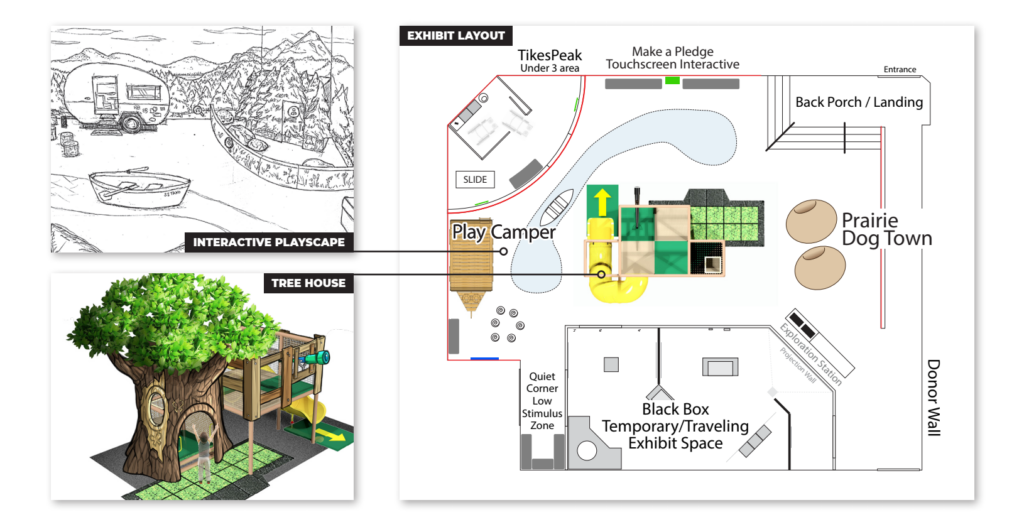
The exhibit was inspired by feedback we received from our members and guests who expressed a deep interest in learning more about the animals and ecosystems right in our backyard. This insight came as no surprise, as us Coloradans – especially those who frequent Butterfly Pavilion – are known for caring deeply about our natural landscapes! We couldn’t be more grateful to be part of this fantastic community.
Our educators and scientists at Butterfly Pavilion were incredibly excited to tap into their expertise and gather the stories of some of the most unique invertebrates that inhabit Colorado, in mountain, wetland, desert, prairie and urban ecosystems. And yes, Colorado has them all! Bumblebees living at over 12,000 feet, beetles that are skilled swimmers, wasps with the ability to paralyze tarantulas, spiders that catch pests behind-the-scenes in our homes – there is so much to discover.
If you’re looking for a sneak peek of the types of stories we’ll uncover, click here for an inside look at the life of our state insect, the Colorado hairstreak butterfly, as told by our Lepidopterist, Kathryn Hokamp.
After experiencing Colorado Backyard, our hope is that when you play in your backyard, trek through the mountains, ski or snowboard through fresh powder, enjoy produce from the farmer’s market, or even do something as seemingly mundane as heading down to your basement to grab an item out of storage, you’ll take a second to think about the little animals that are making a big, and positive, impact on the spaces we need and enjoy daily. We also plan to make sure you’re well-equipped to take small, but impactful, actions every day that can ensure these hidden heroes are protected for the future.
See the full exhibit layout at butterflies.local/exhibit/coloradobackyard. Stay updated on the exhibit construction and all the other exciting happenings going on at Butterfly Pavilion by following us on Facebook and by visiting our website – butterflies.local.
Our countdown begins! We look forward to seeing you on March 23 for the grand opening of Colorado Backyard.
Butterfly Pavilion experts encourage simple actions to protect invertebrates and their habitats
Media note: Photos, video and other editorial material is available by request. Rosie the Tarantula, other invertebrates and scientific experts are available for media appearances and interviews. Contact kstewart@butterflies.org
Westminster, Colo. – Feb. 20, 2019 – Nearly 40 percent of all insects, the hidden heroes of the animal kingdom, are vulnerable to extinction, according to a new study published in the journal Biological Conservation and making headlines around the world.
“People are asking us if this is cause for alarm,” said Patrick Tennyson, president and CEO of Colorado’s Butterfly Pavilion, the world’s only stand-alone, Association of Zoos and Aquariums (AZA)-accredited invertebrate zoo. “The answer is complex – kind of like insects themselves.”
As one of the few institutions focused solely on the state of invertebrates (animals without backbones) Butterfly Pavilion experts say more study is needed on this topic and needs to be done soon to truly answer this question.
“In addition to more research, acting on behalf of insects with a sense of urgency will make a critical difference in the outcome of this story,” said Mary Ann Colley, Butterfly Pavilion’s vice president of Science and Conservation.
Butterfly Pavilion is leading the way in ensuring invertebrates are protected for the future by providing unique, hands-on learning experiences in its exhibits and educational programs, conducting new research that sets the standard for zoos across the country, or building innovative solutions for species and habitat conservation in countries around the world.
“The challenges facing insects have never been greater, but Butterfly Pavilion is working hard to conserve these vitally important members of our environment and restore the balance to nature. There are many things people can do to help us in this work locally, regionally, and globally,” said Richard P. Reading, Ph.D., Butterfly Pavilion’s director of Research and Conservation, who is known for his work on grassland ecosystems in six continents, and has authored or edited eight books, more than 175 scientific papers and book chapters, and dozens of popular articles.
“We look forward to an ever-expanding role in reversing these severe declines in insect populations, working hand in hand with our people everywhere,” he added.
Butterfly Pavilion’s role is already far-reaching with a list of research and conservation projects in the U.S. that includes: Butterfly monitoring, dragonfly and firefly conservation, restoring pollinator habitat, consulting with the Bureau of Land Management on the restoration of coastal dunes, and leading the AZA’s effort to sustain invertebrate species for collections throughout North America.
Butterfly Pavilion also travels the globe to better understand and ultimately help invertebrates. Butterfly Pavilion researchers are working in Mongolia to study native butterflies and their ecology to create a conservation plan for the butterflies and all invertebrates. They are helping mitigate the conflict between humans and elephants in Nepal and Tanzania by installing bee fences to keep elephants from raiding local crops and food stores. And they are working throughout Saudi Arabia to help establish new protected areas and improve the management of existing protected areas in the country. For a full list of projects, visit Butterfly Pavilion’s blog.
Concerned citizens don’t need to a Ph.D. or passport to make a difference. Invertebrate conservation is something people from all walks of life can have an impact on.
“Invertebrate conservation is as simple as practicing clean gardening, recycling or composting,” said Colley. “If you want to take the next step, plant native plants, volunteer to restore pollinator habitat, or join institutions like Butterfly Pavilion and learn more.”
“Butterfly Pavilion will continue to drive conservation efforts and shape the perceptions of future generations of scientists, ecologists, educators and decision makers,” said Tennyson. “Just like the animals we study, Butterfly Pavilion is small but still has an important impact on the world.”
Butterfly Pavilion is open 9am to 5pm daily at 6252 West 104th Avenue in Westminster, Colo. Visit the website at www.butterflies.local.
About Butterfly Pavilion:
Butterfly Pavilion is the world’s only stand-alone, Association of Zoos and Aquariums-accredited invertebrate zoo dedicated to transforming the way people think about the small but mighty animals that are the hidden heroes of the animal kingdom. As the leader in invertebrate knowledge, inspiration and connection, and as a member institution of the Scientific and Cultural Facilities District, Butterfly Pavilion works to foster an appreciation of these critical animals by educating the public about the need to protect and care for threatened habitats globally, while conducting research for solutions in invertebrate conservation. Whether it is providing unique, hands-on learning experiences in our exhibits and educational programs, conducting new research that sets the standard for zoos across the country or building innovative solutions for species and habitat conservation in countries around the world, Butterfly Pavilion is leading the way in ensuring invertebrates are protected for the future. Learn more at butterflies.local.
# # #
Butterfly Pavilion Media Contact(s):
Kristen Petitt Stewart, kstewart@butterflies.org or 970-389-1561
Russ Pecoraro, Vice President of Marketing and Communications, rpecoraro@butterflies.org or 720.375.9984
Discover spineless wonders this holiday season.
Dec. 1-31, 2018, enjoy special animal showcase and wear your favorite holiday sweater to get $2 off admission. December is the perfect time to enjoy a trip to the Tropics!
Media note: Photos, video and other editorial material is available by request. Rosie the Tarantula, other invertebrates and scientific experts are available for media appearances and interviews. Contact kstewart@butterflies.org
Westminster, Colo. – November 27, 2018 – “♫On the first day of invertebrates at the BP, I held Rosie.♫” Wait, an invertebrate for the holidays? That’s exactly what guests will find during the 12 Days of Invertebrates showcase at Colorado’s Butterfly Pavilion, Dec. 1-31, 2018. The holiday-themed exhibit also includes 12 butterflies flitting, 11 bees buzzing, 10 stick insects hiding, 9 sun beetles pooping, and the list goes on in the spirit of the classic holiday song. In all, 12 spineless wonders will be highlighted during the month of December.
In addition to seeing the 12 different animals highlighted in this exhibit, the public can hear the entire list in a special 12 Invertebrates of Christmas song, premiering Saturday, Dec. 1 on butterflies.local and Butterfly Pavilion’s social channels. The original song created just for Butterfly Pavilion, has been penned and performed by Boulder’s own Jeff & Page, the musical duo who bring science and nature to life through kid-delighting music and stories.
Visit butterflies.local to learn more about the 12 Days of Invertebrates, hear the song (starting Dec. 1) and learn more about ongoing exhibits and other programs. The 12 Days of Invertebrates showcase is included in general admission and is $8/children (2-12), $12/adults (Westminster residents $10), $10/seniors and children under 2 are free. During December, wear a holiday sweater and get $2 off admission!
December is the perfect time to enjoy a trip to the Tropics
With an arctic blast heading toward Colorado this weekend, it’s easy to stay warm in the Wings of the Tropics exhibit! The 7,200 square-foot, indoor tropical rainforest averages a balmy 70 degrees during the winter and features stunning tropical plants in bloom and free-flying butterflies from around the world! The indoor zoo and play area provide the perfect opportunity for the whole family to get their winter wiggles out while engaging with science, incredible live animals, and learning focused on habitat and species conservation. Visit Butterfly Pavilion from 9 a.m. – 5 p.m. daily, 6252 West 104th Ave., Westminster, CO 80020. Last entry is at 4:15 p.m.
Give the gift of over 5,000 invertebrates this Holiday
A Butterfly Pavilion Membership makes the perfect gift for families, friends or anyone with a young (or young at heart) science or animal enthusiast on their hands. It comes with hours of entertainment and education, as well as the knowledge that membership helps support the conservation and research work Butterfly Pavilion is doing all around the globe. A Butterfly Pavilion zoo membership opens the door to science learning, invertebrate exploration and year-round entertainment that will engage and inspire.
Butterfly Pavilion membership includes: unlimited admission all year, guest passes and discounted guest admission rates, VIP access to events and special sneak peeks, 10% discount on all camps and programs for kids and adults, 10% discount on birthday parties and private event rentals and much more. Memberships (and renewals) are now on sale at butterflies.local.
About Butterfly Pavilion:
Here at Butterfly Pavilion, we transform the way people think about invertebrates. These small but mighty animals that surround us are so much more than people think. They are everywhere, because everything depends on them. They are the hidden heroes of the animal kingdom. As the world’s only stand-alone invertebrate zoo accredited by the Association of Zoos and Aquariums, Butterfly Pavilion works to foster an appreciation of these critical animals by educating the public about the need to protect and care for threatened habitats globally, while conducting research for solutions in invertebrate conservation. Whether it is providing unique, hands-on learning experiences in our exhibits and educational programs, conducting new research that sets the standard for zoos across the country or building innovative solutions for species and habitat conservation in countries around the world, Butterfly Pavilion is leading the way in ensuring invertebrates are protected for the future. Learn more at butterflies.local.
# # #
Butterfly Pavilion Media Contact(s):
Kristen Petitt Stewart, kstewart@butterflies.org or 970-389-1561
Russ Pecoraro, Vice President of Marketing and Communications, rpecoraro@butterflies.org or 720.375.9984