
Colorado State University and Butterfly Pavilion Formalize Partnership
By Dr. Rich Reading, Director of Conservation at Butterfly Pavilion, and Mary Ann Colley, VP of Science and Conservation at Butterfly Pavilion.
What kinds of habitats do tarantulas prefer? How do we best stimulate our octopuses with enrichment? These are just a couple of the fascinating questions that students from Colorado State University (CSU) have researched in the strong and growing partnership between our two world-class organizations.
With dozens of students from CSU coming to work as paid and unpaid interns for Butterfly Pavilion over the years, our organizations have been working together for decades, but only recently has that partnership been formalized in a signed Memorandum of Understanding (MOU). More specifically, BP signed the MOU with CSU’s College of Agricultural Sciences and we are working to develop a second MOU with the College of Natural Sciences.
In addition to ensuring meaningful experiences for CSU interns, the MOU will allow for scientists from both CSU and Butterfly Pavilion to take either Research Associate or Affiliate Faculty positions at each other’s institutions, expanding the impact of both organizations. Dr. Ruth Hufbauer of CSU’s Department of Bioagricultural Sciences and Pest Management (BSPM; where most of CSU’s entomologists and the Gillette Museum of Arthropod Diversity reside) within the College of Ag and Dr. Jennie Willis of CSU’s Department of Biology within the College of Natural Sciences have both become Research Associates at Butterfly Pavilion. On the Butterfly Pavilion side, Dr. Rich Reading, Director of Conservation, has become an Affiliate Faculty member with the College of Ag and Mary Ann Colley, Vice President of Science and Conservation, has become an Affiliate Faculty member within the Department of Biology. Along with these positions, these folks will act as the main liaisons between the two organizations as we implement the cooperative agreements.
As outlined in our agreement, there are three primary objectives of this partnership:
- Improve the quantity and quality of conservation, management and research projects conducted by both partners.
- Increase the educational opportunities for students at CSU through internships; jointly conducted research and conservation projects; and conservation education opportunities.
- Increase the visibility of the work conducted by BP and CSU among the general public, but especially BP visitors.
In addition, the cooperative agreement outlines the obligations of each party and better describes how we will work together. For example, we will use the C. P. Gillette Museum as a repository for insects we collect during our field research projects, solving the problem of where we can store these animals while adding to the growth of the museum’s collection. Most of our collaboration, however, revolves around joint research projects and providing for opportunities for CSU students. In this win-win, we get high quality interns and the students get access to our collection and real world experiences with meaningful work.
As we continue to build the Center for Invertebrate Research and Conservation (CIRC), partnering with CSU will become even more important and these cooperative agreements will help guide our relationship with a great university.
About Butterfly Pavilion:
Butterfly Pavilion is the world’s only stand-alone, Association of Zoos and Aquariums-accredited invertebrate zoo dedicated to transforming the way people think about the small but mighty animals that are the hidden heroes of the animal kingdom. As the leader in invertebrate knowledge, inspiration and connection, and as a member institution of the Scientific and Cultural Facilities District, Butterfly Pavilion works to foster an appreciation of these critical animals by educating the public about the need to protect and care for threatened habitats globally, while conducting research for solutions in invertebrate conservation. Whether it is providing unique, hands-on learning experiences in our exhibits and educational programs, conducting new research that sets the standard for zoos across the country or building innovative solutions for species and habitat conservation in countries around the world, Butterfly Pavilion is leading the way in ensuring invertebrates are protected for the future. Learn more at butterflies.local.
Butterfly Pavilion Media Contact(s):
Kristen Petitt Stewart, kstewart@butterflies.org or 970-389-1561
Russ Pecoraro, Vice President of Marketing and Communications, rpecoraro@butterflies.org or 720.375.9984
Invertebrates are in trouble.
Latest National Academy of Sciences report shows startling loss of insect abundance.
At Butterfly Pavilion, we’ve closely monitored the dramatic declines in invertebrate populations for several years. The latest study published in the National Academy of Sciences showing the startling loss of insect abundance in Puerto Rico over the last 35 years is further proof that invertebrates, the unsung heroes of our world, are in peril and fuels Butterfly Pavilion’s mission to create a global hub for invertebrate science, conservation and education where we will continue to contribute additional research and monitoring; engage in meaningful invertebrate conservation; and summarize and communicate all of this work to the public.
About Butterfly Pavilion:
Butterfly Pavilion is the world’s only stand-alone, Association of Zoos and Aquariums-accredited invertebrate zoo dedicated to transforming the way people think about the small but mighty animals that are the hidden heroes of the animal kingdom. As the leader in invertebrate knowledge, inspiration and connection, and as a member institution of the Scientific and Cultural Facilities District, Butterfly Pavilion works to foster an appreciation of these critical animals by educating the public about the need to protect and care for threatened habitats globally, while conducting research for solutions in invertebrate conservation. Whether it is providing unique, hands-on learning experiences in our exhibits and educational programs, conducting new research that sets the standard for zoos across the country or building innovative solutions for species and habitat conservation in countries around the world, Butterfly Pavilion is leading the way in ensuring invertebrates are protected for the future. Learn more at butterflies.local.
Butterfly Pavilion Media Contact(s):
Kristen Petitt Stewart, kstewart@butterflies.org or 970-389-1561
Russ Pecoraro, Vice President of Marketing and Communications, rpecoraro@butterflies.org or 720.375.9984
Bugtober: Toxic Terrors at Butterfly Pavilion
Butterfly Pavilions new brand celebrates Butterfly Pavilion’s heritage while highlighting the inextricable link between humans and invertebrates. The organization’s new web site simplifies navigation so visitors can explore the world of invertebrates faster and easier.
Media note: Photos, video and other editorial material is available by request. Rosie the Tarantula, other invertebrates and scientific experts are available for media appearances and interviews. Contact kstewart@butterflies.org
Westminster, Colo. – Sept. 27, 2018 – Colorado’s Butterfly Pavilion has launched a new brand and website signaling its transformation into an asset for the global community focused on invertebrate science, conservation and education, in addition to being a beloved destination for kids and families looking to learn more about these unsung heroes of life.
“Butterfly Pavilion deserves a brand that not only captures the imaginations of kids and their parents, but also speaks to the global community of scholars, researchers, scientists and educators who will flock to Butterfly Pavilion as the hub of invertebrate science,” said Patrick Tennyson, Butterfly Pavilion’s president and CEO.
The new brand reflects Butterfly Pavilion’s status as an accredited zoological organization engaged in invertebrate research and conservation projects all around the world, its role as an educational institution serving 60,000 kids every year, as well as the sentimental place it occupies in the hearts of generations of Coloradoans as a cherished community and cultural asset. It also highlights the critical role invertebrates play as the foundation of virtually every ecosystem on the planet.
The website has a radically simplified architecture making it lightweight for quick uploads, optimizing it for mobile devices, as nearly 65 percent of Butterfly Pavilion guests access the site through that platform as they look for things to do with their families. Information about exhibits, events, and news on Butterfly Pavilion’s research and conservation efforts is easily accessible. Buying tickets and memberships, donating, and signing up for programs and classes are streamlined for the user’s convenience.
“As we undergo this transformation, Butterfly Pavilion will continue to drive conservation efforts and shape the perceptions of future generations of scientists, ecologists, educators and decision makers,” said Tennyson.
Butterfly Pavilion is open 9am to 5pm daily at 6252 West 104th Avenue in Westminster, Colo. Visit the website at www.butterflies.local.
About Butterfly Pavilion:
Butterfly Pavilion is the world’s only stand-alone, Association of Zoos and Aquariums-accredited invertebrate zoo dedicated to transforming the way people think about the small but mighty animals that are the hidden heroes of the animal kingdom. As the leader in invertebrate knowledge, inspiration and connection, and as a member institution of the Scientific and Cultural Facilities District, Butterfly Pavilion works to foster an appreciation of these critical animals by educating the public about the need to protect and care for threatened habitats globally, while conducting research for solutions in invertebrate conservation. Whether it is providing unique, hands-on learning experiences in our exhibits and educational programs, conducting new research that sets the standard for zoos across the country or building innovative solutions for species and habitat conservation in countries around the world, Butterfly Pavilion is leading the way in ensuring invertebrates are protected for the future. Learn more at butterflies.local.
# # #
Butterfly Pavilion Media Contact(s):
Kristen Petitt Stewart, kstewart@butterflies.org or 970-389-1561
Russ Pecoraro, Vice President of Marketing and Communications, rpecoraro@butterflies.org or 720.375.9984
We Are Butterfly Pavilion
At Butterfly Pavilion, we are committed to changing the way people thing about invertebrates. The truth is, we are inextricably linked with these tiny giants.
Our Vision:
Butterfly Pavilion is the premier invertebrate research, conservation and education institution in the world.
Our Mission:
To foster an appreciation of invertebrates by educating the public about the need to protect and care for threatened habitats globally, while conducting research for solutions in invertebrate conservation.
In conjunction with National Pollinator Week, Colorado’s Butterfly Pavilion is proud to announce a new beehive management agreement with Denver farm-to-table restaurant group, Edible Beats. Starting this month, Butterfly Pavilion staff entomologists will begin managing a beehive at the restaurant group’s 4,000 square foot urban garden in the heart of Denver to provide local, raw honey in its five Denver restaurants.
In conjunction with National Pollinator Week, Colorado’s Butterfly Pavilion is proud to announce a new beehive management agreement with Denver farm-to-table restaurant group, Edible Beats. Starting this month, Butterfly Pavilion staff entomologists will begin managing a beehive at the restaurant group’s 4,000 square foot urban garden in the heart of Denver to provide local, raw honey in its five Denver restaurants.
“We are thrilled to partner with The Butterfly Pavilion and bring not only exposure to the importance of bees in our food system but to also serve our guests with local, clean, raw honey,” said Edible
Beats Director of Operations and Development, Megan Baldwin.
Since launching in late 2008, Edible Beats’ concept group has grown six-restaurants strong — Root Down, Linger, Root Down DIA, Ophelia’s, Vital Root, and El Five — and is known for responsibly grown and sourced, innovatively simple, vegetable-forward menus.
For the Butterfly Pavilion, managing the hive means staff entomologists will be installing the honeybee colony, checking on the health of the hive and size of the brood nest every seven-to-ten days. Butterfly Pavilion staff will also harvest the honey when ready and continuing check-ups to make sure the bees survive the winter.
Beehive management is just one more way the non-profit, invertebrate zoo is trying to increase awareness of the importance of pollinators and promote habitat and species conservation.
“We are grateful for this new partnership with Edible Beats, if just for pollinator awareness alone,” said Butterfly Pavilion vice president of Science and Conservation, Mary Ann Colley. “Bees are vital to human production of food sources and the reproduction of native plants. With a restaurant group like Edible Beats installing its own local hive, they will help protect these vital pollinators and promote their importance to a key audience – culinary enthusiasts!”
Beehive management and habitat garden landscape design make up professional services the experts at Butterfly Pavilion can provide for any home or business to create customized, thriving, and sustainable spaces and solutions. For more information, visit https://www.butterflies.local/butterfly-pavilion-professional-services/.
Pollinator Week, June 18-24, 2018
Another way Butterfly Pavilion is promoting the importance of bees is by celebrating National Pollinator Week now through June 24, 2018. As part of the Pollinator Awareness through Conservation and Education (PACE) initiative, Butterfly Pavilion hosts this week-long event with pollinator-focused learning, animal encounters and more!
This year’s celebration will also feature a new exhibit documenting the pollinating migration of the mighty Monarch Butterfly and an exclusive honey tasting event for adults, featuring world-renowned honey sommelier, Carla Marina Marchese. All Pollinator week activities are included in general admission, except for the honey tasting.
Butterfly Pavilion is open daily from 9 a.m. to 5 p.m., at 6252 West 104th Ave., Westminster. Admission is $8/children (2-12), $12/adults (Westminster residents $10), $10/seniors and children under 2 are free. Learn more by visiting butterflies.local or by calling 303-469-5441.
About Edible Beats:
Edible Beats was born from a single idea: The creation of a vibrant neighborhood restaurant in Denver, starting in late 2008. In the span of 10 years, Edible Beats has grown into six thriving nationally recognized, award-winning restaurants known for thoughtful, vegetable- forward and sustainably-sourced menus.
All of the Edible Beats restaurants share a commonality: taking inspiration from the history and location of their original buildings and mixing in design elements from Owner Justin Cucci’s reclaimed and mid-mod collections, creating interior spaces like nothing guests have seen before.
Edible Beats is a collection of enticing ingredients—food based, groove-friendly, and guest driven. www.ediblebeats.com
About Butterfly Pavilion:
Founded in July 1995 and accredited by the Association of Zoos and Aquariums, Butterfly Pavilion is the world’s only stand-alone, AZA-accredited invertebrate zoo, occupying a 30,000-square foot facility on an 11-acre campus provided by the City of Westminster, Colorado. Butterfly Pavilion’s mission is to foster an appreciation of invertebrates by educating the public about the need to protect and care for threatened habitats globally, while conducting research for solutions in invertebrate conservation. Learn more at butterflies.local.
# # #
Butterfly Pavilion Media Contact(s):
Kristen Petitt Stewart, kstewart@butterflies.org or 970-389-1561
Russ Pecoraro, Vice President of Marketing and Communications, rpecoraro@butterflies.org or 720.375.9984
Edible Beats Media Contact:
Sam Alviani, Sprocket Communications, sam@sprocketcommunications.com
Butterfly Pavilion Statement on Poisoned Boulder Bees
These pesticides are starting to be banned in other countries but remain legal in the United States. Boulder officials said that neonicotinoids are banned for use on city property, but local municipalities have no power to curtail their use on private property.

“Spring is the time when we all start taking care of our yards. It’s also a critical time for pollinators, as they start foraging for food after a long winter,” said Mary Ann Colley vice president of science and conservation at Colorado’s Butterfly Pavilion. “The dandelions we see as a nuisance are actually a really important source of early-season food for bees. Pollinators, such as bees, are responsible for a third of the food we eat every day, playing a vital role in keeping fruits, nuts, and vegetables in our diets. However, their numbers are decreasing at an alarming rate.”
Butterfly Pavilion, Pollinator Awareness through Conservation and Education, and Rice’s Honey
Butterfly Pavilion loves pollinators, and you should too!
Pollinators are animals that help feed the world. From the smallest fly to a large, lumbering bumble bee, pollinators are vital for food production and healthy and diverse ecosystems. By transferring pollen from flower to flower, pollinators initiate the reproductive process in plants, in agriculture and in the wild. This process gives us fruits, nuts, chocolate, coffee and even tequila! Almost one out of every three bites of food we eat is because of a pollinator. This vast importance led Butterfly Pavilion to create the Pollinator Awareness through Conservation and Education (PACE) Initiative.
The scary thing is, pollinators are in decline. From 2016-2017, beekeepers in the US have lost 33% of their colonies and native bees have not fared much better. One recent study analyzed the status of over 1,000 native bee species and found that over 50% were in decline and 25% are at risk of extinction. The cause for declines of both managed and native bee species can be summed up with the 4 Ps: parasites, pathogens, pesticides and poor nutrition. Butterfly Pavilion is aiming to curb these losses by taking a holistic approach to pollinator protection.
From local programs to work on a global scale, our work is focused around the study and monitoring of pollinators, pollinator habitat restoration, collaborative partnerships, sustainable business ventures via capacity building, and education. It is our duty to protect this vital group of animals now so they can continue to support successful ecosystems in the future.
Some local projects include: the Urban Prairies Project, which aims to restore our prairies to their original beauty to support native pollinators, Colorado Butterfly Monitoring Network, which trains citizen scientists around Colorado to identify native butterfly species to impact conservation decisions, and Beekeeping Bootcamp, which trains backyard beekeepers about the wonder of honey bees and how to keep them in a sustainable, environmentally friendly way. Global projects include work in Nepal with Honey Bee Fences, which provide a sustainable income via honey to farmers while keeping elephants out of their valuable crops. Elephants hate bees (who knew?)!
One innovative way Butterfly Pavilion is making all of this work happen is through a brand new partnership with Rice’s Honey. Rice’s Honey is a leading producer of high quality, U.S. only raw and unfiltered honey headquartered in Greeley Colorado, and has a mission to promote pollinators and sustainable bee farms across the country. To fulfill that mission, Rice’s Honey donates a portion of proceeds from every bottle of its Local Hive ™ honey sold to Butterfly Pavilion’s PACE initiative, which aims to promote and protect the prosperity of pollinators worldwide.
This partnership enables Butterfly Pavilion scientists and educators to have a local, regional, and global impact on pollinator declines. This work cannot be done alone, so it is vital to partner with like-minded organizations to protect these imperiled animals.
To purchase Local Hive by Rice’s Honey, please visit www.localhivehoney.com. To learn more about PACE, please visit www.pace4pollinators.org.

Helping save a beach one insect at a time
Butterfly Pavilion studies how the restoration of California’s coastal dunes could help conserve populations of invertebrates .
In the early 1900’s developers used a grass called European beach grass to help stabilize the ever-shifting sand dunes so they could build closer to the ocean. At the time, it seemed like a great idea. But soon the beach grass grew out of control and took over, blanketing the coast in a sea of invasive plants! It changed more than the landscape; it also impacted the animals that called these dunes home.
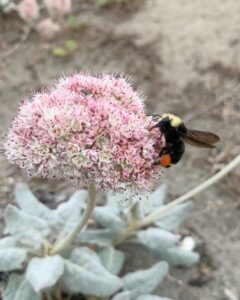
Over the years the Bureau of Land Management (BLM) made a decision to restore the dunes around Eureka, California. This required hundreds of volunteers removing millions of plants year after year in order to successfully return the dunes back to their naturally-diverse state. As the native plants have returned, so have the animals, including threatened and endangered species! As with many conservation projects, some members of the community have raised concerns about the impact of removing the grasses. Why would you get rid of the lush grass and replace it with scrubby native plants? The main answer: diversity! In order to make sure this restoration is truly having a positive impact on the environment, the BLM agreed to bring in a team of experts from Butterfly Pavilion to decide which was better: restored or unrestored dunes. The Butterfly Pavilion research team has made many trips to these dunes to collect and identify the number and diversity of invertebrates (like beetles, bees, spiders, and butterflies) living on the restored dunes. It is important to protect the diversity of invertebrates on the dunes so that many different species can perform their diverse roles, such as pollination and decomposition, which keep the ecosystem healthy. By comparing the populations of invertebrates between the restored and unrestored sites, we can inform BLM about the vegetation and management practices that will promote healthy invertebrate life on the dunes!
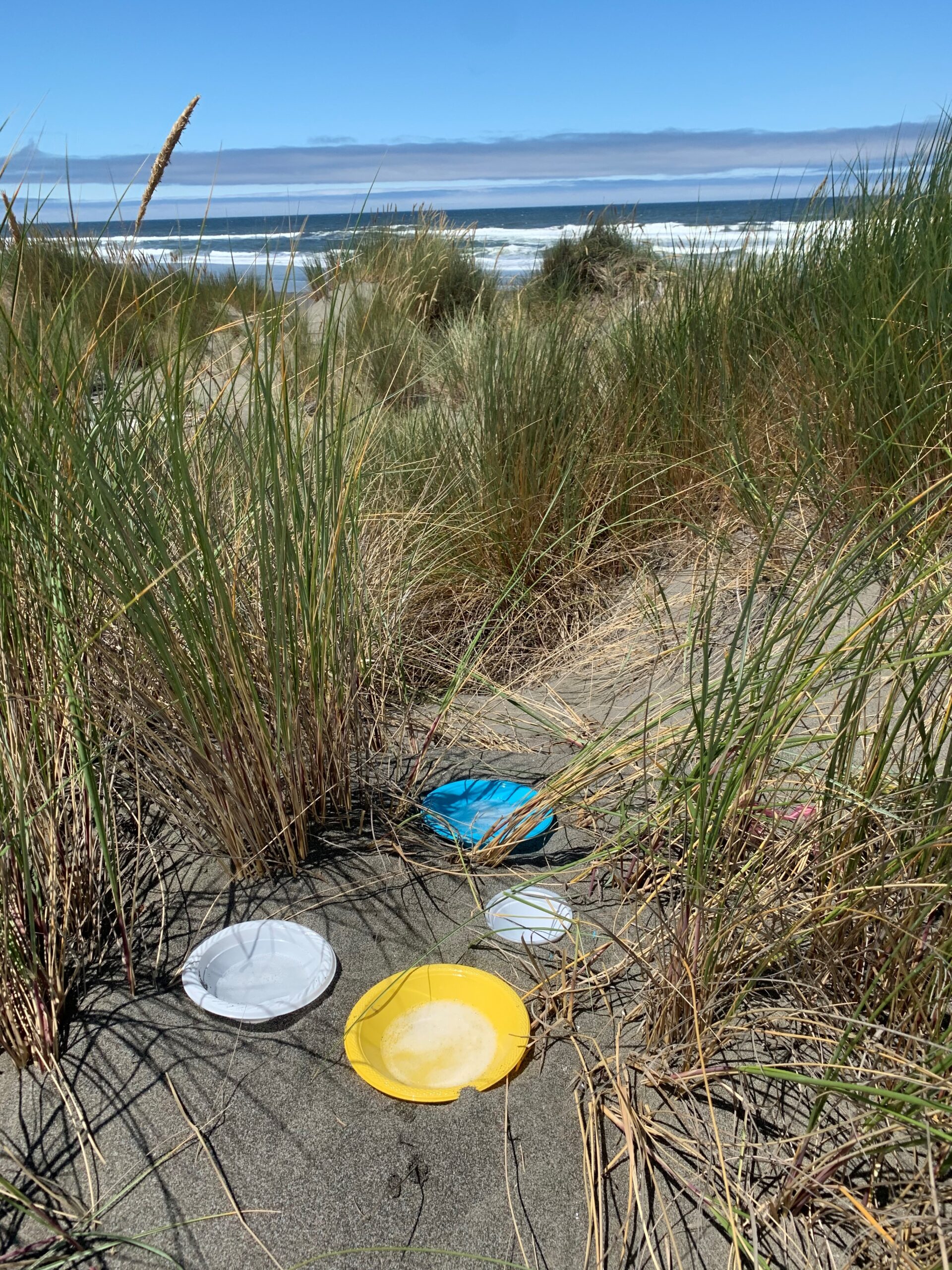
At the trailhead, I saw what I thought was an explosion of paper litter in the distance and hurried over to clean it up. What a happy surprise to find that I was actually looking at a patch of crown-leaf primrose (Oenothera coronipifolia).

These frilly, ephemeral wildflowers stood out against the browns and pale greens of early spring like lace against sandpaper.
What I learned – nature is full of surprises. Think of the last time you were out in nature – what surprised you?
Urban and suburban open spaces facilitate transformative experiences for visitors, while providing healthy habitat for native plants and wildlife. Healthy open spaces can address many of the challenges of population growth by providing accessible opportunities for people to exercise, to pursue lifelong learning and to appreciate natural beauty. This engagement with the natural world has proven profoundly beneficial to human health. With this in mind, in 2013 the American Public Health Association officially recommended that land use decisions should prioritize the preservation and restoration of natural areas and green spaces for people of all ages, income levels and abilities. In addition, urban and suburban open spaces contribute millions of dollars in ecological services, including flood management, pollution abatement and access to crop pollination. Their importance should not be underestimated!
But not all open spaces are created equal. Suburban open spaces often struggle with a high degree of disturbance, pollution and invasive species. In comparison to wild lands, suburban natural areas also support a far lower number of plant and animal species. By restoring local open spaces to a greater degree of biodiversity, land managers and volunteers can include “planned complexity” in urban and suburban landscapes, which leads to better function and sustainability over time.

With over half of the human population now living in cities and towns, a habitat network of open spaces, parks and private gardens can add significant resources, especially for beneficial wildlife such as pollinators. These “habitat pockets” can grow over time to become linked corridors for wildlife. One successful example of this model is Seattle’s Pollinator Pathway, which revolutionized the idea of human and natural landscapes by educating the public to reconsider the priorities for public and private landscaping.
The growing communities of Westminster and Broomfield, Colorado currently have over 8000 acres of open space parks and trails. Since residents in Broomfield and Westminster report that they value the wildlife and native plants found on open spaces, effective habitat restoration plays a vital role in maintaining these sites for the community to enjoy. In order to increase impactful restoration activities on open space parks and to cultivate a stewardship ethic among local residents, Butterfly Pavilion, the City of Westminster and the City and County of Broomfield created the Urban Prairies Project in 2016.
With open space department staff stretched thin over so much acreage, the partners aimed to tap into local enthusiasm for open spaces. Beginning in March 2016, the partners launched a Restoration Master Volunteer program. These committed and passionate individuals complete 25 hours of intensive training which includes subjects from weed identification and management to how to share scientific information with the public. So far, 31 Restoration Master Volunteers are contributing their skills to everything from revegetation projects to pollinator monitoring. These volunteers have so far astounded us with their skills and expertise, as well as their enthusiasm for learning and even the hard physical labor of restoration.
The Urban Prairies Project partners have also worked closely with other groups, such as local schools, to involve more local residents in restoration work. A relationship with Legacy High School has resulted in four youth service learning projects, including planting native shrubs and collecting invertebrate diversity data. Kristina Schaad, the biology teacher at Legacy High School and the advisor for the Environmental Club, notes that, “Participating in restoration work has been invaluable for my students. It has provided them with the opportunity to learn while getting their hands dirty, giving back to their community, and working with others–all of which are extremely important for today’s adolescents. I know that working with Urban Prairies Project has positively impacted my students and increased their appreciation of natural spaces. We are excited to continue our work with this organization in the future!”
2018 is already shaping up to be an exciting and productive year. Our next set of Restoration Master Volunteer trainings will begin on March 11th. This year, Urban Prairies Project volunteers will be working in areas as diverse as Standley Lake, Skyestone and Metzger Farm open spaces this year, improving habitat and collecting data on everything from beavers to bees to birds. Volunteers are also helping to raise awareness among people of all ages about the importance of natural areas by creating educational materials and attending public fairs. The inspiring message that we can all make a difference for our communities and our planet has never been more timely.
If you are interested in learning more about how you can get involved, please contact me by clicking here.