
Butterfly Pavilion is partnering with the Bureau of Land Management Colorado (BLM CO) to estimate the diversity and relative abundance of daytime pollinators on BLM CO-managed land. This project will examine several habitats that represent the more than 8.3 million acres of public land in Colorado. Butterfly Pavilion and BLM CO scientists will provide baseline survey data on invertebrates across the western half of the state. These efforts will help inform conservation of these species, including those proposed for listing under the Endangered Species Act, such as monarch butterflies (Danaus plexippus) and western bumblebees (Bombus occidentalis).
These animals make up 97% of all species on earth. Invertebrates have no backbone, yet they are the backbone of all life on earth. They are the basis of most food webs, pollinate the vast majority of flowering plants, decompose waste, aerate the soil, and improve water quality. Life on our planet would collapse without them. Conserving these vital animals means conserving life as we know it.
Baseline data is needed for public land to properly implement management strategies that preserve biodiversity and protect invertebrate species. In the last four decades, conservation biologists have estimated a 45% decline in invertebrate populations worldwide.
Butterfly Pavilion entomologists and researchers have already surveyed over 60 locations across the west. Locations are co-selected with the BLM and represent major ecosystem types in Colorado including sagebrush regions, grasslands, arid deserts, forest, and alpine regions. Survey locations span across the four major watersheds in Colorado (Upper Colorado, Rio Grande, Arkansas-White-Red, and Missouri Rivers).
During these surveys, researchers record which species are present, how many of each species are present, and what flowers they are visiting. Each morning, traps are set at sample sites, and specimens are collected at the end of the day. During the wait, researchers use net to collect invertebrates on flowers. Peak hours for most invertebrates are mid-to-late mornings to early afternoons when it is warmest.
However, this is not always the case. Andrew Draper, the project coordinator for pollinator research, recalls a stormy day that prompted multiple velvet ants to emerge from the ground. ,“Flying invertebrates such as bees thrive in warmer weather, while velvet ants burrow to escape the heat. As soon as cloud cover appeared, so did the velvet ants..” Our researchers have seen many different invertebrates in the field, such as swallowtail butterflies, bumblebees, beetles, wolf spiders, and many more. Butterfly Pavilion researchers work diligently in the field, so much so that friendly sweat bees often land on them to collect their perspiration as they survey the areas!
The data and samples collected from this project will help inform future land management decisions, better describe pollinator species in the area, and understand their conservation needs. Scientists are examining species abundance and diversity between sites to best inform our scientific conservation and education recommendations. The data, including flower association, is also used to update our pollinator gardening and Environmental and Ecological Services recommendations. All findings will be submitted to the BLM to support the Endangered and Threatened Species Program working to protect sensitive populations in Colorado
Masters of Disguise: How Plants Dress Up for Pollinators
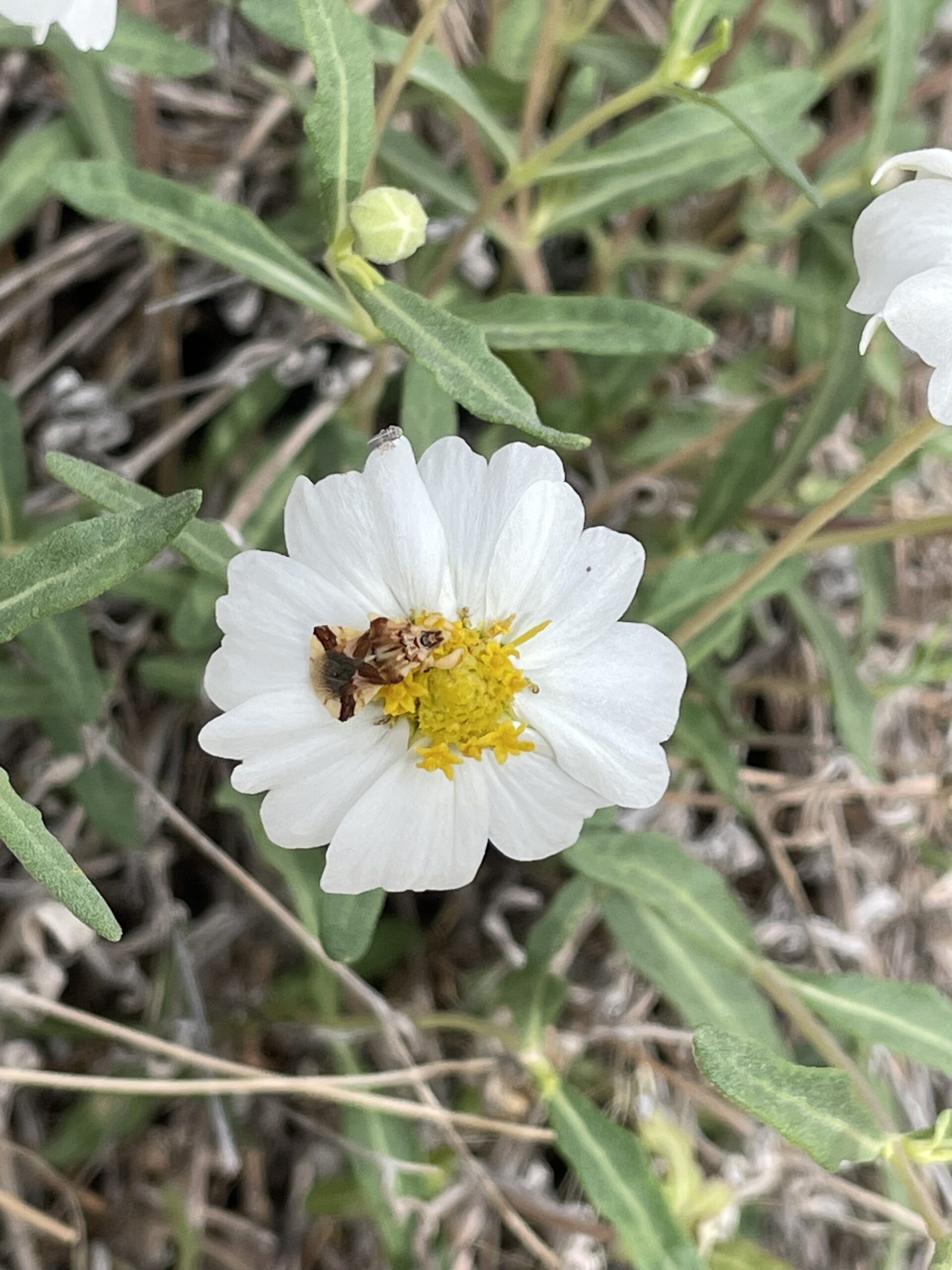
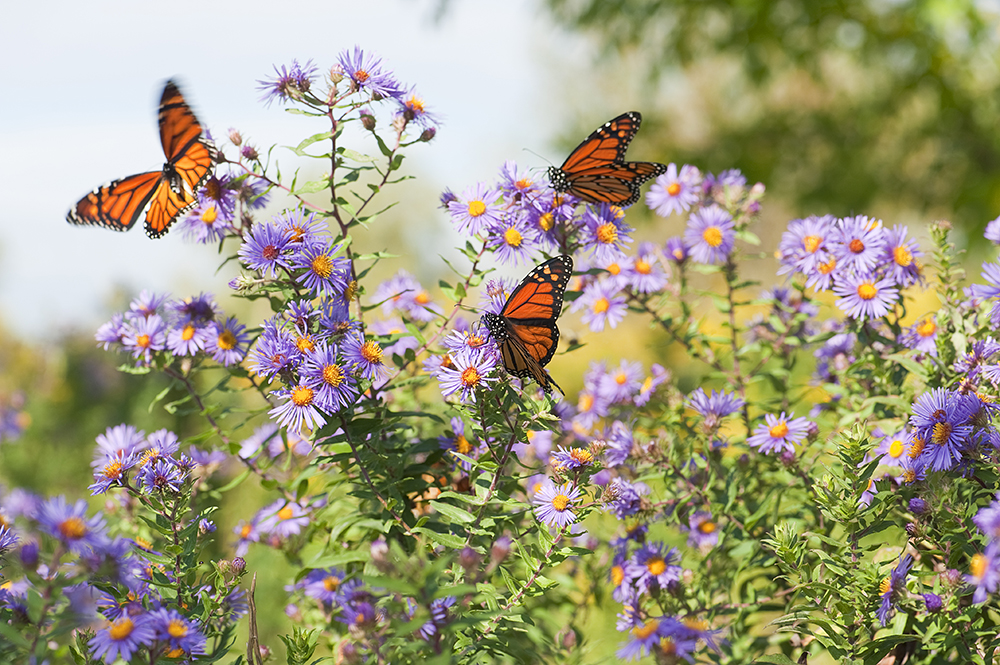
Pollination is crucial for the survival and reproduction of most flowering plants. For this reason, many plants have evolved unique methods to attract pollinators. Plants manipulate their flower color, shape, scent, and other structures to attract specific pollinators. These adaptations are known as ‘pollinator syndrome.’ Flowers attracting bees are brightly colored in white, blue, or yellow and have a fresh scent. Bees are a diverse species that range in size and shape, and so do the flowers they pollinate. Asters, coneflowers, penstemon, bee balm, and poppies are all flowers pollinated by bees. A fascinating example of a flower appealing to bees is the bee orchid (Ophrys apifera). The bee orchid has petals shaped like a bee to attract bees looking for a mate. This petal also makes for a perfect landing pad while the bee attempts to mate with what they think is a hot date. In the process, they pick up pollen and move to the next “potential mate.” Butterflies also enjoy brightly colored flowers, specifically those in red and purple tones. These flowers have a faint, fresh scent and have a landing platform. Tubular narrow flowers are also acceptable because butterflies can use their proboscis to sip nectar from the center. These tubular flowers usually sprout in clusters to provide a makeshift landing pad. Notable flowers that are pollinated by butterflies include columbines, goldenrods, and milkweed. Milkweed flowers are particularly attractive to Monarch butterflies. They use milkweed as a host for their caterpillars and visit the flowers as adults once blooming has finished for the year.
Similarly, moths prefer red, pink, white, and purple flowers. However, bright colors aren’t their style. They prefer flowers that are pale or dark-toned. Pale, fragrant flowers are perfect for nocturnal moths, while darker-toned flowers stand out to day-flying moths. Like butterflies, moths have a long proboscis to sip nectar, meaning they also seek tubular-shaped flowers. Some flowers go to extremes to attract pollinators. The corpse flower (Amorphophallus titanium), native to Sumatra, has the largest unbranched flower head in the animal kingdom and can grow up to twelve feet. When it blooms, it releases a putrid smell reminiscent of rotting flesh. Why? To attract flies and carrion beetles for pollination! Some flies are attracted to flowers with rancid scents, so naturally, they are fooled by the corpse flower’s scent. Pollinating beetles are usually attracted to dull green or white flowers with sturdy petals to protect from beetle mandibles. On the other hand, Carrion beetles feed on carcasses, and in their search for food, they inadvertently pick up pollen from the corpse flower. Corpse flowers bloom for two to three days and only every one or two years. Botanic gardens across the U.S. maintain these flowers in their collection to preserve their genetic material because there are only 1,000 corpse flowers in the wild. It’s no wonder they go to extreme lengths to attract pollinators!
Although flowers have developed interesting ways to attract pollinators, these rules aren’t set in stone. Many flowers attract all sorts of pollinators, and pollinators visit all kinds of flowers. Being aware of these distinctive adaptations can help us know how to attract specific pollinators and accommodate pollinators that share a space with us.
Written by Celena Romero
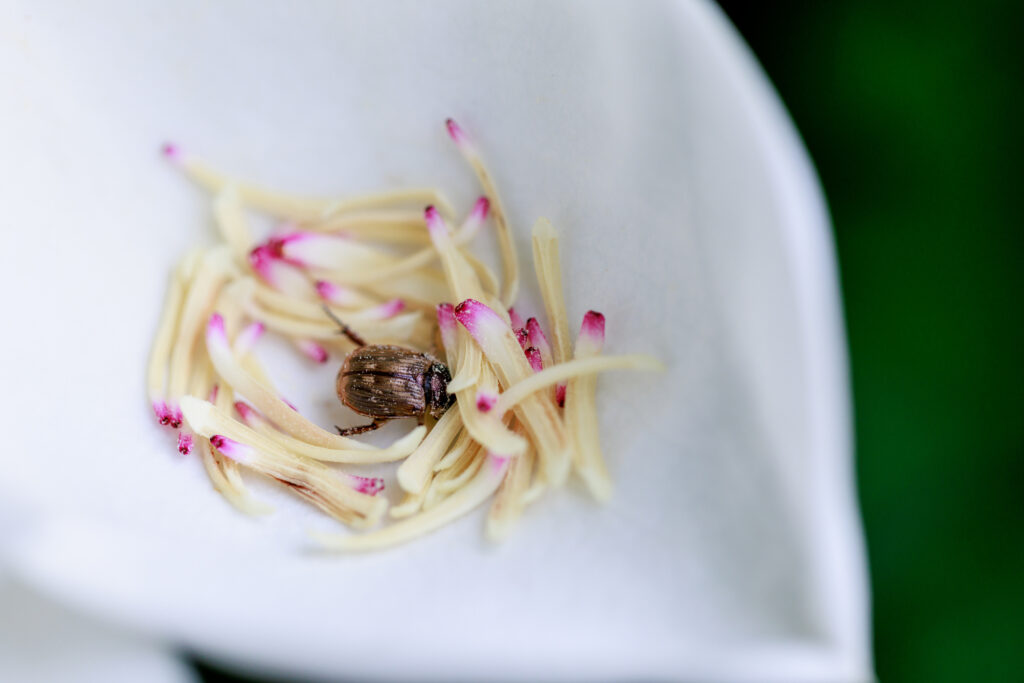
Many of us are familiar with bees and butterflies as pollinators, but other invertebrates contribute to pollination and important plant services. For example, beetles pollinated flowering plants before bees and butterflies even existed! They were abundant during the Mesozoic era, 200 million years ago, and the earliest plant life on Earth appeared soon after. Magnolias, a flower frequently pollinated by beetles, first appeared on Earth about 95 million years ago and still utilize beetle pollination today!
You may notice that magnolias have large, tough petals and sturdy carpals. This helps prevent major damage from beetle mandibles. Beetles are in the order Coleoptera, one of the most diverse species of animals on the planet. There are more than 300,000 described species of beetles in the world! Soldier beetles, scarabs, long-horned beetles, sap beetles, and checkered beetles are all examples of beetle species that pollinate flowers.
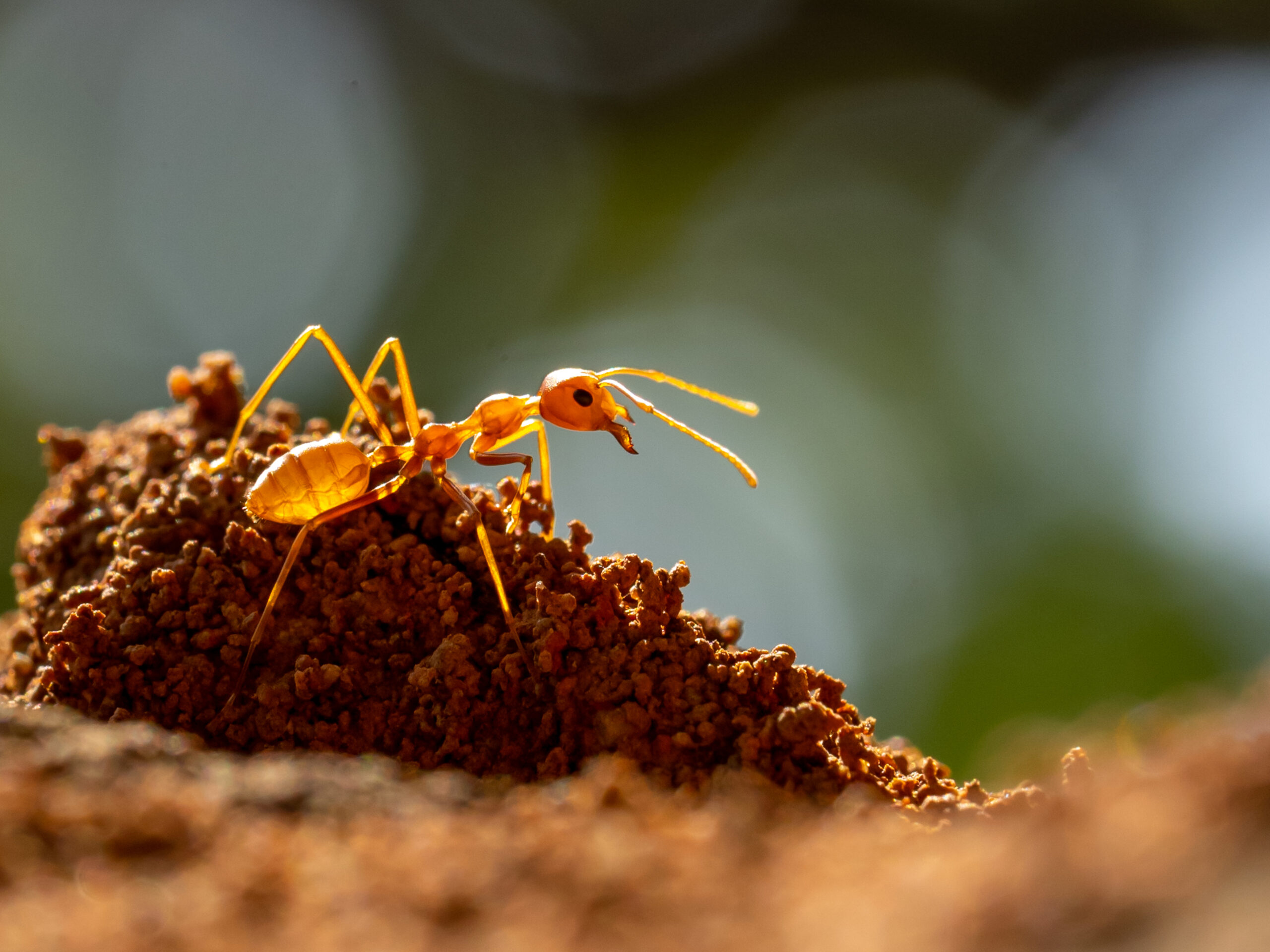
Bees may get most of the pollination glory, but ants are another member of the Hymenoptera order that are pollinators. Ants often seek out the sweet nectar of flowers and may transfer pollen after visiting a flower. Ants aren’t as successful at carrying pollen as other pollinators due to their smooth and hairless bodies. However, some ant species protect plants by providing their stinging power to deter pests. For example, Acacia trees utilize ants for protection against herbivores, and in return, the ants receive food and shelter. Plants that use ant colonies as a defense mechanism are known as myrmecophytes.
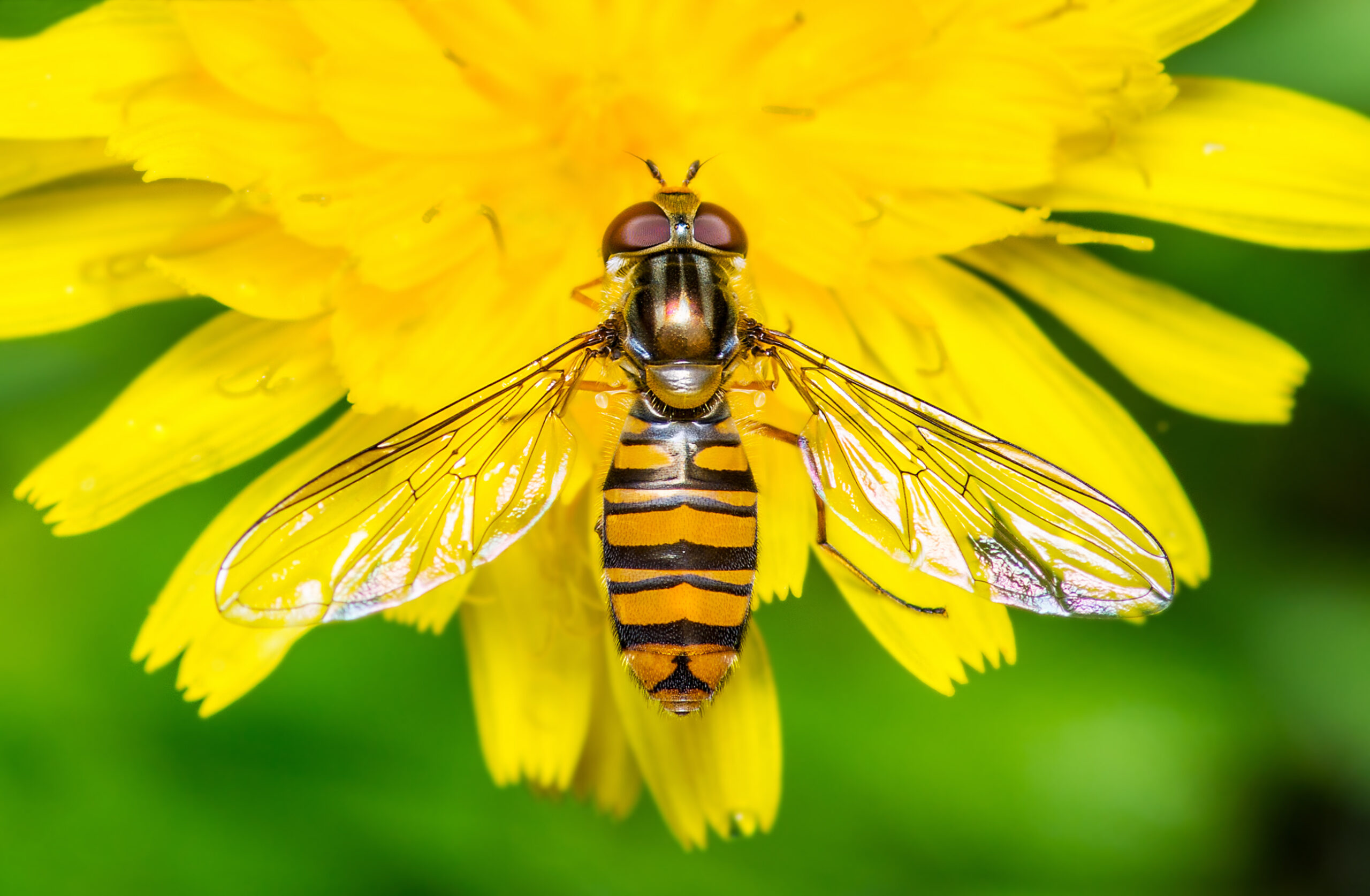
Flies are typically considered pests, but they are another unsung pollinator hero! Flies, gnats, and mosquitoes all visit flowers for nectar. Hoverflies are a species of fly that resemble tiny bees. The difference is that they have one pair of wings, while bees have two pairs. They are often called “incidental pollinators” because they hover over flowers rather than landing on them and, in the process, pick up pollen. Chocolate midges sound like a sweet treat, but they are a species of fly responsible for chocolate! Chocolate midges are smaller than a pinhead, making them perfect for pollinating the tiny downturned flowers of cacao trees. They are the only pollinators for cacao trees, meaning that their survival is crucial to the survival of chocolate!
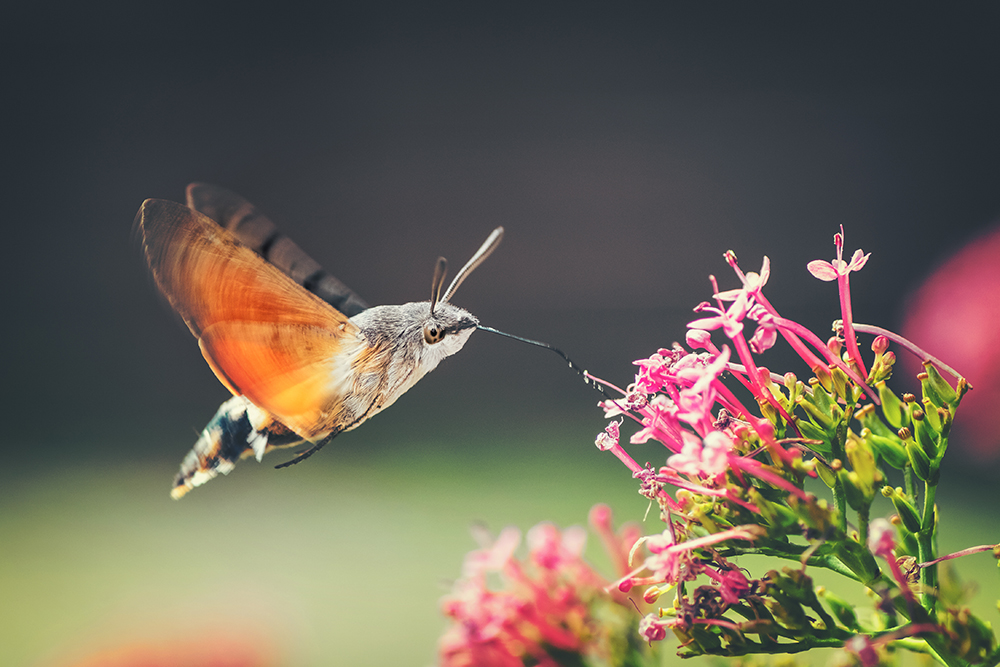
The most interesting unknown pollinator resembles a combination of multiple pollinator species. It is the hummingbird-hawk moth (Macroglossum stellatarum), which is neither a hummingbird nor hawk. The hummingbird hawk-moth is a species of moth that resembles a hummingbird in appearance and movement. It hovers from flower to flower and uses its long straw-like proboscis to sip nectar from flowers. Like hummingbirds, their fuzzy bodies are perfect for picking up pollen and dispersing it to the neighboring flowers. The most commonly seen species of hummingbird moth in northern Colorado is the whitelined sphinx (Hyles lineata). Next time you hear a humming noise and see a flying creature darting from flower to flower, double-check. It may be a hummingbird moth!
We now know we can’t give all the pollination credit to bees and butterflies. Many pollinator conservation efforts are focused on these more well-known species. The good news is that most effort put toward saving a butterfly can also save a beetle, ant, fly, or any other pollinator! Actions such as avoiding pesticides, cultivating a pollinator garden, choosing native plants for your garden, and participating in community science can increase the biodiversity of our landscapes. This ultimately helps us and our pollinator heroes!
Written by Celena Romero
A World Without Pollinators: Why Pollinators Matter and How You Can Help Ensure Their Survival
Imagine starting your morning without a cup of coffee. A salad with nothing but lettuce. No fragrant flowers in the spring or sweet watermelons in the summer. These are a few of the food items we would be missing without pollinators; others include almonds, apples, apricots, bananas, carrots, tomatoes, strawberries, kale, vanilla, and chocolate. 80% of all flowering plants that produce fruits, vegetables, nuts, and spices require pollination. Pollination is the process of pollen moving from the male part of a flower to the female part. For most flowering plants, this cannot be done without help from pollinators. Pollinators move from flower to flower in search of food, and in the process, they pick up and drop off pollen. Pollinators come in all shapes and forms. You may be most familiar with bees and butterflies, but other invertebrates like beetles, ants, flies, moths, and wasps are also pollinators. In the US, it is estimated that the pollination of crops is valued at $10 billion annually. Globally, pollinator services are valued at $3 trillion! Pollinators are not only crucial to our economy and health, but they also play a pivotal role in sustaining life on Earth. Most flowering plants require pollination to reproduce. Plants provide habitat for other living organisms, reduce soilerosion, and convert carbon dioxide into oxygen for the planet. It’s crucial to understand that despite their vital role, pollinators are facing a global decline. This is primarily due to habitat loss, pollution, climate change, and the use of harmful chemicals. The urgency of this issue cannot be overstated. Pollinators need our help now more than ever. How can we contribute to the survival of these life-sustaining creatures? Fortunately, Butterfly Pavilion offers accessible ways for everyone to participate in pollinator conservation. Here are a few ways you can make a difference: Create a space for pollinators in your garden! We have some helpful tips here. Butterfly Pavilion also frequently hosts Pollinator Gardening Boot Camps, which are workshops that focus on cultivating a pollinator-friendly space in your garden.
Take part in pollinator conservation projects at Butterfly Pavilion! The Colorado Butterfly Monitoring Program involves counting butterflies to compile data useful for land managers when making conservation decisions. If you’re looking for more variety in work, join the Urban Prairies Project! The Urban Prairie Project utilizes volunteers for pollinator habitat restoration, data collection, and community outreach.
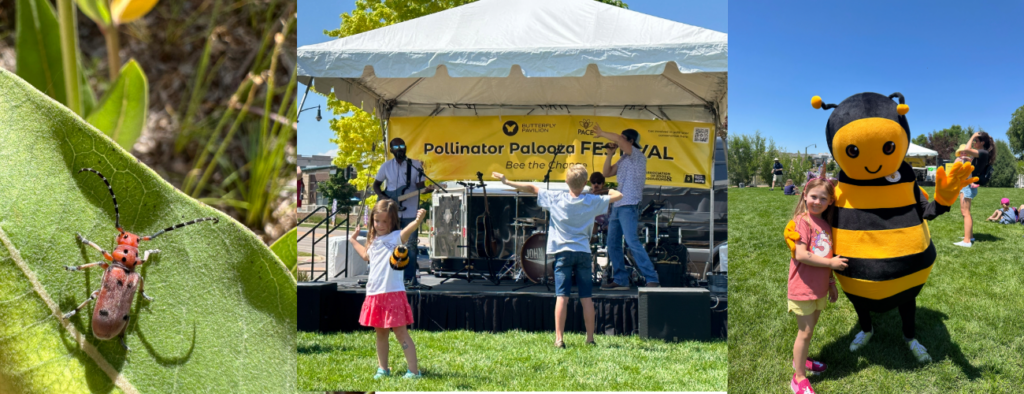
Finally, celebrate Pollinator Palooza with Butterfly Pavilion! June is National Pollinator Month, and we are hosting a series of events all month long to engage and educate the community in pollinator protection and conservation. The grand finale is our Pollinator Palooza Festival on June 29th from 12:00 2-8:00 p.m. a hybrid outdoor-indoor pollinator celebration featuring live bands, a pollinator artisan market, beer garden, food trucks, pollinator workshops, garden tours, live butterfly releases and more!
Written by Celena Romero
Butterfly Pavilion Partners with Ronald McDonald House to Offer Families Free Access to Invertebrate Zoo
Butterfly Pavilion and Ronald McDonald House of Denver (RMHC) are pleased to announce a new partnership. Families staying with their loved ones receiving treatment at RMHC can now explore the world’s premier invertebrate zoo for free. RMHC provides a comforting home away from home for families seeking medical treatment for their seriously ill children in Denver, with no charges for their stay. Butterfly Pavilion creates a haven where invertebrates and the community can engage and interact, fostering an appreciation for these remarkable creatures.
We make the wonders of the natural world accessible to our community so that they can deepen their understanding of the vital role invertebrates have within ecosystems worldwide. Guests connect with thousands of invertebrates, from tropical rainforest butterflies to colorful coral that call the barrier reef home. We are grateful and excited to allow families to explore the wonders of the natural world, partake in engaging educational experiences, and create lasting memories with their loved ones. We aim to provide RMHC families with solace during their extended stays by allowing them to discover the beauty and complexity of the invertebrate world. Butterfly Pavilion has been a staple in Colorado for decades, and providing this opportunity to families is one way we can give back to our community.
Governor Signs Landmark Legislation at Butterfly Pavilion Recognizing Invertebrates as Wildlife
Today at Butterfly Pavilion, Governor Jared Polis signed into law Colorado House Bill 24-1117, a groundbreaking step for wildlife conservation by adding invertebrates to the species that may be studied and conserved in Colorado. With invertebrates comprising a staggering 97% of all animal species on earth, this legislation officially recognizes them under the purview of the Colorado Parks and Wildlife (CPW), empowering CPW to protect and conserve these vital creatures of virtually every ecosystem on the planet. “Butterfly Pavilion enthusiastically embraces this milestone and eagerly anticipates the profound impact it will have on invertebrate well-being,” declared Dr. Rich Reading, Vice President of Science and Conservation at Butterfly Pavilion. “This bill signifies a monumental stride in invertebrate conservation in Colorado, offering unprecedented opportunities to propel efforts to prioritize data collection to help protect and conserve these critical creatures which are the foundation of all life on earth.” Prior to this bill, there was no public funding or managing authority dedicated to actively conserving invertebrate populations in Colorado. With this legislation, CPW now has the capability to fund and develop programs aimed at studying and conserving invertebrates, including butterflies, beetles, bees, spiders and many others. Butterfly Pavilion welcomes this legislation as it will significantly benefit invertebrate research, conservation and education efforts in Colorado for several reasons:
-
Recognition and Support
: This bill signals a shift in public perception and will potentially increase support for invertebrate conservation efforts.
-
Research Opportunities
: With the passage of this bill, Colorado Parks and Wildlife (CPW) now has the authority to fund programs dedicated to studying and conserving invertebrates.
-
Collaborative Partnerships
: The bill empowers CPW to develop programs focused on invertebrate conservation.
-
Educational Impact
: As invertebrates gain recognition as an integral part of Colorado’s wildlife, there will likely be increased interest in learning about these creatures. Butterfly Pavilion is pleased to offer educational programs to raise awareness about invertebrates and their importance in the ecosystem.
-
Long-term Conservation
: This bill helps ensure the long-term survival of these species. Butterfly Pavilion contributes to this goal through our research, conservation, breeding programs and public engagement activities.
Butterfly Pavilion passionately testified in support of this bill at the Capitol on two occasions; February 22 and April 3, 2024. Embedded within this legislation is a powerful message:
“With a few exceptions, Colorado Parks and Wildlife does not have statutory authority over invertebrate species, nor does any state agency have oversight of native rare plants. Lack of data limits Colorado’s ability to assess the status of threats to, and conservation needs of invertebrates and rare plants. Creating programs designed to support conservation of rare native plants and invertebrates can lessen the likelihood that the species will be added to federal threatened or endangered lists. … Therefore, the general assembly determines that the Parks and Wildlife division should study and determine the conservation needs of native rare plants and invertebrates and implement voluntary programs to conserve and protect them” “Together with Colorado Parks and Wildlife and community partners, Butterfly Pavilion will work tirelessly to safeguard the well-being of invertebrates and the ecosystems they inhabit,” concluded Dr. Reading.
Impact Beyond the Numbers: A Spotlight on Our Urban Prairies Project
Over the last century, the shortgrass prairie ecosystem that once dominated the Colorado Front Range has declined to less than one-fifth of its original area. In addition, we have witnessed a significant loss in crucial plant and animal species, including critical pollinators.
To combat this issue, in 2016 Butterfly Pavilion partnered with the City of Broomfield and City of Westminster to create the Urban Prairies Project, where we train community members to become Master Restoration Volunteers who help restore and enhance Colorado open spaces. With this program, Master Restoration Volunteers focus on areas in need of restoration and collect data about plants and wildlife, lead restoration workdays, conduct post restoration assessments, and educate the public about their local open spaces and the need for restoration efforts. Restoration helps protect and revitalize invertebrate populations, a critical piece of healthy ecosystems.
In 2023 alone, 43 new Master Restoration Volunteers contributed over 100 hours of field work to restore Colorado open space at 11 different work sites. Since 2016, 134 volunteers have given over 1,000 hours restoring over 3,500 acres of land.
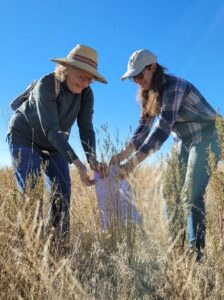
Ashley White, Butterfly Pavilion’s Community Habitats Manager who leads the Urban Prairies Project shares that the Urban Prairies Project is a very holistic restoration program. “We focus on it not just being one and done, but getting the whole picture of the health of the site. Volunteers go through a 15-hour training where they learn restoration best practices from start to finish. This includes conducting initial land assessments, conducting restoration activities, monitoring for changes in the ecosystem, post-restoration assessments, leave no trace principles, and more.” says, White.
Yet, the numbers only tell half the story.
White explains, “The idea behind the Urban Prairies Project is to facility ripple effects in the community, where beyond training volunteers to restore land, we are empowering volunteers to lead their own restoration projects in their own communities. This project helps build a sense of comradery between neighbors and allows people to spend more time outdoors in nature. We’re building up community leaders and forming a supportive and engaged community right before our eyes.”
Brandon and Michelle are two Master Restoration Volunteers who joined the program in 2023 and have since started their own restoration project in Northglenn.
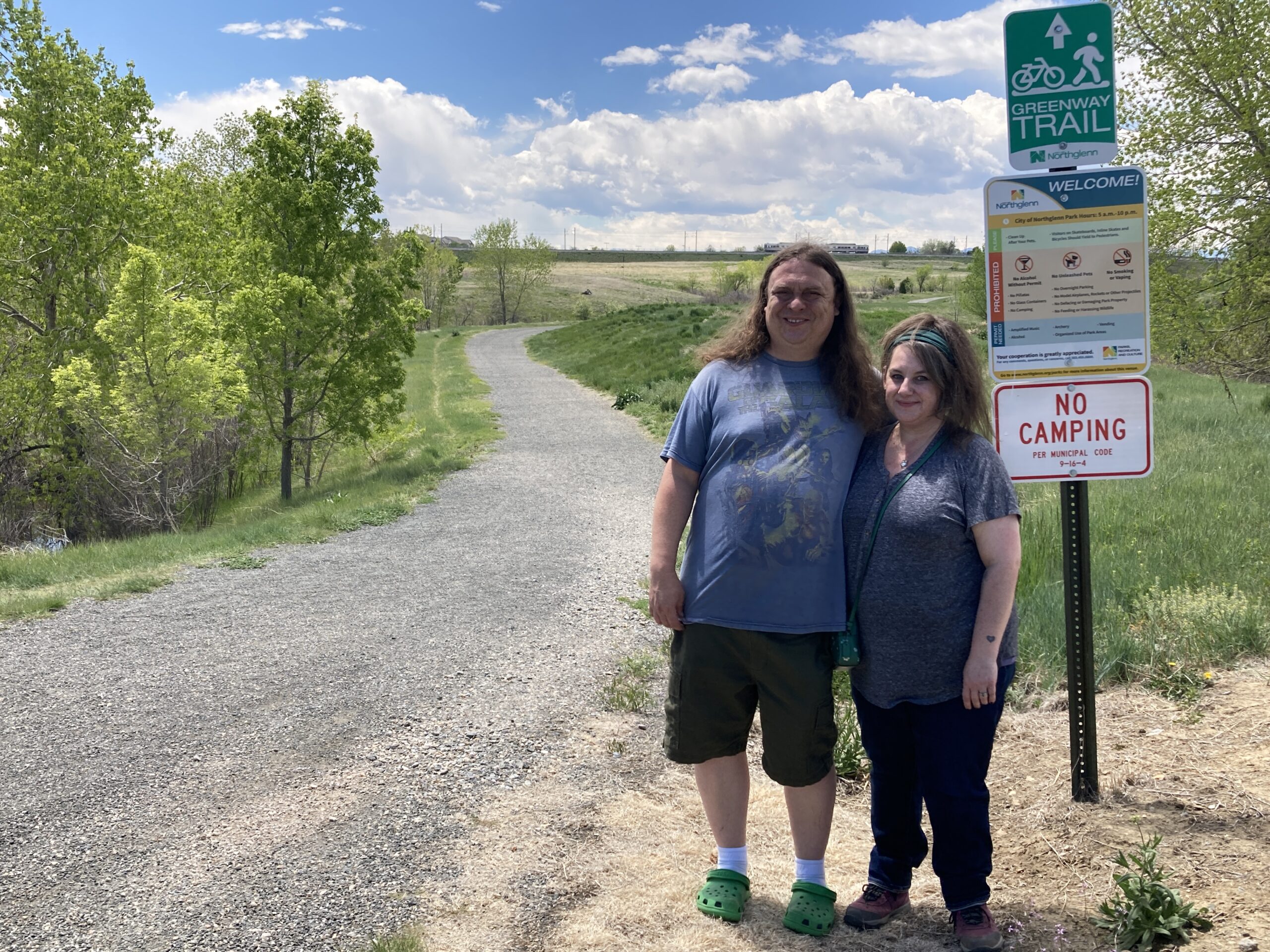
“Our intrigue started a few years ago when milkweed started popping up in our yard. At the time, we didn’t know what it was, but we did some research and learned that it was food for monarchs. When we learned that monarch populations were in decline, we planted more milkweed and now our yard is a monarch waystation.” says Michelle.
“We also had this beautiful and lush canal that backed up to our backyard. But a few years ago, they cut down all the trees. It was devastating.” said Michelle, “We emailed the city and started bugging them, trying to figure out what we could do about it”.
After these experiences, Brandon and Michelle felt inspired to get involved in the Urban Prairies Project. “We’ve learned so much about our natural surroundings. We’ve learned what’s what, which plants are weeds and what do we really need.” says Brandon. “It’s been a wonderful learning experience.”
With a year of restoration efforts under their belts, Michelle and Brandon connected Butterfly Pavilion with their contacts at the city of Northglenn and are now leading collaboration efforts to help restore Fox Run Open Space. Though it’s not the private canal behind their house, it’s a valuable start to getting restoration projects underway in their community. They’ll invite their neighbors to support the efforts and leverage their knowledge as Master Restoration Volunteers.
In reference to UPP, Michelle says, “We are loving it so far. I just love getting outside and working on something. Working from home, I don’t feel like we get outside enough anymore. I love nature, and pollinators, and flowers and plants, so being part of this work is perfect.” Brandon adds, “I also like how Butterfly Pavilion teams up with the city. Such a big focus is on educating the community, and it’s important to have those connections.”
The vision for the Urban Prairies Project is for Butterfly Pavilion to further evolve as a resource for municipalities seeking to restore their community spaces, and to continue empowering people to initiate their own restoration projects in their communities. Restoration work is so vital to our local ecosystems, and with all of us working together, we can make an incredible difference!
To learn more or get involved in our Urban Prairies Projects, visit our program webpage!
Joining forces for the good of Flatiron Park, Boulder
March 18, 2024 – Butterfly Pavilion, the first Association of Zoos and Aquariums (AZA)- accredited, stand-alone, non-profit invertebrate zoo in the world and BioMed Realty, a Blackstone portfolio company and leading provider of real estate solutions to the life science and technology industries, announced today a partnership to develop and enhance pollinator habitat in BioMed Realty’s Flatiron Park in Boulder. It represents Butterfly Pavilion’s first partnership with a life science and technology campus through its Environmental and Ecological Services offerings. The partnership involves a multi-year
project that officially began in 2023 with a baseline fall assessment. In 2024, pollinator friendly habitats will be designed and implemented at four buildings in Flatiron Park, with other buildings planned for 2025 and 2026.
The model of collaborative conservation creates pollinator habitats by increasing the presence of diverse plant species to attract beneficial insects and birds, creating a balanced ecosystem. This ripple effect extends beyond the property, positively impacting the broader environment and promoting a healthier, more resilient ecosystem.
“This initiative will promote the cultivation of native plants that cater to the specific needs of local butterfly species, bees, and other invertebrates, thereby enhancing biodiversity and building a greater appreciation for these critical species and their habitats,” said Hannah Brown, Environmental and Ecological Services Manager at Butterfly Pavilion.
Pollinators, such as honey bees, native bees and butterflies, play a critical role in ecosystem function and are vital to the human production of food and the reproduction of native plants. Yet global pollinators are at risk with habitat destruction, chemical pollution, parasites, and pathogens…
Read the full press release here.
Want to learn more? Check out the pages below:
Environment and Ecological Services
Shiran Hershcovich, Lepidopterist Manager and Rich Reading, Ph.D, VP of Science and Conservation share about importance of butterflies, invertebrates, community science opportunities, and new partnership with Colorado State University.
The following is an excerpt of the full article. To read the full article, please visit gazette.com, or click the button at the bottom of the page.
In the meadows of southern Colorado, a new life begins.
Under the leaf of a bog violet, near shallow groundwater, a butterfly flutters her brown wings and lays her eggs. The underside of her wings are lined with silvery-white spots, an ode to the species’ name. After about two weeks, the cooling October air welcomes the new hatchlings. For now, it is time for them to rest for winter.The silverspot butterfly, native to southwest Colorado, has been listed as threatened under the Endangered Species Act. With its new classification, Colorado scientists are hoping to protect the creature’s habitats — and ultimately preserve the species as a whole.
“It is quite rare for invertebrates to be listed, even though they make up the majority of known animal life on Earth,” said entomologist Shiran Hershcovich, the lepidopterist manager at the Butterfly Pavilion in Westminster. “They have not been traditionally given as much research efforts or research funding, so this is a monumental decision that gives a little more visibility to these butterflies.”
The threatened status, Hershcovich said, is a way to say that while the butterfly is not in immediate danger of extinction or full loss, things are not looking great for it. From the impact of climate change to development and improper livestock grazing, here’s what to know about the silverspot butterfly.
Read the Full Article on Gazette.com
Psst…here’s some more for you!
To read more butterfly approved blogs, click here
To learn more about Butterfly Pavilion’s conservation efforts, click here
For Zoo Conservation, click here
Winter Blooms in Wings of the Tropics
The butterflies in our Wings of the Tropics exhibit need nectar no matter the season, so Butterfly Pavilion’s horticulturists keep the rainforest blooming 365 days a year. Here are a few spectacular flowers you can see right now:
Red powderpuff –
Calliandra haematocephala
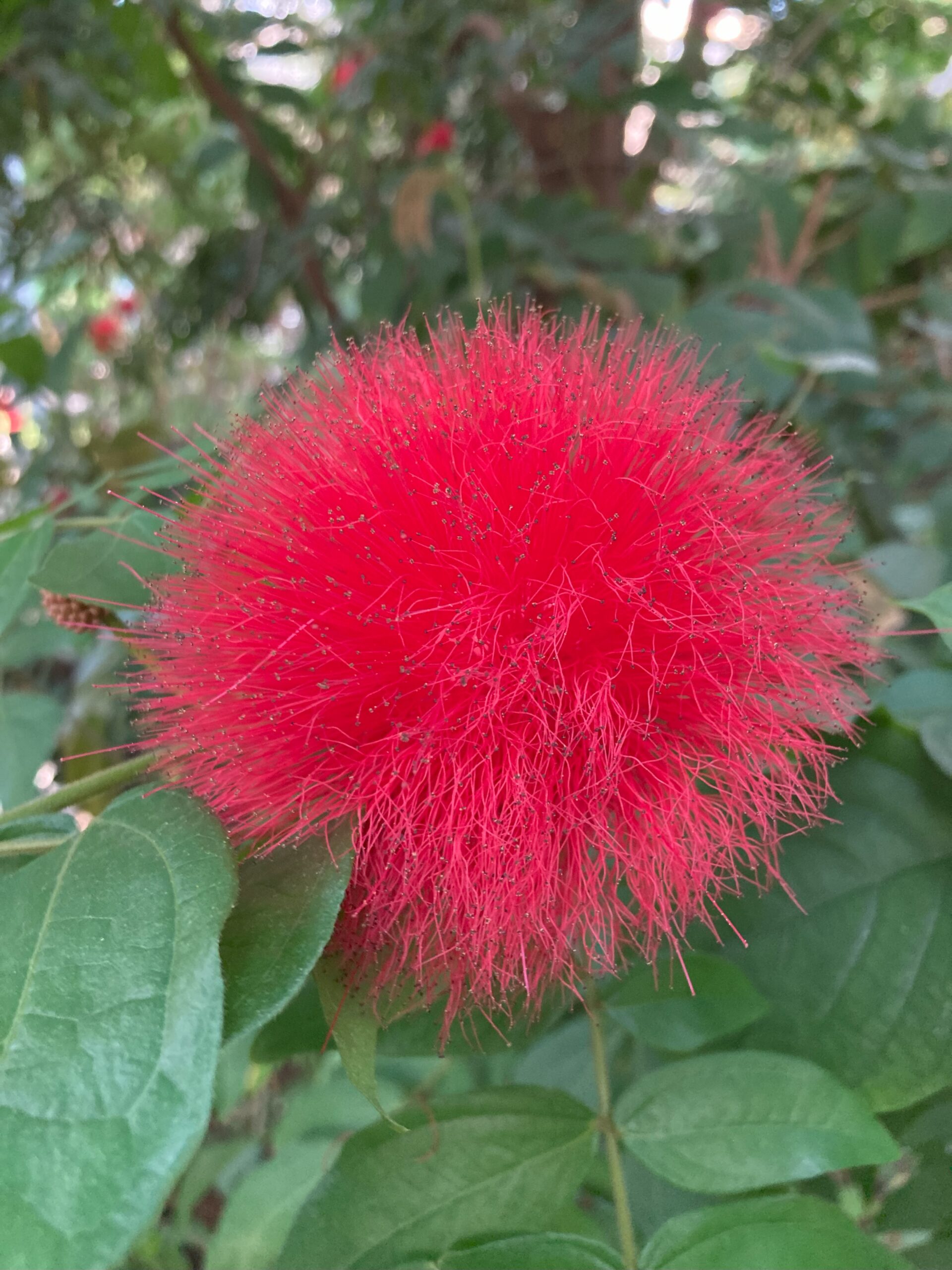
The red powderpuff, a native of Bolivia, is a small tree growing to about 16 feet tall with bright red puff-like flower heads. These fabulous flowers are favorites of scarlet Mormon butterflies and other swallowtails.
Glory bower –
Clerodendrum splendens
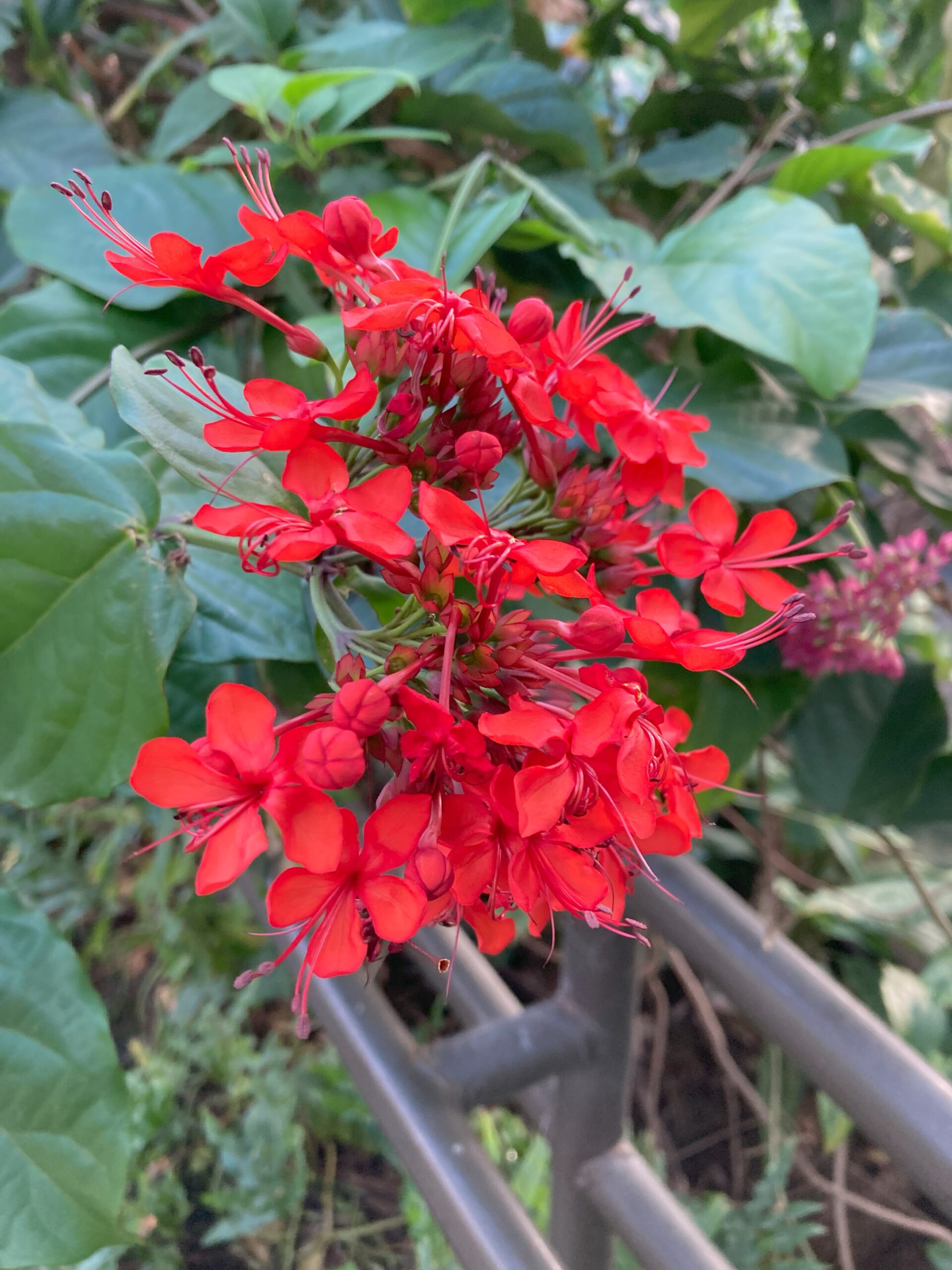
Glory bower is a twining shrub native to West Africa. The flowers are brilliant red, and even after the corollas fall, the calyxes become purplish-pink or red, retaining a bit of cheerful color. This species feeds most of our nectar-feeding butterflies from little yellow sulfur butterflies to large swallowtails.
Flame vine –
Pyrostegia venusta
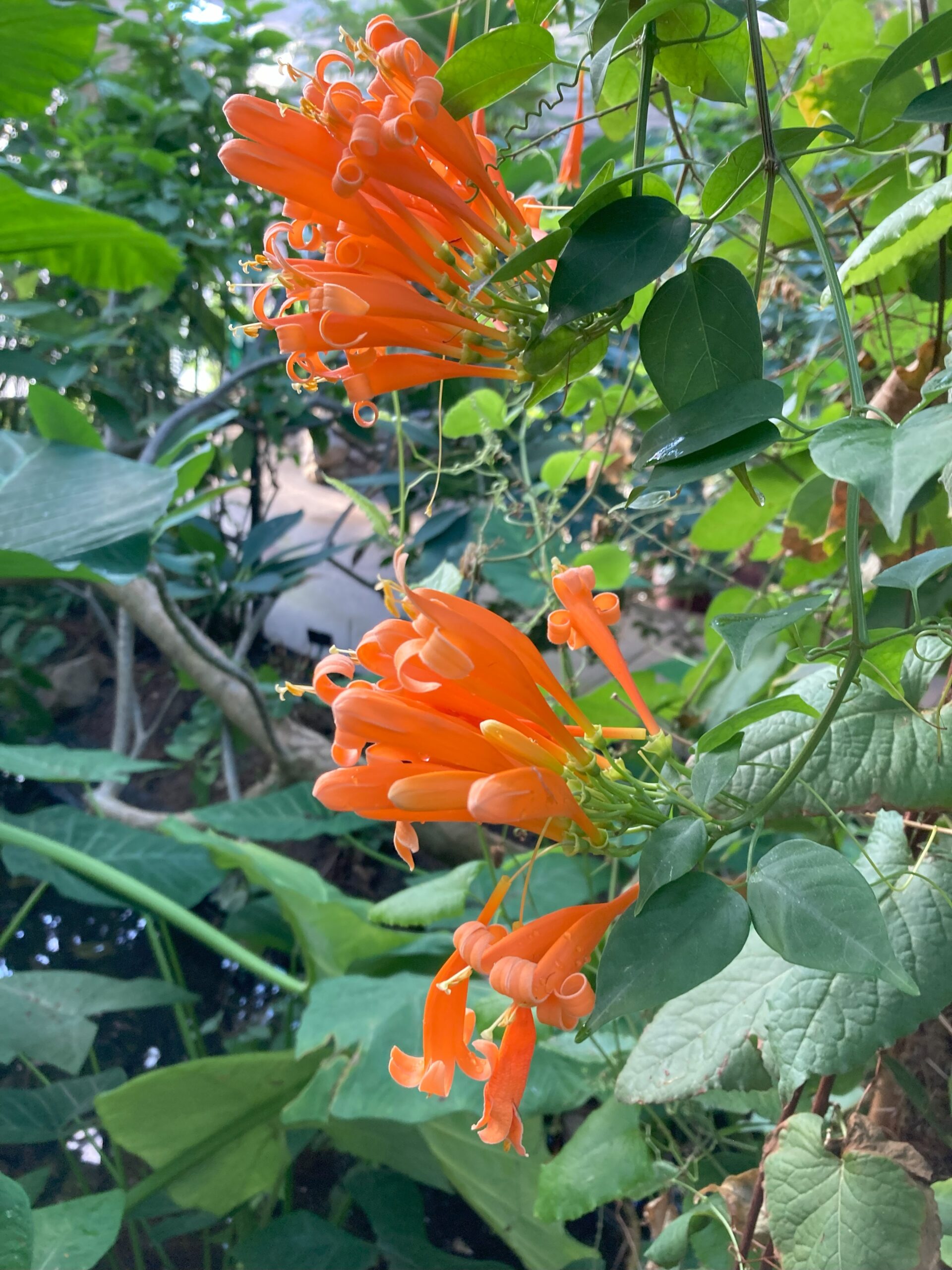
Flame vine is a native of Brazil, and its name is from the Greek pyr, fire, and stege, a roof, referring to the color and shape of the upper lip of the flower. Large nectar-feeding butterflies with long tongues, such as paper kites, visit this flower.